


Screening for personality disorder in incarcerated adolescent boys: preliminary validation of an adolescent version of the standardised assessment of personality - abbreviated scale (SAPAS-AV)
- PMID: 22846474
- PMCID: PMC3507652
- DOI: 10.1186/1471-244X-12-94
Screening for personality disorder in incarcerated adolescent boys: preliminary validation of an adolescent version of the standardised assessment of personality - abbreviated scale (SAPAS-AV)
Abstract
Background: Personality disorder (PD) is associated with significant functional impairment and an elevated risk of violent and suicidal behaviour. The prevalence of PD in populations of young offenders is likely to be high. However, because the assessment of PD is time-consuming, it is not routinely assessed in this population. A brief screen for the identification of young people who might warrant further detailed assessment of PD could be particularly valuable for clinicians and researchers working in juvenile justice settings.
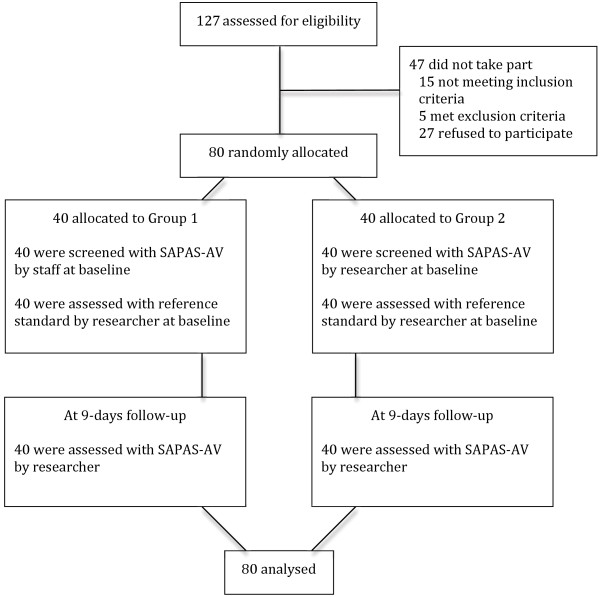
Method: We adapted a rapid screen for the identification of PD in adults (Standardised Assessment of Personality - Abbreviated Scale; SAPAS) for use with adolescents and then carried out a study of the reliability and validity of the adapted instrument in a sample of 80 adolescent boys in secure institutions. Participants were administered the screen and shortly after an established diagnostic interview for DSM-IV PDs. Nine days later the screen was readministered.
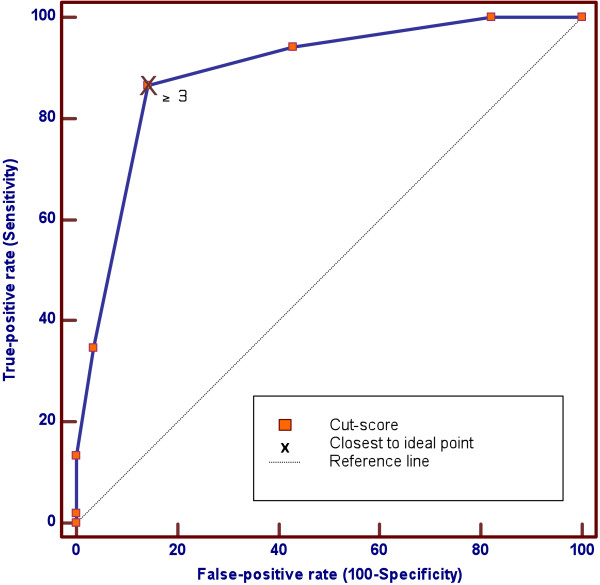
Results: A score of 3 or more on the screening interview correctly identified the presence of DSM-IV PD in 86% of participants, yielding a sensitivity and specificity of 0.87 and 0.86 respectively. Internal consistency was modest but comparable to the original instrument. 9-days test-retest reliability for the total score was excellent. Convergent validity correlations with the total number of PD criteria were large.
Conclusion: This study provides preliminary evidence of the validity, reliability, and usefulness of the screen in secure institutions for adolescent male offenders. It can be used in juvenile offender institutions with limited resources, as a brief, acceptable, staff-administered routine screen to identify individuals in need of further assessment of PD or by researchers conducting epidemiological surveys.
Figures
References
-
- Colins O, Vermeiren R, Vreugdenhil C, van den Brink W, Doreleijers T, Broekaert E. Psychiatric disorders in detained male adolescents: a systematic literature review. Can J Psychiatry. 2010;55:255–263. - PubMed
-
- Fazel S, Doll H, Långström N. Mental disorders among adolescents in juvenile detention and correctional facilities: a systematic review and metaregression analysis of 25 surveys. J Am Acad Child Adolesc Psychiatry. 2008;47:1010–1019. - PubMed
-
- Roberts RE, Attkisson CC, Rosenblatt A. Prevalence of psychopathology among children and adolescents. Am J Psychiatry. 1998;155:715–725. - PubMed
-
- Fazel S, Danesh J. Serious mental disorder in 23 000 prisoners: a systematic review of 62 surveys. Lancet. 2002;359:545–550. - PubMed
-
- American Academy of Child and Adolescent Psychiatry. Practice Parameter for the Assessment and Treatment of Youth in Juvenile Detention and Correctional Facilities. J Am Acad Child Adolesc Psychiatry. 2005;44:1085–1098. - PubMed
Publication types
MeSH terms
LinkOut - more resources
Full Text Sources
Medical
Miscellaneous
