. 2012 Aug 21;109(34):13704-9.
doi: 10.1073/pnas.1203126109. Epub 2012 Jul 30.

Functional epialleles at an endogenous human centromere

Affiliations

Functional epialleles at an endogenous human centromere

Kristin A Maloney et al. Proc Natl Acad Sci U S A. .

Abstract

Human centromeres are defined by megabases of homogenous alpha-satellite DNA arrays that are packaged into specialized chromatin marked by the centromeric histone variant, centromeric protein A (CENP-A). Although most human chromosomes have a single higher-order repeat (HOR) array of alpha satellites, several chromosomes have more than one HOR array. Homo sapiens chromosome 17 (HSA17) has two juxtaposed HOR arrays, D17Z1 and D17Z1-B. Only D17Z1 has been linked to CENP-A chromatin assembly. Here, we use human artificial chromosome assembly assays to show that both D17Z1 and D17Z1-B can support de novo centromere assembly independently. We extend these in vitro studies and demonstrate, using immunostaining and chromatin analyses, that in human cells the centromere can be assembled at D17Z1 or D17Z1-B. Intriguingly, some humans are functional heterozygotes, meaning that CENP-A is located at a different HOR array on the two HSA17 homologs. The site of CENP-A assembly on HSA17 is stable and is transmitted through meiosis, as evidenced by inheritance of CENP-A location through multigenerational families. Differences in histone modifications are not linked clearly with active and inactive D17Z1 and D17Z1-B arrays; however, we detect a correlation between the presence of variant repeat units of D17Z1 and CENP-A assembly at the opposite array, D17Z1-B. Our studies reveal the presence of centromeric epialleles on an endogenous human chromosome and suggest genomic complexities underlying the mechanisms that determine centromere identity in humans.


Figures
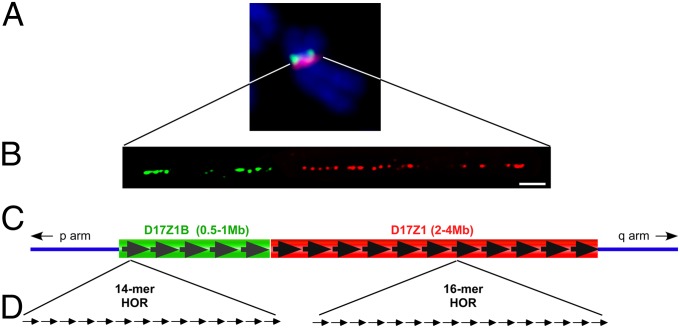
Fig. 1.
Fig. 1.
Genomic organization of HSA17 centromere. (A) HSA17 contains two HOR alpha-satellite arrays, D17Z1 (red) and D17Z1-B (green), that can be identified by high-stringency FISH. D17Z1-B is located on the short (p) arm side of the centromere. (B) Stretched chromatin fibers hybridized with D17Z1 (red) or D17Z1-B (green) FISH probes confirm that the two arrays are juxtaposed. (C and D) D17Z1 primarily contains reiterated HOR units composed of 16 individual 171-bp alpha-satellite monomers that are tandemly arranged. Overall, the array is estimated to cover 2–4 Mb. The HOR of D17Z1-B contains 14 monomers, and the entire array is estimated to be one-fourth the size of D17Z1. (Scale bar: 10 microns.)
Fig. 2.
Fig. 2.
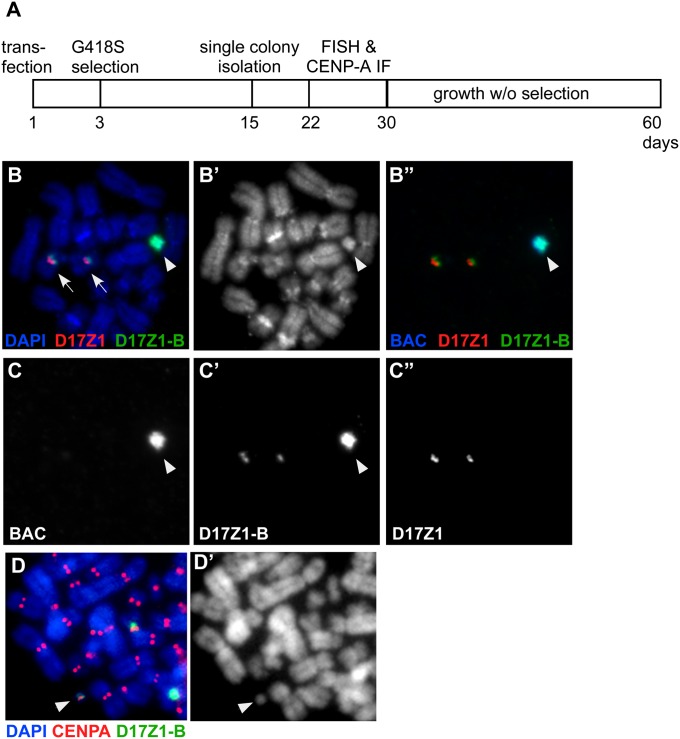
HAC assays confirm that D17Z1-B can form de novo centromeres. (A) Schematic of HAC assay. BAC constructs containing large D17Z1-B (or D17Z1 control) sequence inserts and a neomycin-selectable marker were introduced into proliferating human HT1080 cells. After 2–3 d, cells were grown in medium containing G418 sulfate (G418S). By day 15, drug-resistant colonies were isolated and expanded to evaluate centromere assembly. (B) FISH with probes to BAC vector, D17Z1, and D17Z1-B shows that the HAC (arrowhead) hybridizes only with D17Z1-B and BAC probes. Endogenous HSA17s are denoted by arrows. B shows a merged image; B′ shows DAPI staining only; B′′ shows BAC (blue), D17Z1 (red), and D17Z1-B (green). (C) Single-channel images of B showing that only the HAC contains BAC and D17Z1-B sequences. C shows BAC; C′ shows D17Z1-B; C′′ shows D17Z1. (D) CENP-A immunostaining and FISH showing that the D17Z1-B–derived HAC (green) assembles a kinetochore, as denoted by CENP-A (red). D′ is DAPI staining.
Fig. 3.
Fig. 3.
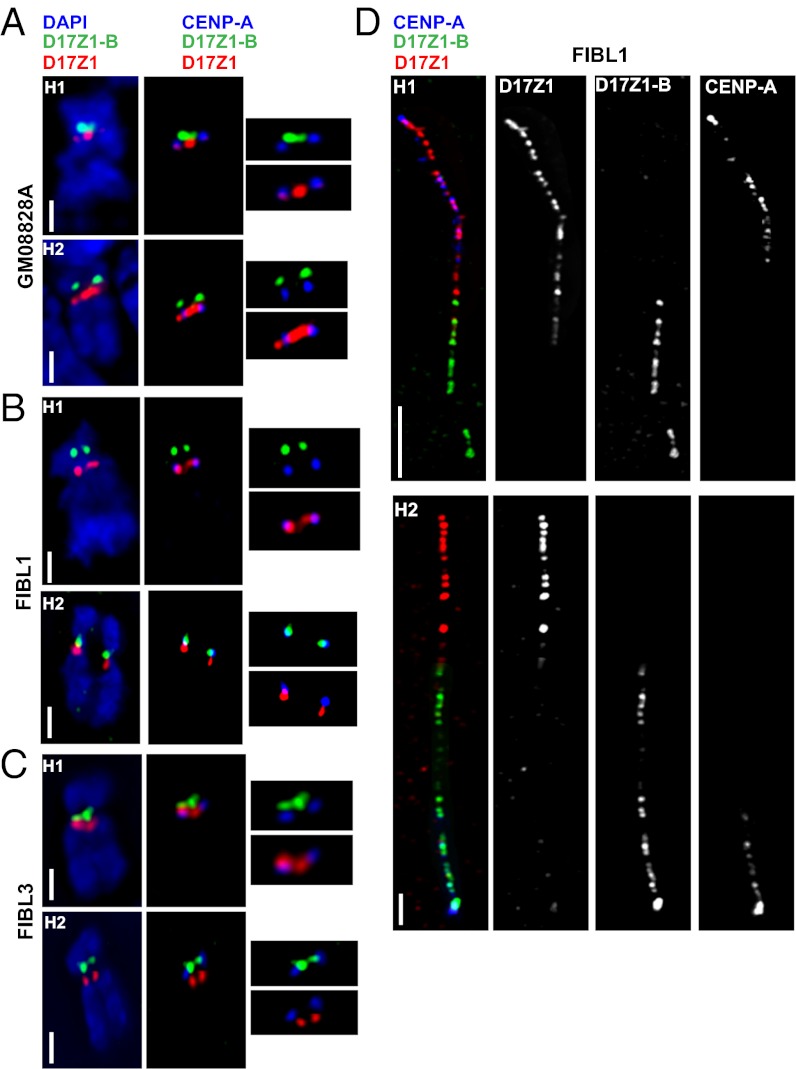
Identification of centromeric epialleles on HSA17. (A) FISH for D17Z1 (red) and D17Z1-B (green) was combined with CENP-A immunostaining to determine the CENP-A location in the diploid line GM08828. CENP-A was located at D17Z1 on both homologs (H1 and H2). (B and C) CENP-A immunostaining and D17Z1/D17Z1-B FISH were performed on line FIBL1 (B) and line FIBL3 (C). In both lines, CENP-A was located at D17Z1 (red) on H1 but at D17Z1-B (green) on H2. (Scale bars: 5 microns in AC.) (D) Extended chromatin fibers from line FIBL1 confirmed the CENP-A location (blue) at D17Z1 (red) on H1 and at D17Z1-B (green) on H2. (Scale bars: 15 microns for H1; 5 microns for H2).
Fig. 4.
Fig. 4.
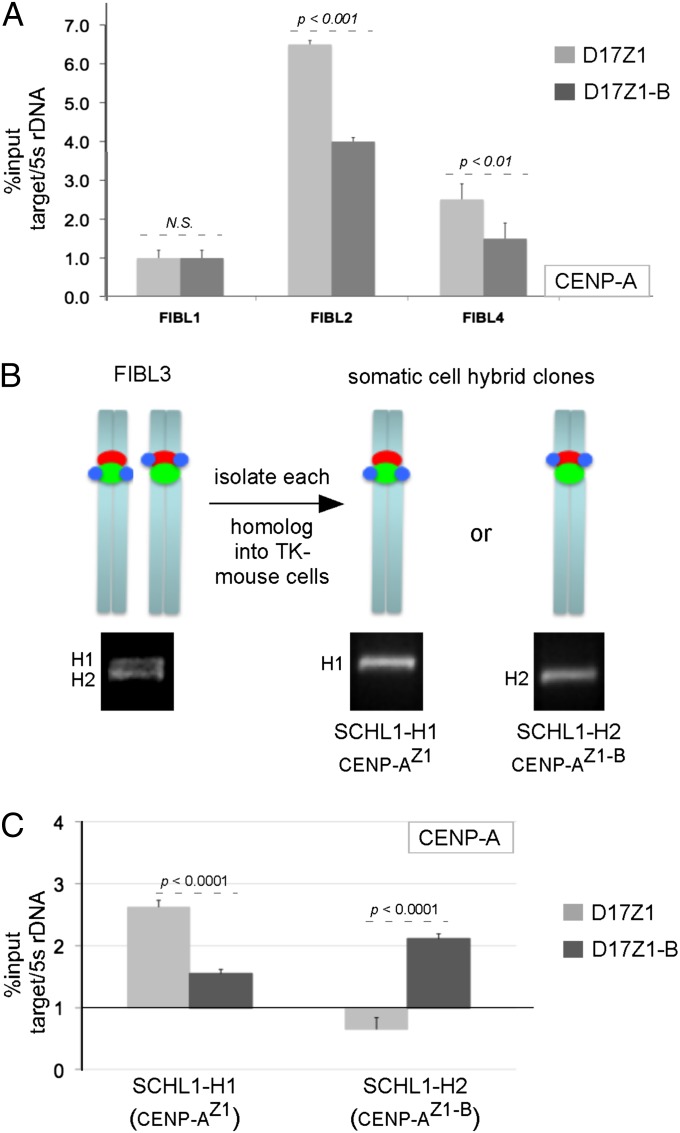
Confirmation of functional heterozygotes for CENP-A location. (A) ChIP analysis of diploid lines FIBL1, FIBL2, and FIBL4. In FIBL1, CENP-A was enriched at both D17Z1 and D17Z1-B, indicating functional heterozygosity. CENP-A was enriched at D17Z1 in FIBL2, suggesting functional homozygosity. In FIBL4, CENP-A appeared more enriched on D17Z1, but immunostaining of FIBL4 revealed tetraploidy for HSA17. Immunostaining of FIBL3, the diploid version of FIBL4, showed one HSA17 with CENP-A at D17Z1 and the other with CENP-A at D17Z1-B (Fig. 3C). (B) Homologs (H) of FIBL3 were separated into mouse–human somatic cell hybrids. H1 and H2 were molecularly distinguished from one another using PCR for a polymorphic 17q locus. (C) CENP-A location was confirmed by ChIP on each HSA17 homolog. CENP-A was maintained stably at D17Z1 on H1 and at D17Z1-B on H2. Data represent three independent experiments. CENP-A enrichment at the target site is reported as percent of input shown relative to the CENP-A–negative site mouse 5s rDNA. Error bars represent SEM.
Fig. 5.
Fig. 5.
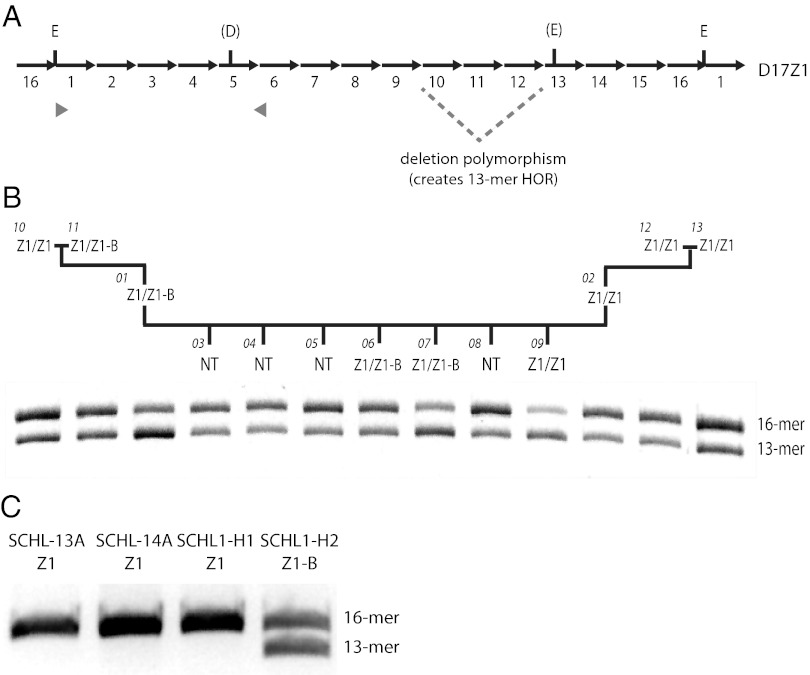
CENP-A location on HSA17 and D17Z1 HOR polymorphisms. (A) The D17Z1 HOR contains 16 monomeric repeats (16-mer) and is defined by EcoRI restriction sites (E). A 3-monomer deletion generates a 13-mer from the 16-mer. Some HORs also contain sequence polymorphisms that create DraI (D) and additional EcoRI restriction sites. Part of the HOR (gray arrowheads) was amplified by PCR and digested with DraI. If the DraI site is present, the 850-bp PCR product is reduced to 750-bp. Each HOR variant can be correlated with the 850-bp (16-mer) or 750-bp (13-mer) bands, and the intensity of bands indicates relative amounts of each repeat form. (B) In the CEPH1345 family, 16-mer and 13-mer D17Z1 variants were present in each individual. Functional homozygotes (Z1/Z1, with CENP-A located at D17Z1 on both HSA17s), such as individual 13, had darker upper bands, indicating a greater proportion of 16-mers. Functional heterozygotes (Z1/Z1-B), such as individual 07, typically had darker lower bands or equivalently dark upper and lower bands. NT, not tested. Because CEPH lines were diploid, proportions of each variant could not be assigned to specific HSA17s. Thus, single HSA17s in somatic cell hybrids were genotyped. (C) In SCHL-13A, SCHL-14A, and SCHL1-H1 that have CENP-A at D17Z1, only the 16-mer was detected. In SCHL1-H2, which shows CENP-A at D17Z1-B, the 13-mer and 16-mer were equally present.

References

    1. Yoda K, et al. Human centromere protein A (CENP-A) can replace histone H3 in nucleosome reconstitution in vitro. Proc Natl Acad Sci USA. 2000;97:7266–7271. - PMC - PubMed
    1. Sullivan KF, Hechenberger M, Masri K. Human CENP-A contains a histone H3 related histone fold domain that is required for targeting to the centromere. J Cell Biol. 1994;127:581–592. - PMC - PubMed
    1. Palmer DK, O’Day K, Margolis RL. Biochemical analysis of CENP-A, a centromeric protein with histone-like properties. Prog Clin Biol Res. 1989;318:61–72. - PubMed
    1. Stimpson KM, et al. Telomere disruption results in non-random formation of de novo dicentric chromosomes involving acrocentric human chromosomes. PLoS Genet. 2010;6:e1001061. - PMC - PubMed
    1. Warburton PE, et al. Immunolocalization of CENP-A suggests a distinct nucleosome structure at the inner kinetochore plate of active centromeres. Curr Biol. 1997;7:901–904. - PubMed

Publication types

LinkOut - more resources