. 2012 Aug;99(8):1263-75.
doi: 10.3732/ajb.1200222. Epub 2012 Jul 30.

Ontologies as integrative tools for plant science

Affiliations

Ontologies as integrative tools for plant science

Ramona L Walls et al. Am J Bot. 2012 Aug.

Abstract

Premise of the study: Bio-ontologies are essential tools for accessing and analyzing the rapidly growing pool of plant genomic and phenomic data. Ontologies provide structured vocabularies to support consistent aggregation of data and a semantic framework for automated analyses and reasoning. They are a key component of the semantic web.

Methods: This paper provides background on what bio-ontologies are, why they are relevant to botany, and the principles of ontology development. It includes an overview of ontologies and related resources that are relevant to plant science, with a detailed description of the Plant Ontology (PO). We discuss the challenges of building an ontology that covers all green plants (Viridiplantae).

Key results: Ontologies can advance plant science in four keys areas: (1) comparative genetics, genomics, phenomics, and development; (2) taxonomy and systematics; (3) semantic applications; and (4) education.

Conclusions: Bio-ontologies offer a flexible framework for comparative plant biology, based on common botanical understanding. As genomic and phenomic data become available for more species, we anticipate that the annotation of data with ontology terms will become less centralized, while at the same time, the need for cross-species queries will become more common, causing more researchers in plant science to turn to ontologies.


Figures
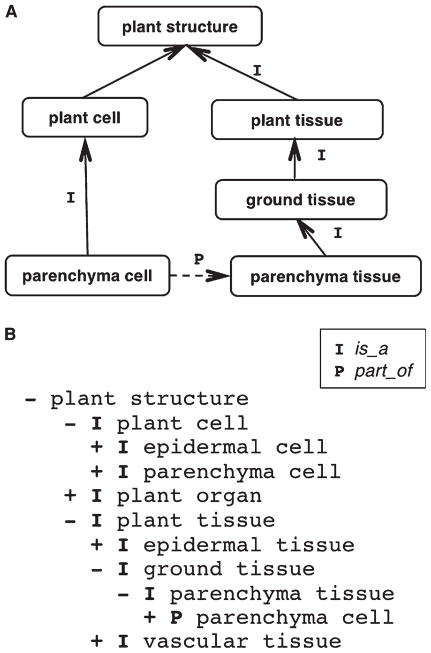
Fig. 1
Fig. 1
(A) A simple ontology in the form of a graph. Boxes represent terms in the ontology and arrows represent relationships. Relationships are read in the direction of the arrow, e.g., “every parenchyma cell is a plant cell” and “every parenchyma cell is part of some parenchyma tissue”. (B) A simple ontology in tree form. Plus signs indicate that a term has additional subclasses not shown in the tree. Relations are read up the tree, from the most indented term to the next highest term of the next highest level, e.g., “every parenchyma cell is a plant cell”.
Fig. 2
Fig. 2
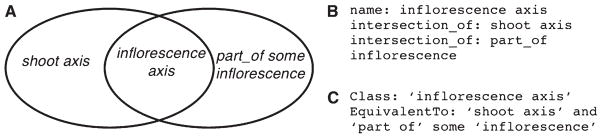
(A) Venn diagram to illustrate the logical definition of inflorescence axis as being equivalent to the class intersection of shoot axis and the class of all things that are part of some inflorescence. (B) Syntactic representation in Open Biomedical Ontologies flat file format (OBOF). (C) Equivalent representation in Web Ontology Language (OWL).
Fig. 3
Fig. 3
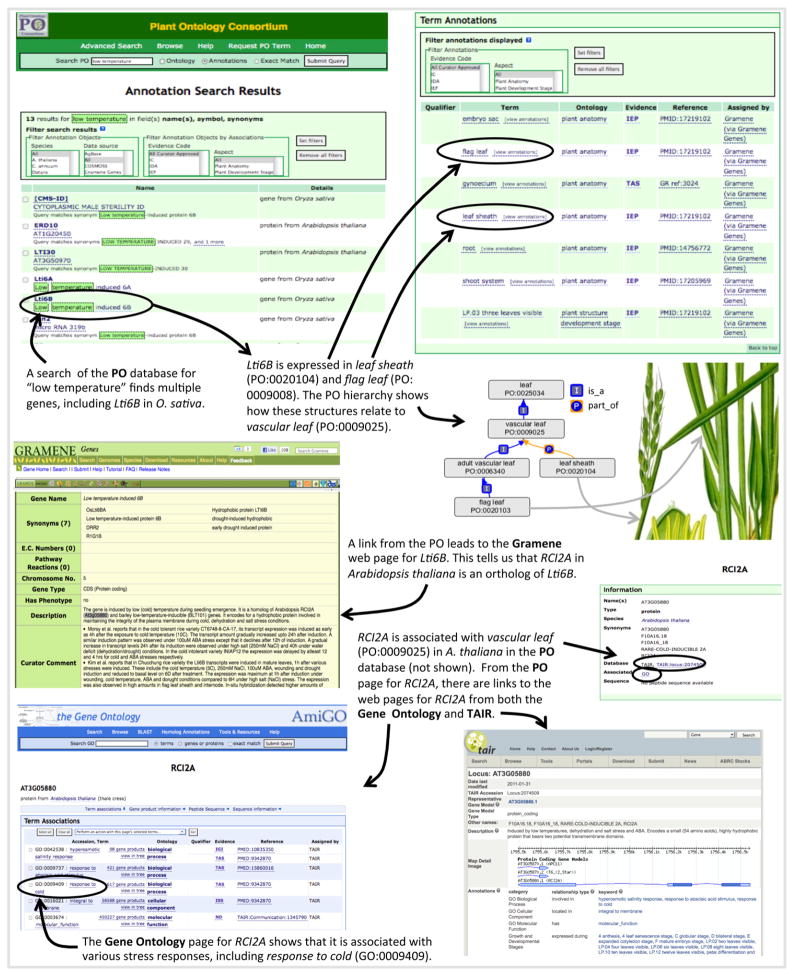
Data exploration with the Plant Ontology (PO). Suppose a researcher wanted to identify genes that are involved in a response to low temperature in the leaves of a nonmodel species. A search of PO annotations for “low temperature” returns a list of genes with those words in their descriptions (upper left). Selecting Lti6B from the list of results takes the user to the PO page for that gene (upper right), where it is shown that Lti6B is expressed in both flag leaf and leaf sheath in Oryza sativa. Because flag leaf and leaf sheath are respectively a subclass of and a part of a vascular leaf (see ontology diagram, center right) we can infer that Lti6B is expressed in vascular leaf. From the PO gene page, there is a direct link to the database that supplied the annotation (Gramene in this case, center left), which provides more detail on Lti6B, including the fact that RCI2A is an ortholog in Arabidopsis. A new search of PO annotations leads to the PO page for RCI2A, which is expressed in vascular leaf. From the RCI2A page, users can link to the TAIR locus page (lower right) or the Gene Ontology page (lower left) for RCI2A. This evidence, which spans the monocot–dicot divide, suggests that Lti6B and its orthologs are important for a response to low temperature in leaves across angiosperms, and provides a candidate for genetic analysis in the nonmodel species. By linking resources from multiple databases, the PO makes this type of information much more accessible. Orzya sativa image modified from http://en.wikipedia.org/wiki/File:Oryza_sativa_-_K%C3%B6hler%E2%80%93s_Medizinal-Pflanzen-232.jpg (image in the public domain).

References

    1. Ashburner M, Ball CA, Blake JA, Botstein D, Butler H, Cherry JM, Davis AP, et al. Gene ontology: Tool for the unification of biology. The Gene Ontology Consortium. Nature Genetics. 2000;25:25–29. - PMC - PubMed
    1. Ashburner M, Lewis S. On ontologies for biologists: The Gene Ontology—Untangling the web. Novartis Foundation Symposium. 2002;247:66–88. - PubMed
    1. Avraham S, Tung CW, Ilic K, Jaiswal P, Kellogg EA, McCouch S, Pujar A, et al. The Plant Ontology Database: A community resource for plant structure and developmental stages controlled vocabulary and annotations. Nucleic Acids Research. 2008;36:D449–D454. - PMC - PubMed
    1. Baader F. The description logic handbook: Theory, implementation, and applications. Cambridge University Press; New York, New York, USA: 2003.
    1. Balhoff JP, Dahdul WM, Kothari CR, Lapp H, Lundberg JG, Mabee P, Midford PE, et al. Phenex. Ontological Annotation of Phenotypic Diversity. 2010;5:e10500. - PMC - PubMed

Publication types