. 2012 Oct 24;18(1):1190-6.
doi: 10.2119/molmed.2012.00180.

Inhibition of GSK3 abolishes bacterial-induced periodontal bone loss in mice

Affiliations

Inhibition of GSK3 abolishes bacterial-induced periodontal bone loss in mice

Karina Adamowicz et al. Mol Med. .

Abstract

The tissue destruction that characterizes periodontitis is driven by the host response to bacterial pathogens. Inhibition of glycogen synthase kinase 3β (GSK3β) in innate cells leads to suppression of Toll-like receptor (TLR)-initiated proinflammatory cytokines under nuclear factor kappa-light-chain-enhancer of activated B cells (NF-κB) p65 transcriptional control and promotion of cyclic adenosine monophosphate response element-binding (CREB)-dependent gene activation. Therefore, we hypothesized that the cell permeable GSK3-specific inhibitor, SB216763, would protect against alveolar bone loss induced by the key periodontal pathogen, Porphyromonas gingivalis (P. gingivalis), in a murine model. B6129SF2/J mice either were infected orally with P. gingivalis ATCC 33277; or treated with SB216763 and infected with P. gingivalis; sham infected; or exposed to vehicle only (dimethyl sulfoxide [DMSO]); or to GSK3 inhibitor only (SB216763). Alveolar bone loss and local (neutrophil infiltration and interleukin [IL]-17) and systemic (tumor necrosis factor [TNF], IL-6, Il-1β and IL-12/IL-23 p40) inflammatory indices also were monitored. SB216763 unequivocally abrogated mean P. gingivalis-induced bone resorption, measured at 14 predetermined points on the molars of defleshed maxillae as the distance from the cementoenamel junction to the alveolar bone crest (p < 0.05). The systemic cytokine response, the local neutrophil infiltration and the IL-17 expression were suppressed (p < 0.001). These data confirm the relevance of prior in vitro phenomena and establish GSK3 as a novel, efficacious therapeutic preventing periodontal disease progression in a susceptible host. These findings also may have relevance to other chronic inflammatory diseases and the systemic sequelae associated with periodontal infections.


Figures

Figure 1
Figure 1
Rationale for targeting GSK3 to prevent TLR-induced alveolar bone loss. There is a large body of existing, predominantly in vitro evidence, that, together, provide strong rationale for examining GSK3 as a potential therapeutic target for periodontal diseases. This figure summarizes the key data. GSK3 is a constitutively active serine-threonine kinase that, upon TLR engagement by P. gingivalis, acts as a downstream effector molecule in the PI3K pathway that augments the production of proinflammatory cytokines including TNF, IL-6, IL-12 and IL-1β. Such cytokines are known to promote osteoclastogenesis and promote alveolar bone loss. Pharmacological inhibition of GSK3 suppresses the bacterial-induced production of multiple proinflammatory cytokines while concurrently augmenting production of the antiinflammatory cytokine, IL-10. This occurs through a mechanism that leads to a shift in the balance of nuclear NF-κB (p65)- and CREB-driven transcription events. Further details are provided in the recent review by Wang et al. (6). Such alterations to the pro- and antiinflammatory cytokine balance would be expected to suppress the progression of periodontitis. Therefore, it is hypothesized that the GSK3 inhibitor, SB216763, will protect susceptible mice from P. gingivalis–mediated alveolar bone loss. Those parts of the pathway that are relevant in vivo remain to be clarified. This report, which confirms that pharmacological inhibition of GSK3b suppresses pathogen-induced periodontal inflammation and alveolar bone loss, represents a first step in this process.
Figure 2
Figure 2
Visualization of P. gingivalis–induced bone loss. 8- to 12-wk-old B6129SF2/J mice were divided randomly into three control groups and two experimental groups (n = 5 per group). The control groups were treated with cellulose (sham infected), 0.02% DMSO, or SB216763 (10 mg/kg) respectively. The experimental groups were infected orally with P. gingivalis 33277 with or without pretreatment with the GSK3 inhibitor, SB216763 (10 mg/kg). Alveolar bone loss was visualized by methylene blue/eosin staining 6 wks later. Typical maxillae from (A) sham-infected, (B) P. gingivalis–infected, and (C) SB216763-treated, P. gingivalis–infected mice are presented.
Figure 3
Figure 3
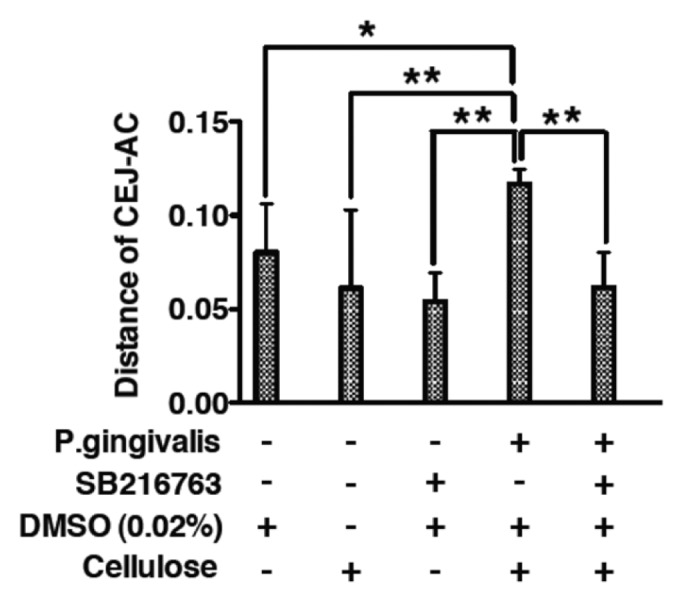
Quantification of P. gingivalis–induced bone loss. The distance from the cementoenamel junction (CEJ) to the alveolar bone crest (ABC) was measured 6 wks after infection at 14 predetermined maxillary buccal sites in 8- to 12-wk-old B6129SF2/J mice divided into three control (cellulose, DMSO, or SB216763 treated) and two experimental (P. gingivalis–infected; and SB216763-treated, P. gingivalis–infected mice) groups. Data are presented as mean distance CEJ-ABC in mm ± s.d. n = 5 mice per group. *p < 0.05 compared with P. gingivalis–treated group. **p < 0.01 compared with P. gingivalis–treated group.
Figure 4
Figure 4
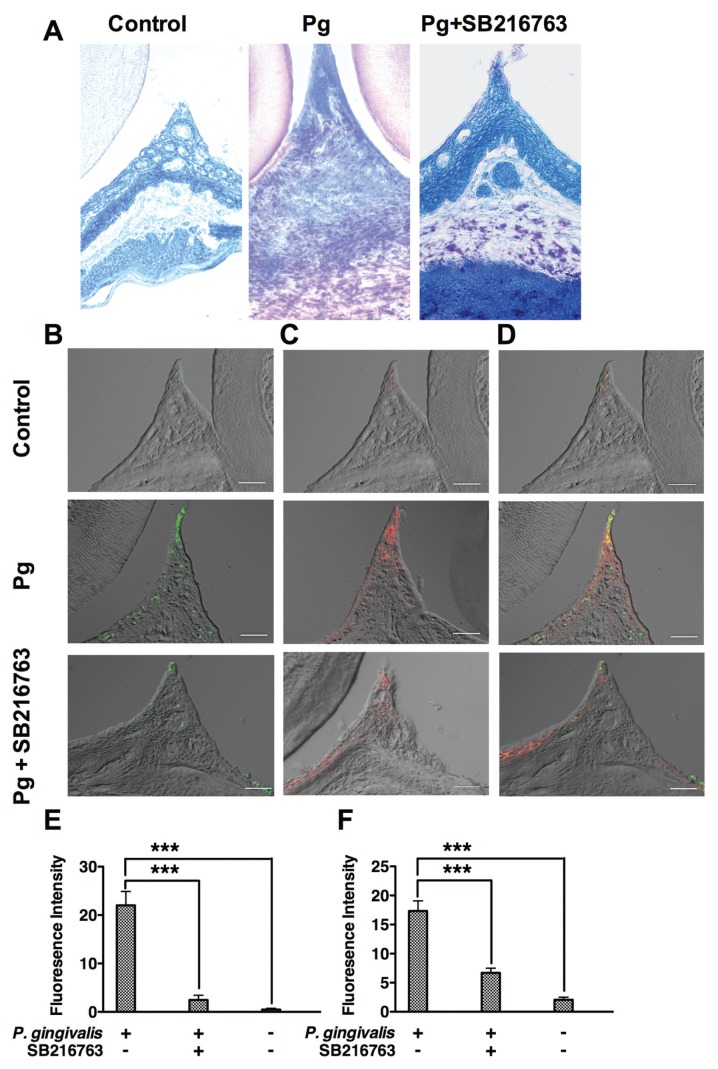
Quantification of maxillary neutrophil infiltration and IL-17 expression. Typical (A) Hematoxylin and eosin (H and E)–stained and (B) confocal microscopy images of Ly6G-postive neutrophil infiltration, (C) IL-17 expression and (D) IL-17 expressing Ly6G-postive cells in periodontal tissues are presented. The mean comparative fluorescence intensity for (E) neutrophils and (F) IL-17 also are presented. Error bars represent the standard deviation. ***p < 0.001 compared with P. gingivalis bone loss group. Pg, P. gingivalis infected; Pg + SB216763, SB216763 treated and P. gingivalis infected. Scale bars, 50 μm.
Figure 5
Figure 5
Systemic cytokine response to P. gingivalis infection and GSK3 inhibition. Systemic cytokine concentrations were determined in mouse serum collected at euthanization, 42 d from the last infection, using Luminex technology (IL-12 p40, IL-1β and IL-6) or ELISA (TNF). Assays were performed in duplicate with n = 5 mice per group. Data are presented as mean cytokine concentration in pg/mL ± s.d. ***p < 0.001 compared with the P. gingivalis bone loss group.

References

    1. Krauss JL, Potempa J, Lambris JD, Hajishengallis G. Complementary Tolls in the periodontium: how periodontal bacteria modify complement and Toll-like receptor responses to prevail in the host. Periodontol 2000. 2010;52:141–62. - PMC - PubMed
    1. Zhang P, et al. TLR2-dependent modulation of osteoclastogenesis by Porphyromonas gingivalis through differential induction of NFATc1 and NF-kappaB. J Biol Chem. 2011;286:24159–69. - PMC - PubMed
    1. Bagaitkar J, et al. Tobacco upregulates P. gingivalis fimbrial proteins which induce TLR2 hyposensitivity. PLoS One. 2010;5:e9323. - PMC - PubMed
    1. Gaddis DE, Michalek SM, Katz J. Requirement of TLR4 and CD14 in dendritic cell activation by Hemagglutinin B from Porphyromonas gingivalis. Mol Immunol. 2009;46:2493–504. - PMC - PubMed
    1. Martin M, Rehani K, Jope RS, Michalek SM. Toll-like receptor-mediated cytokine production is differentially regulated by glycogen synthase kinase 3. Nat Immunol. 2005;6:777–84. - PMC - PubMed

Publication types

MeSH terms

LinkOut - more resources