Review
. 2012 Aug;23(15):2823-30.
doi: 10.1091/mbc.E11-07-0645.

A simple guide to biochemical approaches for analyzing protein-lipid interactions

Affiliations
Review

A simple guide to biochemical approaches for analyzing protein-lipid interactions

Hongxia Zhao et al. Mol Biol Cell. 2012 Aug.

Abstract

Eukaryotic cells contain many different membrane compartments with characteristic shapes, lipid compositions, and dynamics. A large fraction of cytoplasmic proteins associate with these membrane compartments. Such protein-lipid interactions, which regulate the subcellular localizations and activities of peripheral membrane proteins, are fundamentally important for a variety of cell biological processes ranging from cytoskeletal dynamics and membrane trafficking to intracellular signaling. Reciprocally, many membrane-associated proteins can modulate the shape, lipid composition, and dynamics of cellular membranes. Determining the exact mechanisms by which these proteins interact with membranes will be essential to understanding their biological functions. In this Technical Perspective, we provide a brief introduction to selected biochemical methods that can be applied to study protein-lipid interactions. We also discuss how important it is to choose proper lipid composition, type of model membrane, and biochemical assay to obtain reliable and informative data from the lipid-interaction mechanism of a protein of interest.


Figures
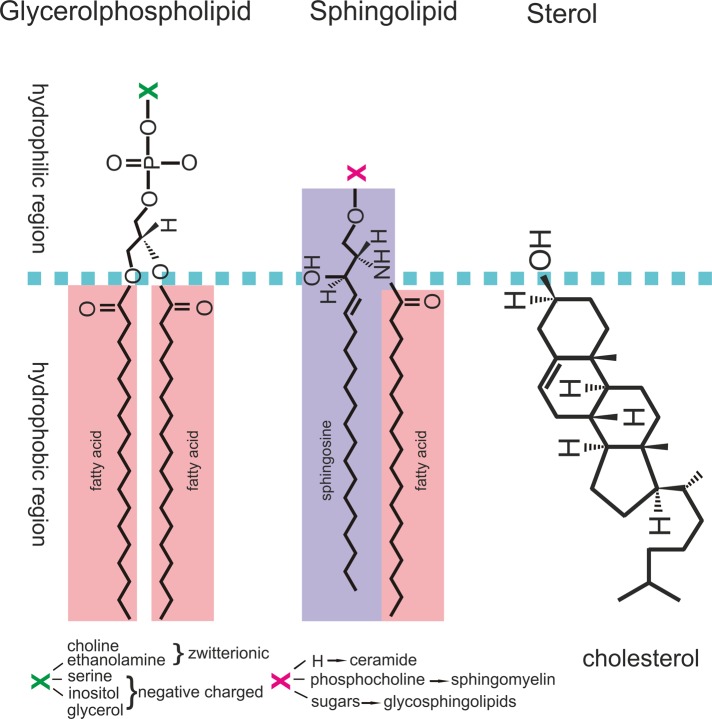
FIGURE 1:
FIGURE 1:
Schematic representation of structures of common lipids. Lipids are hydrophobic or amphiphilic molecules. Lipid molecules are typically composed of two major regions: a hydrophilic region (regions above the dashed line) and hydrophobic tails (regions below the dashed line). Glycerophospholipids are the most abundant lipids in cellular membranes, and they are composed of two fatty acid chains linked to a phosphate and a specific head group. Sphingolipids are composed of a backbone of a sphingoid base, such as sphingosine, connected to a fatty acid chain and a specific head group. Sterol lipids, such as cholesterol (with a small polar head) and its derivatives, are also important components of cellular membranes.
FIGURE 2:
FIGURE 2:
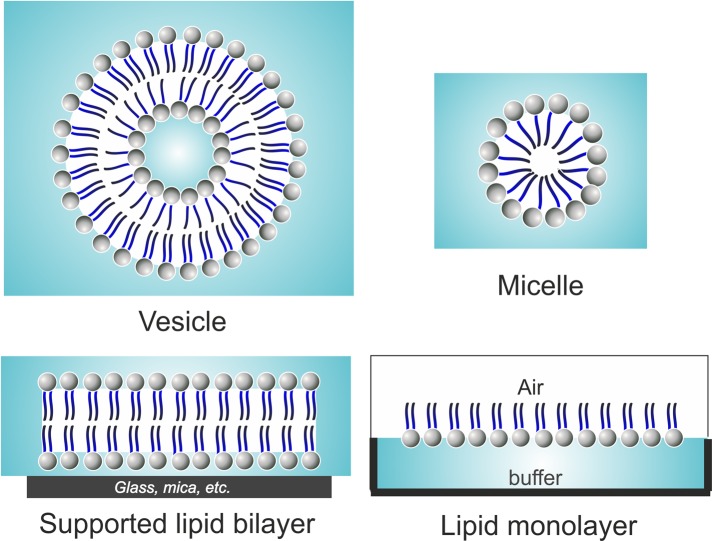
Different model membranes for studying protein–lipid interactions. Lipid vesicles or liposomes are spherical hollow structures composed of a lipid bilayer. Micelles are also spherical, but are formed from a lipid monolayer that contains a hydrophobic core. Planar model membranes include supported lipid bilayers and lipid monolayers. The former are made up of a flat lipid bilayer supported by a solid surface, such as mica, glass, or silicon oxide wafers. Lipid monolayers can be formed by spreading lipid molecules at the surface of a buffer, where the lipid molecules obtain a specific orientation with the polar head groups of phospholipids pointing toward the aqueous subphase and the hydrophobic acyl chains pointing toward the air.
FIGURE 3:
FIGURE 3:
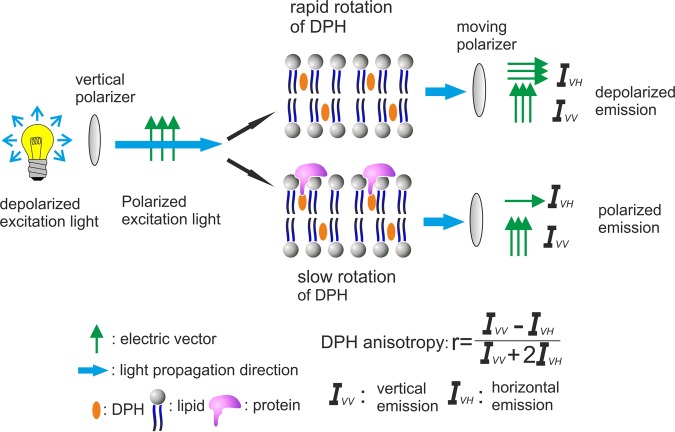
Insertion of proteins into a lipid bilayer increases the lipid acyl chain order, which can be monitored by DPH anisotropy. A linearly polarized excitation beam is generated by a vertical polarizer. The polarized light preferentially excites DPH with transition moments aligned parallel to the incident polarization vector. The resulting fluorescence is collected and directed into two channels through a moving polarizer that measure the intensity of the fluorescence polarized both parallel (IVV) and perpendicular (IVH) to that of the excitation beam. With these two measurements, the fluorescence anisotropy, r, can be calculated. When the membrane is fluid, DPH molecules tumble quickly and have depolarized emission, thus displaying low anisotropy values. However, insertion of proteins into the hydrophobic core of a lipid bilayer diminishes the tumbling of DPH during the excitation state, and the emitted light is polarized in the perpendicular direction, resulting in increased DPH anisotropy.
FIGURE 4:
FIGURE 4:
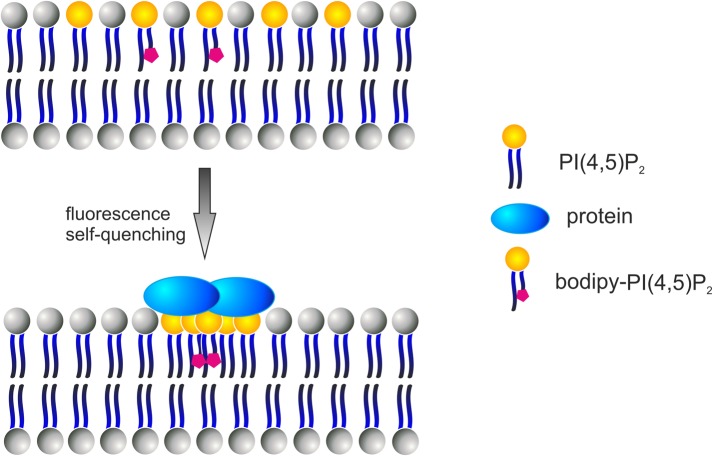
Detection of PI(4,5)P2 microdomain formation by a fluorometric assay using BODIPY-PI(4,5)P2.Interaction of a protein in a multivalent manner with specific lipids (e.g., PI(4,5)P2) may induce lipid clustering. Furthermore, oligomerization of membrane-binding proteins may induce clustering of specific lipid molecules. The BODIPY fluorescent probe has highly superimposable absorption and emission spectra and exhibits self-quenching properties when two or more molecules are brought into proximity. Upon lipid clustering, BODIPY-labeled lipids (e.g., PI(4,5)P2) form excimers, which results in intramolecular self-quenching of the BODIPY fluorescence. This change in BODIPY fluorescence can be applied for studying the effects of a protein on clustering of specific BODIPY-conjugated lipid species.

References

    1. Abkarian M, Loiseau E, Massiera G. Continuous droplet interface crossing encapsulation (cDICE) for high throughput monodisperse vesicle design. Soft Matter. 2011;7:4610–4614.
    1. Ananthanarayanan B, Stahelin RV, Digman MA, Cho W. Activation mechanisms of conventional protein kinase C isoforms are determined by the ligand affinity and conformational flexibility of their C1 domains. J Biol Chem. 2003;278:46886–46894. - PubMed
    1. Angelova MI, Soleau S, Meleard PH, Faucon JF, Bothorel F. Preparation of giant vesicles by external AC electric fields. Kinetics and applications. Progr Colloid Polymer Sci. 1992;89:127–131.
    1. Bacia K, Futai E, Prinz S, Meister A, Daum S, Glatte D, Briggs JA, Schekman R. Multibudded tubules formed by COPII on artificial liposomes. Sci Rep. 2011:17. - PMC - PubMed
    1. Bassereau P, Goud B. Physics, biology and the right chemistry. F1000 Biol Rep. 2011;3:7. - PMC - PubMed

Publication types

LinkOut - more resources