Nuclear factor-κB signalling and transcriptional regulation in skeletal muscle atrophy
- PMID: 22848079
- PMCID: PMC3505235
- DOI: 10.1113/expphysiol.2011.063321
Nuclear factor-κB signalling and transcriptional regulation in skeletal muscle atrophy
Abstract
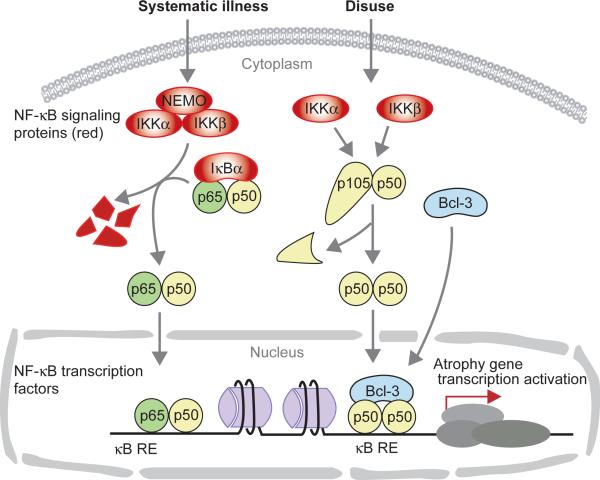
The nuclear factor-κB (NF-κB) signalling pathway is a necessary component of adult skeletal muscle atrophy resulting from systemic illnesses or disuse. Studies showing a role for the NF-κB pathway in muscle disuse include unloading, denervation and immobilization, and studies showing a role for NF-κB in systemic illnesses include cancer, chronic heart failure and acute septic lung injury. Muscle atrophy due to most of these triggers is associated with activation of NF-κB transcriptional activity. With the exception of muscle unloading, however, there is a paucity of data on the NF-κB transcription factors that regulate muscle atrophy, and little is known about which genes are targeted by NF-κB transcription factors during atrophy. Interestingly, in some cases it appears that the amelioration of muscle atrophy by genetic inhibition of NF-κB signalling proteins is due to effects that are independent of the downstream NF-κB transcription factors. These questions are prime areas for investigation if we are to understand a key component of muscle wasting in adult skeletal muscle.
Figures
References
-
- Acharyya S, Butchbach ME, Sahenk Z, Wang H, Saji M, Carathers M, Ringel MD, Skipworth RJ, Fearon KC, Hollingsworth MA, Muscarella P, Burghes AH, Rafael-Fortney JA, Guttridge DC. Dystrophin glycoprotein complex dysfunction: a regulatory link between muscular dystrophy and cancer cachexia. Cancer Cell. 2005;8(5):421–432. - PubMed
-
- Adams V, Spate U, Krankel N, Schulze PC, Linke A, Schuler G, Hambrecht R. Nuclear factor-kappa B activation in skeletal muscle of patients with chronic heart failure: correlation with the expression of inducible nitric oxide synthase. Eur J Cardiovasc Prev Rehabil. 2003;10(4):273–277. - PubMed
-
- Bakkar N, Guttridge DC. NF-kappaB signaling: a tale of two pathways in skeletal myogenesis. Physiol Rev. 2010;90(2):495–511. - PubMed
Publication types
MeSH terms
Substances
Grants and funding
LinkOut - more resources
Full Text Sources
Other Literature Sources