


Hunter-gatherer energetics and human obesity
- PMID: 22848382
- PMCID: PMC3405064
- DOI: 10.1371/journal.pone.0040503
Hunter-gatherer energetics and human obesity
Abstract
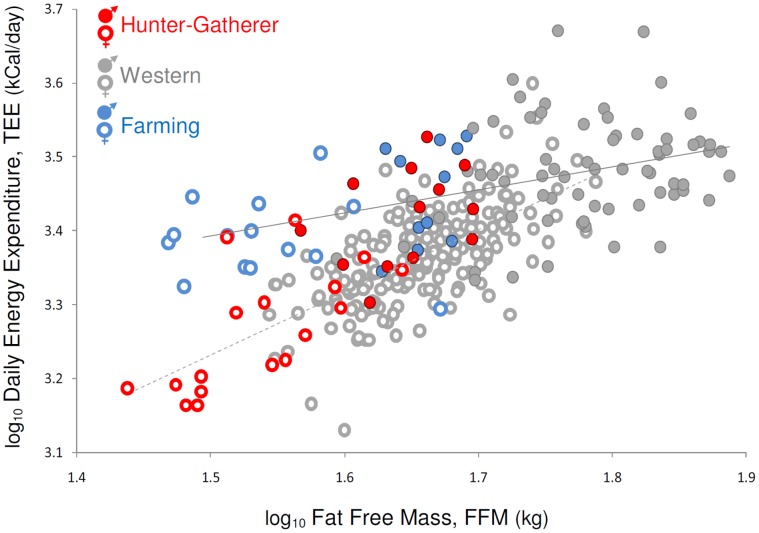
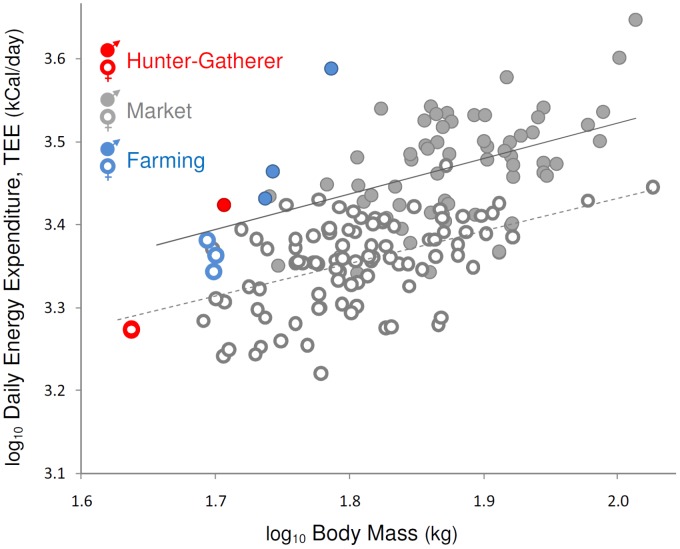
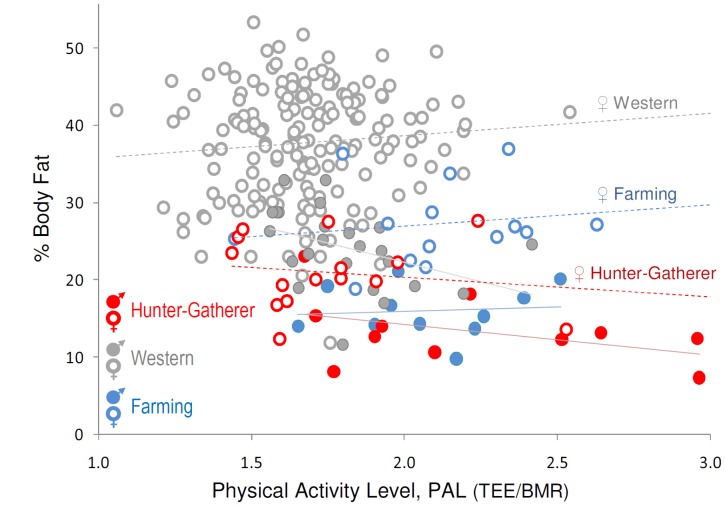
Western lifestyles differ markedly from those of our hunter-gatherer ancestors, and these differences in diet and activity level are often implicated in the global obesity pandemic. However, few physiological data for hunter-gatherer populations are available to test these models of obesity. In this study, we used the doubly-labeled water method to measure total daily energy expenditure (kCal/day) in Hadza hunter-gatherers to test whether foragers expend more energy each day than their Western counterparts. As expected, physical activity level, PAL, was greater among Hadza foragers than among Westerners. Nonetheless, average daily energy expenditure of traditional Hadza foragers was no different than that of Westerners after controlling for body size. The metabolic cost of walking (kcal kg(-1) m(-1)) and resting (kcal kg(-1) s(-1)) were also similar among Hadza and Western groups. The similarity in metabolic rates across a broad range of cultures challenges current models of obesity suggesting that Western lifestyles lead to decreased energy expenditure. We hypothesize that human daily energy expenditure may be an evolved physiological trait largely independent of cultural differences.
Conflict of interest statement
Figures
References
-
- World Health Organization. Obesity and Overweight. 2011. Fact sheet No. 311, Available: http://www.who.int/mediacentre/factsheets/fs311/en/index.html. Accessed 2011 January 20.
-
- Popkin BM. Using research on the obesity pandemic as a guide to a unified vision of nutrition. Public Health Nutr. 2005;8:724–729. - PubMed
-
- Prentice AM, Jebb SA. Fast foods, energy density and obesity: a possible mechanistic link Obesity Reviews. 2003;4:187–194. - PubMed
-
- Isganaitis E, Lustig RH. Fast food, central nervous system insulin resistance, and obesity. Arterioscler Thromb Vasc Biol. 2005;25:2451–2462. - PubMed
Publication types
MeSH terms
LinkOut - more resources
Full Text Sources
Medical
