


A novel murine model of inflammatory bowel disease and inflammation-associated colon cancer with ulcerative colitis-like features
- PMID: 22848611
- PMCID: PMC3407062
- DOI: 10.1371/journal.pone.0041797
A novel murine model of inflammatory bowel disease and inflammation-associated colon cancer with ulcerative colitis-like features
Abstract
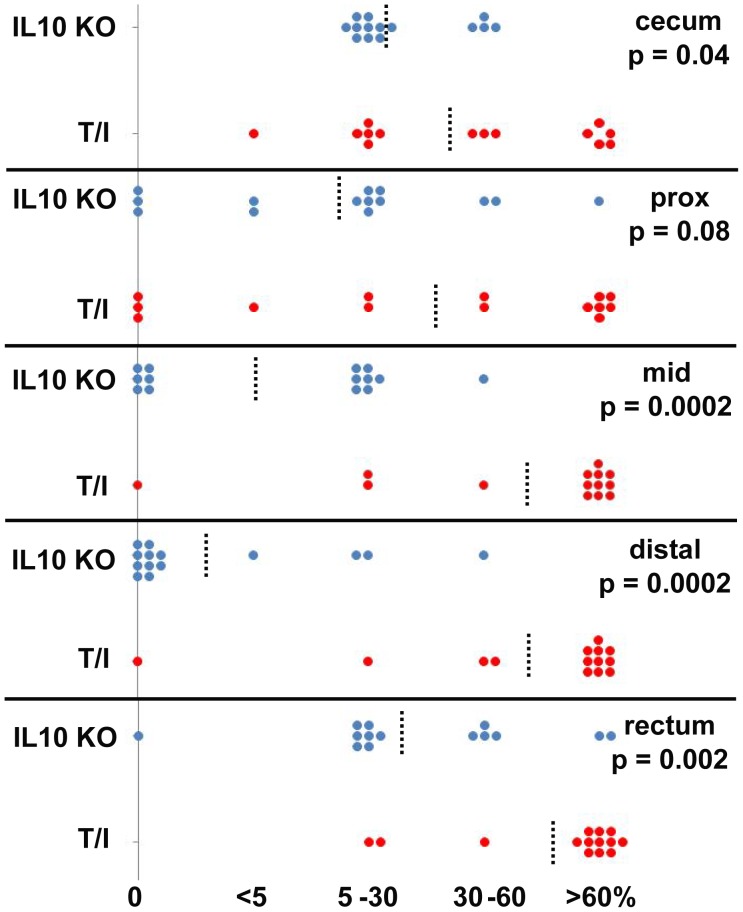
Mutations that increase susceptibility to inflammatory bowel disease (IBD) have been identified in a number of genes in both humans and mice, but the factors that govern how these mutations contribute to IBD pathogenesis and result in phenotypic presentation as ulcerative colitis (UC) or Crohn disease (CD) are not well understood. In this study, mice deficient in both TNF and IL-10 (T/I mice) were found to spontaneously develop severe colitis soon after weaning, without the need for exogenous triggers. Colitis in T/I mice had clinical and histologic features similar to human UC, including a markedly increased risk of developing inflammation-associated colon cancer. Importantly, development of spontaneous colitis in these mice was prevented by antibiotic treatment. Consistent with the known role of Th17-driven inflammation in response to bacteria, T/I mice had elevated serumTh17-type cytokines when they developed spontaneous colitis and after systemic bacterial challenge via NSAID-induced degradation of the mucosal barrier. Although TNF production has been widely considered to be be pathogenic in IBD, these data indicate that the ability to produce normal levels of TNF actually protects against the spontaneous development of colitis in response to intestinal colonization by bacteria. The T/I mouse model will be useful for developing new rationally-based therapies to prevent and/or treat IBD and inflammation-associated colon cancer and may further provide important insights into the pathogenesis of UC in humans.
Conflict of interest statement
Figures
References
-
- Van der Linde K, Boor PPC, Sandkuijl LA, Meijssen MAC, Savelkoul HFJ, et al. (2003) A Gly15Arg mutation in the interleukin-10 gene reduces secretion of interleukin-10 in Crohn disease. Scand J Gastroenterol 38: 611–617. - PubMed
-
- Franke A, Balschun T, Karlsen TH, Sventoraityte J, Nikolaus S, et al. (2008) Sequence variants in IL10, ARPC2 and multiple other loci contribute to ulcerative colitis susceptibility. Nature Genet. 40: 1319–1323. - PubMed
-
- Mottet C, Uhlig HH, Powrie F (2003) Cutting edge: Cure of colitis by CD4+CD25+ regulatory T cells. J Immunol. 170: 3939–3943. - PubMed
Publication types
MeSH terms
Substances
Grants and funding
LinkOut - more resources
Full Text Sources
Medical
Molecular Biology Databases
