. 2012;7(7):e41895.
doi: 10.1371/journal.pone.0041895. Epub 2012 Jul 25.

Immunodominance of antigenic site B over site A of hemagglutinin of recent H3N2 influenza viruses

Affiliations

Immunodominance of antigenic site B over site A of hemagglutinin of recent H3N2 influenza viruses

Lyubov Popova et al. PLoS One. 2012.

Abstract

H3N2 influenza viruses have now circulated in the human population for 43 years since the pandemic of 1968, accumulating sequence changes in the hemagglutinin (HA) and neuraminidase (NA) that are believed to be predominantly due to selection for escape from antibodies. Examination of mutations that persist and accumulate led to identification of antigenically significant mutations that are contained in five antigenic sites (A-E) mapped on to the H3 HA. In early H3N2 isolates, antigenic site A appeared to be dominant while in the 1990s site B seemed more important. To obtain experimental evidence for dominance of antigenic sites on modern H3 HAs, we have measured antibodies in plasma of human subjects who received the 2006-07 trivalent subunit influenza vaccine (H3 component A/Wisconsin/67/05) or the 2008-09 formulation (H3 component A/Uruguay/716/07). Plasmas were tested against expressed HA of Wisconsin-like influenza A/Oklahoma/309/06 and site-directed mutants in antigenic site A (NNES121-124ITEG, N126T, N133D, TSSS135-138GSNA, K140I, RSNNS142-146PGSG), and antigenic site B (HL156-157KS, KFK158-160GST, NDQI189-192QEQT, A196V). "Native ELISA" analysis and escape mutant selection with two human monoclonal antibodies demonstrated that antibody E05 binds to antigenic site A and 1_C02 binds to site B. We find that most individuals, after vaccination in seasons 2006-07 and/or 2008-09, showed dominance of antigenic site B recognition over antigenic site A. A minority showed dominance of site A in 2006 but these were reduced in 2008 when the vaccine virus had a site A mutation. A better understanding of immunodominance may allow prediction of future antigenic drift and assist in vaccine strain selection.


Conflict of interest statement

Competing Interests: The authors have declared that no competing interests exist.

Figures

Figure 1
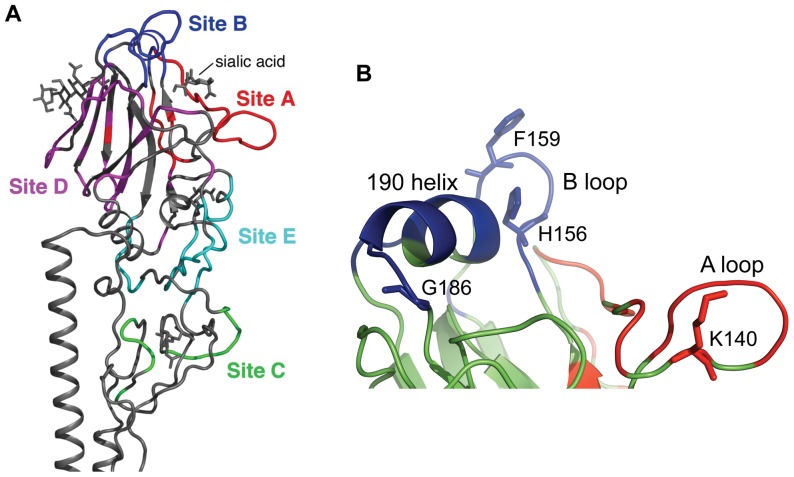
Figure 1. Antigenic structure of H3 HA.
Five antigenic sites A–E are mapped on the HA1 surface of H3N2 influenza viruses. (A). Antigenic site A (red color) and antigenic site B (blue color) are localized on the top of HA around the receptor binding pocket. (B). The “190 helix” and “B loop” create antigenic site B. The “A loop” is a part of antigenic site A. Figure 1A was made from PDB ID 2VIR using PyMol (Schrödinger, LLC). Figure 1B was made from an Oklahoma/309 HA structural model made by SWISS-MODEL.
Figure 2
Figure 2. Expression of wild type and mutant HAs in the baculovirus system.
1. Wild type 309 HA 2. Mutant HL156-157KS 3. Mutant KFK158-160GST 4. NDQI189-192QEQT 5. A196V 6. N133D 7. TSSS135-138GSNA 8. K140I. Supernatant (25 µl) from a 25 cm2 flask of Sf9 cells infected with the recombinant baculoviruses expressing wild type and mutant HA was loaded on a 12% SDS-polyacrylamide gel. HA was visualized by immunoblotting assay with anti-HA tag (YPYDVPDYA) polyclonal antiserum.
Figure 3
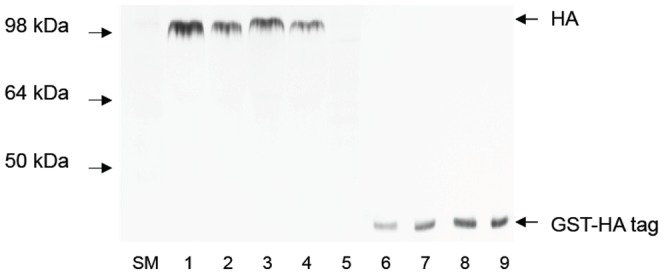
Figure 3. Quantitation of expressed HA by immunoblotting assay using anti-HA-tag antibody.
Different concentrations of standard protein GST-HA tag were visualized in the same membrane as HAs. 1–2, 309 HA (10 µl, 7 µl); 3–4, mutant HA HL156-157KS (10 µl, 7 µl); 5, mock infected; 6–9. GST-HA tag 4 ng, 6 ng, 8 ng, 10 ng, respectively. The bands were scanned and quantitated using ImageQuant software (Molecular Dynamics). Amounts of HA were determined from a standard curve of GST-HA tag fusion protein. Standard curves were built for each sample of HA.
Figure 4
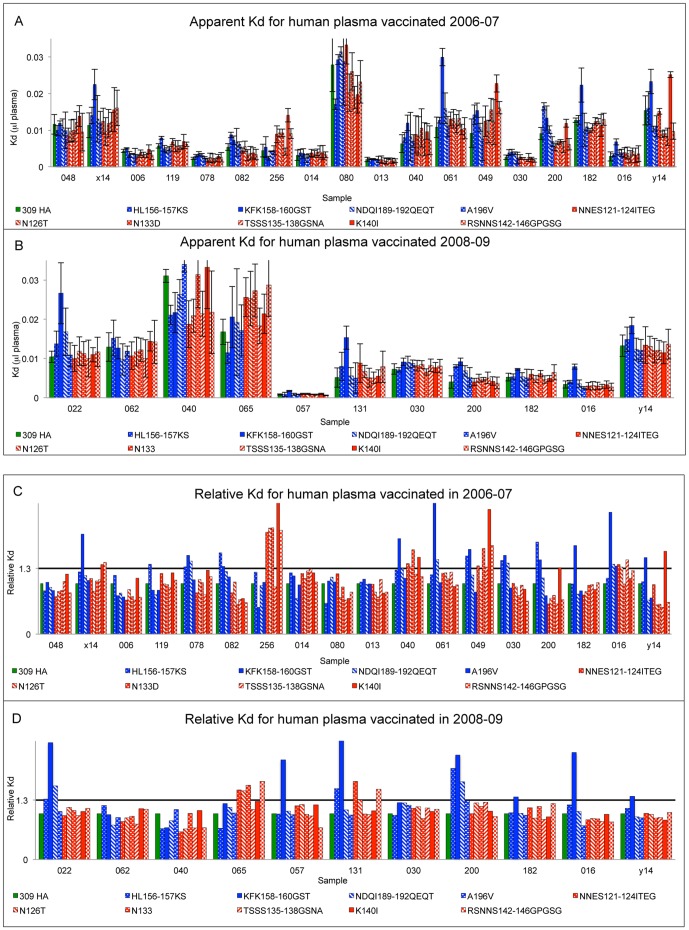
Figure 4. Analysis of human plasma samples vaccinated in season 2006–07 (H3 component A/Wisconsin/67/05) and season 2008–09 (H3 component A/Uruguay/716/07).
A, B. Overall affinity (Kd ± St. dev.) of antibodies in human plasma against wt 309 HA and mutants. Overall affinity labeled as dissociation constant (Kd) of binding of antibodies in plasma from subjects to wild type and mutants in antigenic site A or B; higher Kd is lower affinity. Kds were measured as described in Materials and Methods and the units are µl plasma in the standard assay. Results are plotted as mean Kd ± standard deviation over 3 experiments. C, D. Relative Kd of antibodies in human plasma against mutants relative to binding of wild type A/OK/309/06 HA. Kds of binding of plasma antibodies to mutants HA are calculated by normalizing Kd of wild type 309 HA to 1.0.
Figure 5
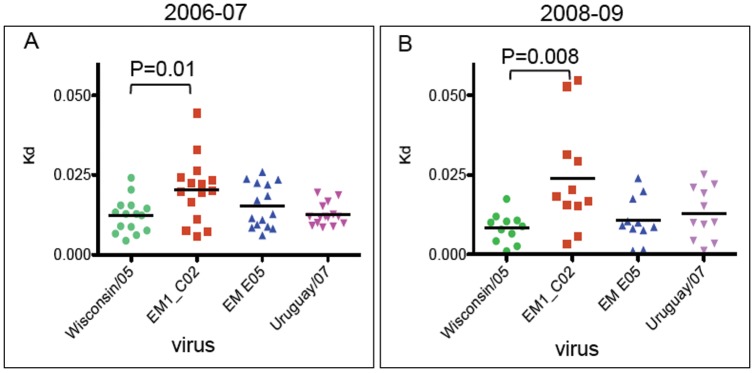
Figure 5. Overall dissociation constants (Kd) of antibodies in human plasma after vaccination.
Kd of antibodies in season 2006–2007 (A) and season 2008–2009 (B). Plasma samples were tested against H3 vaccine viruses A/Wisconsin/67/05 (2006–2007 vaccine) and A/Uruguay/716/07 (2008–2009) and against escape mutant viruses EM 1_C02, EM E05. The median Kd is represented by a horizontal bar, and the p values are from the Student's T test.

References

    1. Fiore AE, Uyeki TM, Broder K, Finelli L, Euler GL, et al. Prevention and control of influenza with vaccines: recommendations of the Advisory Committee on Immunization Practices (ACIP), 2010. MMWR Recommendations and reports : Morbidity and mortality weekly report Recommendations and reports/Centers for Disease Control. 2010;59:1–62. - PubMed
    1. Tong S, Li Y, Rivailler P, Conrardy C, Castillo DA, et al. A distinct lineage of influenza A virus from bats. Proc Natl Acad Sci U S A. 2012;109:4269–4274. - PMC - PubMed
    1. Skehel JJ, Wiley DC. Receptor binding and membrane fusion in virus entry: the influenza hemagglutinin. Annu Rev Biochem. 2000;69:531–569. - PubMed
    1. Gerhard W, Webster RG. Antigenic drift in influenza A viruses. I. Selection and characterization of antigenic variants of A/PR/8/34 (HON1) influenza virus with monoclonal antibodies. J Exp Med. 1978;148:383–392. - PMC - PubMed
    1. Webster RG, Laver WG. Determination of the number of nonoverlapping antigenic areas on Hong Kong (H3N2) influenza virus hemagglutinin with monoclonal antibodies and the selection of variants with potential epidemiological significance. Virology. 1980;104:139–148. - PubMed

Publication types

MeSH terms