


Risk factors for onset of hypothermia in trauma victims: the HypoTraum study
- PMID: 22849694
- PMCID: PMC3580728
- DOI: 10.1186/cc11449
Risk factors for onset of hypothermia in trauma victims: the HypoTraum study
Abstract
Introduction: Hypothermia is common in trauma victims and is associated with an increase in mortality. Its causes are not well understood. Our objective was to identify the factors influencing the onset of hypothermia during pre-hospital care of trauma victims.
Methods: This was a multicenter, prospective, open, observational study in a pre-hospital setting.
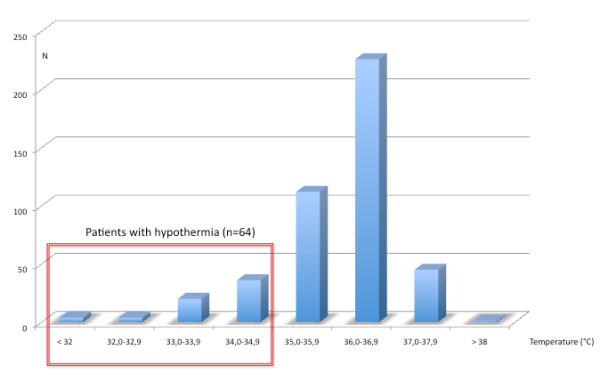
Results: A total of 448 patients were included. Hypothermia (<35 °C) on hospital arrival was present in 64/448 patients (14%). Significant factors associated with the absence of hypothermia in a multivariate analysis were no intubation: Odds Ratio: 4.23 (95% confidence interval 1.62 to 1.02); RTS: 1.68 (1.29 to 2.20); mobile unit temperature: 1.20 (1.04 to 1.38); infusion fluid temperature: 1.17 (1.05 to 1.30); patient not unclothed: 0.40 (0.18 to 0.90); and no head injury: 0.36 (0.16 to 0.83).
Conclusions: The key risk factor for the onset of hypothermia was the severity of injury but environmental conditions and the medical care provided by EMS were also significant factors. Changes in practice could help reduce the impact of factors such as infusion fluid temperature and mobile unit temperature.
Figures
Comment in
-
Hypothermia in trauma patients: predicting the big chill.Crit Care. 2012 Sep 21;16(5):155. doi: 10.1186/cc11473. Crit Care. 2012. PMID: 23134653 Free PMC article.
References
-
- Beilman GJ, Blondet JJ, Nelson TR, Nathens AB, Moore FA, Rhee P, Puyana JC, Moore EE, Cohn SM. Early hypothermia in severely injured trauma patients is a significant risk factor for multiple organ dysfunction syndrome but not mortality. Ann Surg. 2009;249:845–850. doi: 10.1097/SLA.0b013e3181a41f6f. - DOI - PubMed
Publication types
MeSH terms
LinkOut - more resources
Full Text Sources
Medical
