


Prevalence of anal incontinence among Norwegian women: a cross-sectional study
- PMID: 22850167
- PMCID: PMC4400729
- DOI: 10.1136/bmjopen-2012-001257
Prevalence of anal incontinence among Norwegian women: a cross-sectional study
Erratum in
-
Correction.BMJ Open. 2012 Sep 27;2(5):e001257corr1. doi: 10.1136/bmjopen-2012-001257corr1. Print 2012. BMJ Open. 2012. PMID: 23019209 Free PMC article. No abstract available.
Abstract
Objective: Anal incontinence (AI) is a symptom associated with age, bowel symptoms and obstetric injuries. Primary aim of the study was to establish the prevalence of AI among women and secondarily to evaluate the impact on daily life and conditions associated with AI.
Design: A cross-sectional study.
Setting: Participants attended research stations located in different parts of Nord-Trøndelag county, Norway. Data were collected through interviews, questionnaires and clinical examinations.
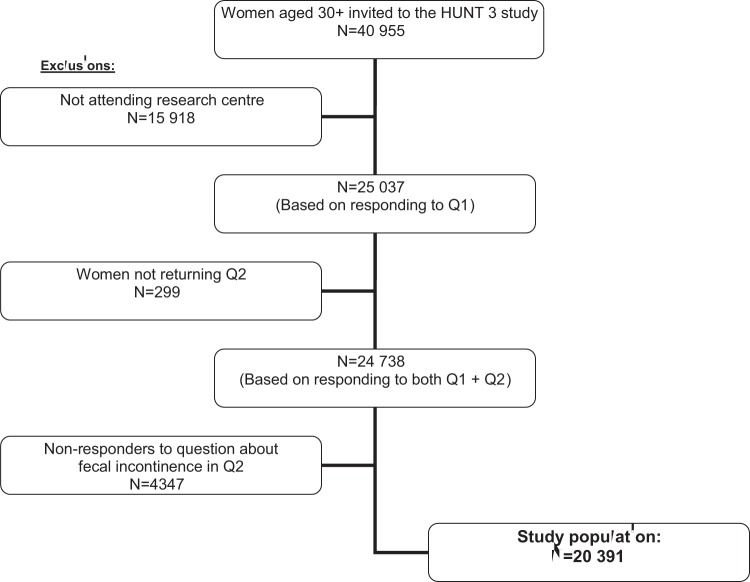
Participants: In total, 40 955 community-dwelling women aged 30 years and older were invited. A total of 25 037 women participated, giving a participation rate of 61.1%.
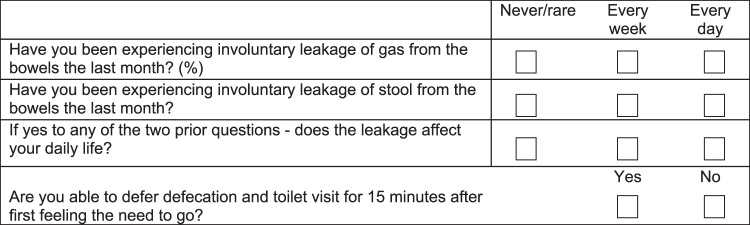
Primary and secondary outcome measures: Fecal incontinence and flatal incontinence was defined as involuntary loss of feces and flatus weekly or more, respectively. AI was defined as the involuntary loss of feces and/or flatus weekly or more. Urgency was defined as the inability to defer defecation for 15 min. Statistical methods included prevalence estimates and logistic regression analysis.
Results: Questions about AI were completed by 20 391 (82.4%) women. Among the 20 391 women, AI was reported by 19.1% (95% CI 18.6% to 19.7%) and fecal incontinence was reported by 3.0% (95% CI 2.8% to 3.2%). Urgency was experienced by 2586 women (12.7%, 95% CI 12.2 to 13.1). Impact on daily life was stated by 794 (26.0%, 95% CI 24.4 to 27.5) women with AI. In bivariate age-adjusted analysis of AI, OR and CI for urgency (OR 3.19, 95% CI 2.92 to 3.49) and diarrhoea (OR 3.81, 95% CI 3.32 to 4.38) revealed strongest associations with AI.
Conclusions: AI affects one in five women older than 30 years. Strongest associated symptoms are urgency and diarrhoea.
Trial registration number: The study was approved by the Regional Committee for Medical and Health Research Ethics (No. 2009/1214) and followed the Declaration of Helsinki.
Conflict of interest statement
Figures
References
-
- Bharucha A. Fecal incontinence. Gastroenterology 2003;124:1672–85. - PubMed
-
- Bharucha A, Zinsmeister A, Locke G, et al. Symptoms and quality of life in community women with faecal incontinence. Clin Gastroenterol Hepatol 2006;4:1004–9. - PubMed
-
- Bharucha A, Zinsmeister A, Locke GR, et al. Risk factors for fecal incontinence: a population-based study in women. Am J Gastroenterol 2006;101:1305–12. - PubMed
-
- Goode PS, Burgio KL, Halli AD, et al. Prevalence and correlates of fecal incontinence in community-dwelling older adults. J Am Geriatr Soc 2005;53:629–35. - PubMed
LinkOut - more resources
Full Text Sources
