Antimicrobial peptides and nitric oxide production by neutrophils from periodontitis subjects
- PMID: 22850872
- PMCID: PMC3854147
- DOI: 10.1590/s0100-879x2012007500123
Antimicrobial peptides and nitric oxide production by neutrophils from periodontitis subjects
Abstract
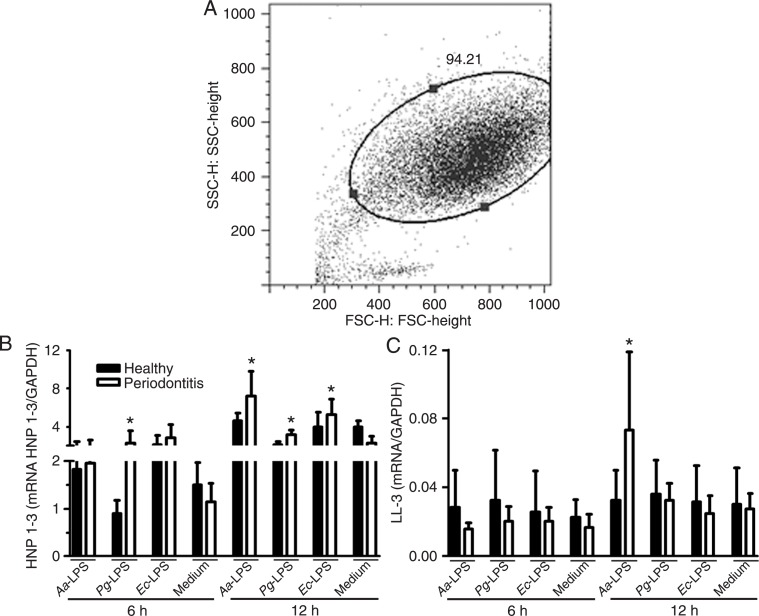
Neutrophils play an important role in periodontitis by producing nitric oxide (NO) and antimicrobial peptides, molecules with microbicidal activity via oxygen-dependent and -independent mechanisms, respectively. It is unknown whether variation in the production of antimicrobial peptides such as LL-37, human neutrophil peptides (HNP) 1-3, and NO by neutrophils influences the pathogenesis of periodontal diseases. We compared the production of these peptides and NO by lipopolysaccharide (LPS)-stimulated neutrophils isolated from healthy subjects and from patients with periodontitis. Peripheral blood neutrophils were cultured with or without Aggregatibacter actinomycetemcomitans-LPS (Aa-LPS), Porphyromonas gingivalis-LPS (Pg-LPS) and Escherichia coli-LPS (Ec-LPS). qRT-PCR was used to determine quantities of HNP 1-3 and LL-37 mRNA in neutrophils. Amounts of HNP 1-3 and LL-37 proteins in the cell culture supernatants were also determined by ELISA. In addition, NO levels in neutrophil culture supernatants were quantitated by the Griess reaction. Neutrophils from periodontitis patients cultured with Aa-LPS, Pg-LPS and Ec-LPS expressed higher HNP 1-3 mRNA than neutrophils from healthy subjects. LL-37 mRNA expression was higher in neutrophils from patients stimulated with Aa-LPS. Neutrophils from periodontitis patients produced significantly higher LL-37 protein levels than neutrophils from healthy subjects when stimulated with Pg-LPS and Ec-LPS, but no difference was observed in HNP 1-3 production. Neutrophils from periodontitis patients cultured or not with Pg-LPS and Ec-LPS produced significantly lower NO levels than neutrophils from healthy subjects. The significant differences in the production of LL-37 and NO between neutrophils from healthy and periodontitis subjects indicate that production of these molecules might influence individual susceptibility to important periodontal pathogens.
Figures


References
-
- Lundy FT, Orr DF, Shaw C, Lamey PJ, Linden GJ. Detection of individual human neutrophil alpha-defensins (human neutrophil peptides 1, 2 and 3) in unfractionated gingival crevicular fluid - a MALDI-MS approach. Mol Immunol. 2005;42:575–579. - PubMed
-
- Trevani AS, Chorny A, Salamone G, Vermeulen M, Gamberale R, Schettini J, et al. Bacterial DNA activates human neutrophils by a CpG-independent pathway. Eur J Immunol. 2003;33:3164–3174. - PubMed
-
- Sosroseno W, Herminajeng E. The role of macrophages in the induction of murine immune response to Actinobacillus actinomycetemcomitans. J Med Microbiol. 2002;51:581–588. - PubMed
-
- Remer KA, Brcic M, Jungi TW. Toll-like receptor-4 is involved in eliciting an LPS-induced oxidative burst in neutrophils. Immunol Lett. 2003;85:75–80. - PubMed
-
- Kinane DF, Demuth DR, Gorr SU, Hajishengallis GN, Martin MH. Human variability in innate immunity. Periodontol 2000. 2007;45:14–34. - PubMed
Publication types
MeSH terms
Substances
LinkOut - more resources
Full Text Sources