


Review
doi: 10.1172/JCI60519.
Epub 2012 Aug 1.
Building and maintaining the epithelium of the lung
Affiliations
- PMID: 22850882
- PMCID: PMC3408736
- DOI: 10.1172/JCI60519
Item in Clipboard
Review
Building and maintaining the epithelium of the lung
J Clin Invest.
2012 Aug.
Abstract
Airspaces of the lung are lined by an epithelium whose cellular composition changes along the proximal-to-distal axis to meet local functional needs for mucociliary clearance, hydration, host defense, and gas exchange. Advances in cell isolation, in vitro culture techniques, and genetic manipulation of animal models have increased our understanding of the development and maintenance of the pulmonary epithelium. This review discusses basic cellular mechanisms that regulate establishment of the conducting airway and gas exchange systems as well as the functional maintenance of the epithelium during postnatal life.
Figures
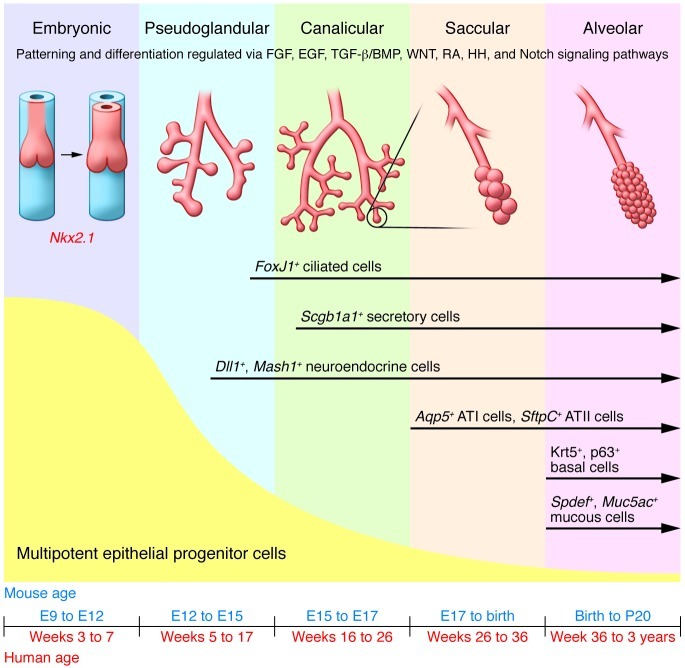
The epithelium is initially composed of multipotent progenitor cells that proliferate and differentiate through development to yield more restricted, differentiated progeny that make up the developed lung epithelium. Signaling pathways that maintain the multipotent progenitor pool are indicated. HH, hedgehog; RA, retinoic acid.
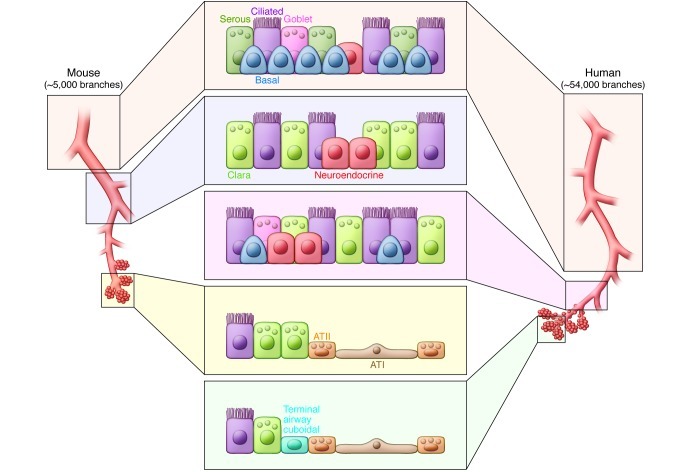
Within the mouse lung, basal cells are restricted to the tracheobronchial epithelium, which is also populated with secretory, ciliated, and neuroendocrine cells to form a pseudostratified epithelium. Beyond the most proximal bronchi, the airway of the mouse is composed of a simple columnar epithelium that consists of secretory, ciliated, and neuroendocrine cells. In human lungs basal cells are present in diminishing numbers all the way to the level of terminal bronchiole. Respiratory bronchioles are lined by a poorly characterized cuboidal epithelium that leads to the alveolar compartment lined with ATI and ATII cells. Putative progenitor cells have been identified using in vivo lineage-tracing experiments (Clara and basal cells) or proposed based on their capacity to proliferate and differentiate in culture (Clara, basal, and ATII cells). The epithelium of the mouse trachea and proximal bronchi is maintained by airway basal cells (39, 78). Within the bronchiolar region, a population of Clara cell secretory protein–expressing (CCSP-expressing) cells localized the neuroepithelial body in the proximal bronchiole and a population of naphthalene-resistant CCSP-expressing cells from the distal bronchiole of the mouse serve to regenerate their respective regional epithelia following cell-specific injury (66, 67). BASCs, at the bronchioalveolar duct junction, have been suggested to serve as progenitors with the capacity to renew both the bronchiolar and alveolar epithelium (68). Finally, it has been long believed that ATII cells serve as the progenitors that maintain the alveolar epithelium (73).
References
-
- Schum M, Yeh HC. Theoretical evaluation of aerosol deposition in anatomical models of mammalian lung airways. Bull Math Biol. 1980;42(1):1–15. - PubMed
Publication types
MeSH terms
Grants and funding
LinkOut - more resources
Full Text Sources
Other Literature Sources
