


A short polybasic segment between the two conserved domains of the β2a-subunit modulates the rate of inactivation of R-type calcium channel
- PMID: 22851179
- PMCID: PMC3463332
- DOI: 10.1074/jbc.M112.362509
A short polybasic segment between the two conserved domains of the β2a-subunit modulates the rate of inactivation of R-type calcium channel
Abstract
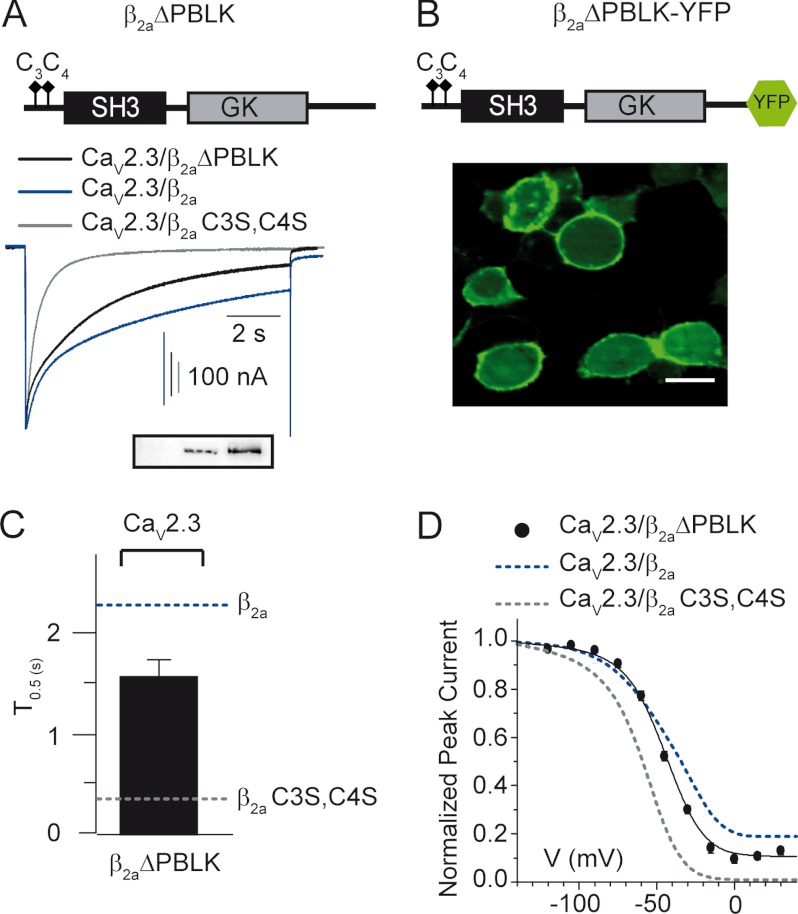
Besides opening and closing, high voltage-activated calcium channels transit to a nonconducting inactivated state from which they do not re-open unless the plasma membrane is repolarized. Inactivation is critical for temporal regulation of intracellular calcium signaling and prevention of a deleterious rise in calcium concentration. R-type high voltage-activated channels inactivate fully in a few hundred milliseconds when expressed alone. However, when co-expressed with a particular β-subunit isoform, β(2a), inactivation is partial and develops in several seconds. Palmitoylation of a unique di-cysteine motif at the N terminus anchors β(2a) to the plasma membrane. The current view is that membrane-anchored β(2a) immobilizes the channel inactivation machinery and confers slow inactivation phenotype. β-Subunits contain one Src homology 3 and one guanylate kinase domain, flanked by variable regions with unknown structures. Here, we identified a short polybasic segment at the boundary of the guanylate kinase domain that slows down channel inactivation without relocating a palmitoylation-deficient β(2a) to the plasma membrane. Substitution of the positively charged residues within this segment by alanine abolishes its slow inactivation-conferring phenotype. The linker upstream from the polybasic segment, but not the N- and C-terminal variable regions, masks the effect of this determinant. These results reveal a novel mechanism for inhibiting voltage-dependent inactivation of R-type calcium channels by the β(2a)-subunit that might involve electrostatic interactions with an unknown target on the channel's inactivation machinery or its modulatory components. They also suggest that intralinker interactions occlude the action of the polybasic segment and that its functional availability is regulated by the palmitoylated state of the β(2a)-subunit.
Figures



References
-
- Clapham D. E. (2007) Calcium signaling. Cell 131, 1047–1058 - PubMed
-
- Catterall W. A. (2000) Structure and regulation of voltage-gated Ca2+ channels. Annu. Rev. Cell Dev. Biol. 16, 521–555 - PubMed
-
- Cens T., Rousset M., Leyris J. P., Fesquet P., Charnet P. (2006) Voltage- and calcium-dependent inactivation in high voltage-gated Ca2+ channels. Prog. Biophys. Mol. Biol. 90, 104–117 - PubMed
-
- Liang H., DeMaria C. D., Erickson M. G., Mori M. X., Alseikhan B. A., Yue D. T. (2003) Unified mechanisms of Ca2+ regulation across the Ca2+ channel family. Neuron 39, 951–960 - PubMed
Publication types
MeSH terms
Substances
LinkOut - more resources
Full Text Sources
Miscellaneous
