


Has highly active antiretroviral therapy increased the time to seroreversion in HIV exposed but uninfected children?
- PMID: 22851494
- PMCID: PMC4990822
- DOI: 10.1093/cid/cis662
Has highly active antiretroviral therapy increased the time to seroreversion in HIV exposed but uninfected children?
Abstract
Background: Since the introduction of highly active antiretroviral therapy (HAART) for prevention of mother-to-child transmission of human immunodeficiency virus (HIV) in pregnancy in the United States, the time of seroreversion in infants born to HIV-infected mothers has not been documented. The objective of this study was to determine the timing of clearance of HIV antibodies and to identify any associated biological and clinical factors.
Methods: A retrospective analysis of infants who remained uninfected after perinatal HIV exposure was performed. Infant and maternal medical records from January 2000 to December 2007 were reviewed and the time of seroreversion was estimated using methods for censored survival data.
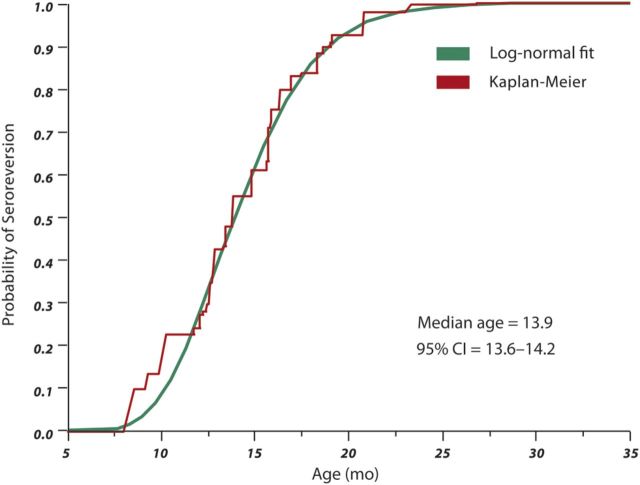
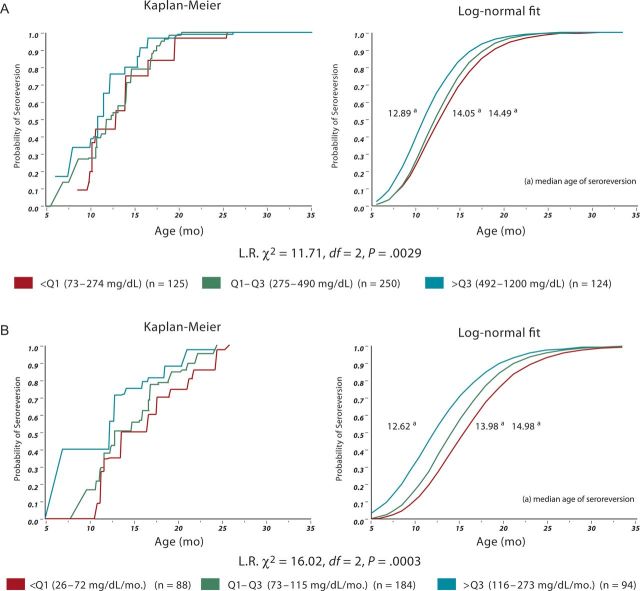
Results: In total, 744 infants were included in the study, with prenatal data available for 551 mothers. The median age of seroreversion was 13.9 months, and 14% of infants remained seropositive after 18 months, 4.3% after 21 months, and 1.2% after 24 months. Earlier age of seroreversion was associated with higher immunoglobulin G (IgG) levels at 3-7 months of age (P = .0029) and a higher rate of IgG change over the next 6 months of life (P = .003). Infants born by vaginal delivery were more likely to serorevert at a younger age (P = .0052), and maternal exposure to protease inhibitors was associated with a later age of seroreversion (P = .026).
Conclusions: Clearance of HIV antibodies in uninfected infants was found to occur at a later age than has been previously reported. Fourteen percent of the infants had persistence of HIV antibodies at or beyond 18 months of age.
Figures
References
-
- Centers for Disease Control and Prevention. Reduction in perinatal transmission of HIV infection—United States, 1985–2005. MMWR Morb Mortal Wkly Rep. 2006;55:592–7. - PubMed
-
- Creek T, Sherman G, Nkengasong J. Infant human immunodeficiency virus diagnosis in resource-limited settings: issues, technologies, and country experiences. Am J Obstet Gynecol. 2007;197(3 suppl):S64–71. - PubMed
-
- Centers for Disease Control and Prevention. HIV surveillance report, 2010. Published March. 2012 Available at: http://www.cdc.gov/hiv/topics/surveillance/reports/ Accessed April 2012.
-
- Panel on Antiretroviral Therapy and Medical Management of HIV-Infected Children. Guidelines for the use of antiretroviral agents in pediatric HIV infection. 16 August 2010. Available at: http://aidsinfo.nih.gov/ContentFiles/PediatricGuidelines.pdf. Accessed on 10 June 2011.
-
- European Collaborative Study. Mother-to-child transmission of HIV infection. Lancet. 1988;332:1039–43. - PubMed
MeSH terms
Substances
Grants and funding
LinkOut - more resources
Full Text Sources
Other Literature Sources
Medical
