Maternal efficacy and safety outcomes in a randomized, controlled trial comparing insulin detemir with NPH insulin in 310 pregnant women with type 1 diabetes
- PMID: 22851598
- PMCID: PMC3447831
- DOI: 10.2337/dc11-2264
Maternal efficacy and safety outcomes in a randomized, controlled trial comparing insulin detemir with NPH insulin in 310 pregnant women with type 1 diabetes
Abstract
Objective: This randomized, controlled noninferiority trial aimed to compare the efficacy and safety of insulin detemir (IDet) versus neutral protamine Hagedorn (NPH) (both with prandial insulin aspart) in pregnant women with type 1 diabetes.
Research design and methods: Patients were randomized and exposed to IDet or NPH up to 12 months before pregnancy or at 8-12 weeks gestation. The primary analysis aimed to demonstrate noninferiority of IDet to NPH with respect to A1C at 36 gestational weeks (GWs) (margin of 0.4%). The data were analyzed using linear regression, taking several baseline factors and covariates into account.
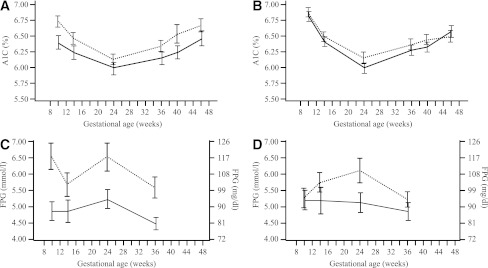
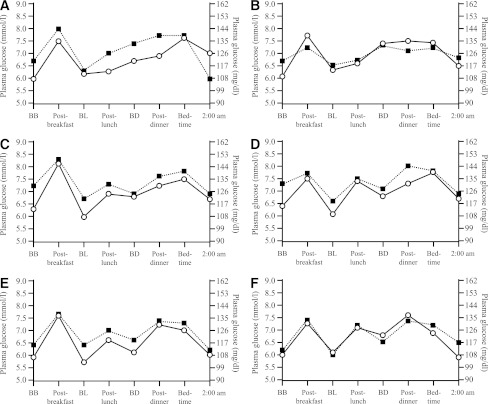
Results: A total of 310 type 1 diabetic women were randomized and exposed to IDet (n = 152) or NPH (n = 158) up to 12 months before pregnancy (48%) or during pregnancy at 8-12 weeks (52%). The estimated A1C at 36 GWs was 6.27% for IDet and 6.33% for NPH in the full analysis set (FAS). IDet was declared noninferior to NPH (FAS, -0.06% [95% CI -0.21 to 0.08]; per protocol, -0.15% [-0.34 to 0.04]). Fasting plasma glucose (FPG) was significantly lower with IDet versus NPH at both 24 GWs (96.8 vs. 113.8 mg/dL, P = 0.012) and 36 GWs (85.7 vs. 97.4 mg/dL, P = 0.017). Major and minor hypoglycemia rates during pregnancy were similar between groups.
Conclusions: Treatment with IDet resulted in lower FPG and noninferior A1C in late pregnancy compared with NPH insulin. Rates of hypoglycemia were comparable.
Figures
Comment in
-
Insulin detemir in pregnancy: a small but significant step forward?Diabetes Care. 2012 Oct;35(10):1968-9. doi: 10.2337/dc12-0971. Diabetes Care. 2012. PMID: 22996181 Free PMC article. No abstract available.
References
-
- Mathiesen ER, Damm P, Jovanovič L, et al. Basal insulin analogues in diabetic pregnancy: a literature review and baseline results of a randomised, controlled trial in type 1 diabetes. Diabetes Metab Res Rev 2011;27:543–551 - PubMed
-
- Mathiesen ER, Kinsley B, Amiel SA, et al. Insulin Aspart Pregnancy Study Group Maternal glycemic control and hypoglycemia in type 1 diabetic pregnancy: a randomized trial of insulin aspart versus human insulin in 322 pregnant women. Diabetes Care 2007;30:771–776 - PubMed
-
- Hod M, Damm P, Kaaja R, Visser GH, Dunne F, Demidova I, et al. Insulin Aspart Pregnancy Study Group. Fetal and perinatal outcomes in type 1 diabetes pregnancy: a randomized study comparing insulin aspart with human insulin in 322 subjects. Am J Obstet Gynecol 2008;198:186.e1–e7 - PubMed
-
- Hermansen K, Fontaine P, Kukolja KK, Peterkova V, Leth G, Gall MA. Insulin analogues (insulin detemir and insulin aspart) versus traditional human insulins (NPH insulin and regular human insulin) in basal-bolus therapy for patients with type 1 diabetes. Diabetologia 2004;47:622–629 - PubMed
-
- Bartley PC, Bogoev M, Larsen J, Philotheou A. Long-term efficacy and safety of insulin detemir compared to neutral protamine Hagedorn insulin in patients with type 1 diabetes using a treat-to-target basal-bolus regimen with insulin aspart at meals: a 2-year, randomized, controlled trial. Diabet Med 2008;25:442–449 - PMC - PubMed
Publication types
MeSH terms
Substances
LinkOut - more resources
Full Text Sources
Medical
Research Materials
Miscellaneous