


Case Reports
doi: 10.1161/HYPERTENSIONAHA.112.196774.
Epub 2012 Jul 30.
Management of antiangiogenic therapy-induced hypertension
Affiliations
- PMID: 22851729
- PMCID: PMC3421063
- DOI: 10.1161/HYPERTENSIONAHA.112.196774
Item in Clipboard
Case Reports
Management of antiangiogenic therapy-induced hypertension
Hypertension.
2012 Sep.
No abstract available
Figures
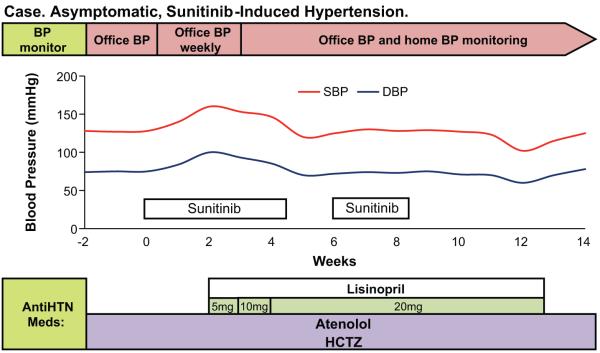
Blood pressure monitoring and therapeutic interventions in a 56 years old male patient with metastatic renal cell carcinoma treated with sunitinib who developed asymptomatic hypertension after sunitinib therapy was started.
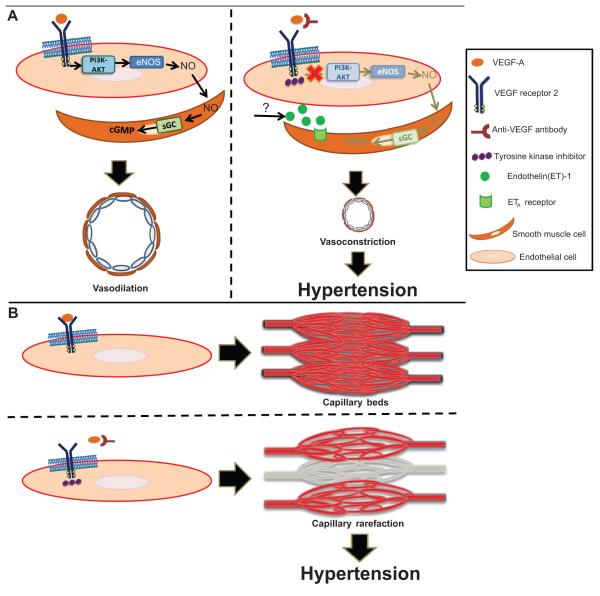
Proposed mechanisms leading to VEGF signaling pathway inhibitor-induced hypertension. a) Activation of VEGFR-2 by VEGF-A leads to subsequent activation of multiple pathways including phosphatidylinositol-3-kinase (PI3K)-AKT. PI3K-AKT phosphorylates and activates endothelial nitric oxide synthase (eNOS), increasing NO production. NO migrates to adjacent vascular smooth muscle cells, binds soluble guanylate cyclase (sGC) leading to cGMP generation and subsequent vasodilation mediated by cGMP-dependent kinases. When VEGF signaling pathway is inhibited, NO pathway is suppressed and ET-1 pathway is stimulated, promoting vasoconstriction and subsequent hypertension. The source of ET-1 is unknown. b) VEGF maintains capillary network integrity. When VEGF signaling pathway is inhibited, rarefaction, or reduction of the density of capillary beds, may occur.
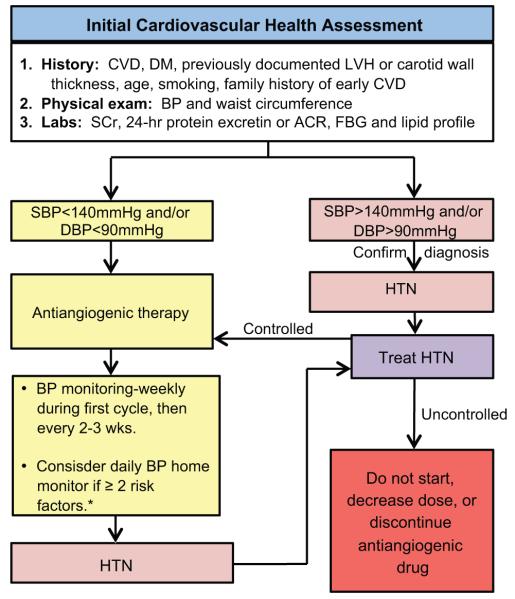
Initial cardiovascular evaluation and monitoring of blood pressure in candidates for antinagiogenic therapy. CVD, cardiovascular disease; DM, diabetes mellitus; LVH, left ventricular hypertrophy; BP, blood pressure; SCr, serum creatinine; ACR, albumin to creatinine ratio; FBG, fasting blood glucose; SBP, systolic blood pressure; DBP, diastolic blood pressure; HTN, hypertension.
Similar articles
-
Sunitinib as adjuvant therapy for renal cell carcinoma.Lancet Oncol. 2016 Nov;17(11):e485. doi: 10.1016/S1470-2045(16)30511-3. Epub 2016 Oct 20. Lancet Oncol. 2016. PMID: 27773485 No abstract available.
-
Tumour lysis syndrome in a patient with renal-cell carcinoma treated with sunitinib malate.Lancet. 2007 Jun 9;369(9577):1923-4. doi: 10.1016/S0140-6736(07)60903-9. Lancet. 2007. PMID: 17560435 No abstract available.
-
Aortic dissection in a patient treated by sunitinib for metastatic renal cell carcinoma.Ann Oncol. 2010 Jan;21(1):186-7. doi: 10.1093/annonc/mdp480. Epub 2009 Oct 29. Ann Oncol. 2010. PMID: 19875754 No abstract available.
-
Reversible posterior leucoencephalopathy syndrome in an elderly male on sunitinib therapy.Br J Clin Pharmacol. 2011 May;71(5):777-9. doi: 10.1111/j.1365-2125.2010.03893.x. Br J Clin Pharmacol. 2011. PMID: 21480952 Free PMC article. Review.
-
Sunitinib malate for the treatment of renal cell carcinoma.Expert Opin Pharmacother. 2012 Jun;13(9):1323-36. doi: 10.1517/14656566.2012.689130. Expert Opin Pharmacother. 2012. PMID: 22607009 Review.
Cited by
-
Mechanism and Management of Cancer Chemotherapy-Induced Atherosclerosis.J Atheroscler Thromb. 2018 Oct 1;25(10):994-1002. doi: 10.5551/jat.RV17027. Epub 2018 Sep 14. J Atheroscler Thromb. 2018. PMID: 30224607 Free PMC article. Review.
-
Novel insights into cardiovascular toxicity of cancer targeted and immune therapies: Beyond ischemia with non-obstructive coronary arteries (INOCA).Am Heart J Plus. 2024 Mar 1;40:100374. doi: 10.1016/j.ahjo.2024.100374. eCollection 2024 Apr. Am Heart J Plus. 2024. PMID: 38510501 Free PMC article.
-
Anti-VEGF-Induced Hypertension: a Review of Pathophysiology and Treatment Options.Curr Treat Options Cardiovasc Med. 2016 May;18(5):33. doi: 10.1007/s11936-016-0452-z. Curr Treat Options Cardiovasc Med. 2016. PMID: 26932588
-
CDK4/6 inhibitors: basics, pros, and major cons in breast cancer treatment with specific regard to cardiotoxicity - a narrative review.Ther Adv Med Oncol. 2023 Oct 11;15:17588359231205848. doi: 10.1177/17588359231205848. eCollection 2023. Ther Adv Med Oncol. 2023. PMID: 37841752 Free PMC article. Review.
-
Mechanisms Underlying Vascular Endothelial Growth Factor Receptor Inhibition-Induced Hypertension: The HYPAZ Trial.Hypertension. 2021 May 5;77(5):1591-1599. doi: 10.1161/HYPERTENSIONAHA.120.16454. Epub 2021 Mar 29. Hypertension. 2021. PMID: 33775123 Free PMC article. Clinical Trial.
References
-
- Motzer RJ, Hutson TE, Tomczak P, Michaelson MD, Bukowski RM, Rixe O, Oudard S, Negrier S, Szczylik C, Kim ST, Chen I, Bycott PW, Baum CM, Figlin RA. Sunitinib versus interferon alfa in metastatic renal-cell carcinoma. N Engl J Med. 2007;356:115–124. - PubMed
-
- Escudier B, Eisen T, Stadler WM, Szczylik C, Oudard S, Siebels M, Negrier S, Chevreau C, Solska E, Desai AA, Rolland F, Demkow T, Hutson TE, Gore M, Freeman S, Schwartz B, Shan M, Simantov R, Bukowski RM. Sorafenib in advanced clear-cell renal-cell carcinoma. N Engl J Med. 2007;356:125–134. - PubMed
-
- Wu S, Chen JJ, Kudelka A, Lu J, Zhu X. Incidence and risk of hypertension with sorafenib in patients with cancer: A systematic review and meta-analysis. Lancet Oncol. 2008;9:117–123. - PubMed
Publication types
MeSH terms
Substances
Grants and funding
LinkOut - more resources
Full Text Sources
Medical
