


Developing Targeted Health Service Interventions Using the PRECEDE-PROCEED Model: Two Australian Case Studies
- PMID: 22852076
- PMCID: PMC3407641
- DOI: 10.1155/2012/279431
Developing Targeted Health Service Interventions Using the PRECEDE-PROCEED Model: Two Australian Case Studies
Abstract
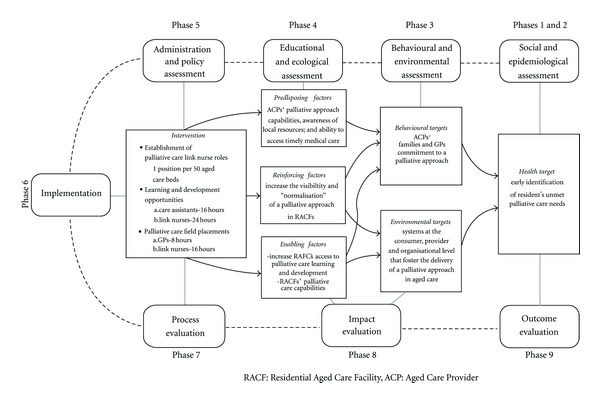
Aims and Objectives. This paper provides an overview of the applicability of the PRECEDE-PROCEED Model to the development of targeted nursing led chronic illness interventions. Background. Changing health care practice is a complex and dynamic process that requires consideration of social, political, economic, and organisational factors. An understanding of the characteristics of the target population, health professionals, and organizations plus identification of the determinants for change are also required. Synthesizing this data to guide the development of an effective intervention is a challenging process. The PRECEDE-PROCEED Model has been used in global health care settings to guide the identification, planning, implementation, and evaluation of various health improvement initiatives. Design. Using a reflective case study approach, this paper examines the applicability of the PRECEDE-PROCEED Model to the development of targeted chronic care improvement interventions for two distinct Australian populations: a rapidly expanding and aging rural population with unmet palliative care needs and a disadvantaged urban community at higher risk of cardiovascular disease. Results. The PRECEDE-PROCEED Model approach demonstrated utility across diverse health settings in a systematic planning process. In environments characterized by increasing health care needs, limited resources, and growing community expectations, adopting planning tools such as PRECEDE-PROCEED Model at a local level can facilitate the development of the most effective interventions. Relevance to Clinical Practice. The PRECEDE-PROCEED Model is a strong theoretical model that guides the development of realistic nursing led interventions with the best chance of being successful in existing health care environments.
Figures
Similar articles
-
Beyond the black stump: rapid reviews of health research issues affecting regional, rural and remote Australia.Med J Aust. 2020 Dec;213 Suppl 11:S3-S32.e1. doi: 10.5694/mja2.50881. Med J Aust. 2020. PMID: 33314144
-
The Experience and Effectiveness of Nurse Practitioners in Orthopaedic Settings: A Comprehensive Systematic Review.JBI Libr Syst Rev. 2012;10(42 Suppl):1-22. doi: 10.11124/jbisrir-2012-249. JBI Libr Syst Rev. 2012. PMID: 27820153
-
The Effectiveness of Integrated Care Pathways for Adults and Children in Health Care Settings: A Systematic Review.JBI Libr Syst Rev. 2009;7(3):80-129. doi: 10.11124/01938924-200907030-00001. JBI Libr Syst Rev. 2009. PMID: 27820426
-
Effect of the PRECEDE-PROCEED model on health programs: a systematic review and meta-analysis.Syst Rev. 2022 Oct 9;11(1):213. doi: 10.1186/s13643-022-02092-2. Syst Rev. 2022. PMID: 36210473 Free PMC article.
-
Reducing unplanned hospital admissions from care homes: a systematic review.Health Soc Care Deliv Res. 2023 Oct;11(18):1-130. doi: 10.3310/KLPW6338. Health Soc Care Deliv Res. 2023. PMID: 37916580
Cited by
-
Malaria preventive behaviors among housewives in suburbs of Bandar-Abbas City, south of Iran: interventional design based on PRECEDE model.Pathog Glob Health. 2019 Feb;113(1):32-38. doi: 10.1080/20477724.2019.1583847. Epub 2019 Feb 20. Pathog Glob Health. 2019. PMID: 30784362 Free PMC article. Clinical Trial.
-
Barriers to HIV Testing: Patient and Provider Perspectives in the Deep South.AIDS Behav. 2019 Apr;23(4):1062-1072. doi: 10.1007/s10461-018-02385-5. AIDS Behav. 2019. PMID: 30607759 Free PMC article.
-
Health needs assessment of workers in Kaveh industrial city.Med J Islam Repub Iran. 2019 Mar 26;33:22. doi: 10.34171/mjiri.33.22. eCollection 2019. Med J Islam Repub Iran. 2019. PMID: 31380312 Free PMC article.
-
Education based on precede-proceed on quality of life in elderly.Glob J Health Sci. 2014 Jul 29;6(6):178-84. doi: 10.5539/gjhs.v6n6p178. Glob J Health Sci. 2014. PMID: 25363108 Free PMC article. Clinical Trial.
-
Student-Led Motivational Interviewing for Physical Activity Promotion among Rural Adults: A Feasibility and Acceptability Trial.Int J Environ Res Public Health. 2021 Feb 1;18(3):1308. doi: 10.3390/ijerph18031308. Int J Environ Res Public Health. 2021. PMID: 33535648 Free PMC article.
References
-
- World Health Organisation. Building Blocks for Action Innovative Care for Chronic Conditions: Global Report. 2002, http://www.who.int/diabetesactiononline/about/icccglobalreport.pdf.
-
- National Health and Hospitals Reform Commission. Final Report of the National Health and Hospitals Reform Commission. Canberra, Australia: Australian Government; 2009. A Healthier Future for all Australians. - PubMed
-
- Chaney JD, Hunt BP, Schultz JW. An examination using the PRECEDE model framework to establish a comprehensive program to prevent school violence. American Journal of Health Studies. 2000;16(4):199–204.
-
- Hawe P. Needs assessment must become more change-focused. Australian and New Zealand Journal of Public Health. 1996;20(5):473–478. - PubMed
LinkOut - more resources
Full Text Sources
