


Using "warm handoffs" to link hospitalized smokers with tobacco treatment after discharge: study protocol of a randomized controlled trial
- PMID: 22853047
- PMCID: PMC3495904
- DOI: 10.1186/1745-6215-13-127
Using "warm handoffs" to link hospitalized smokers with tobacco treatment after discharge: study protocol of a randomized controlled trial
Abstract
Background: Post-discharge support is a key component of effective treatment for hospitalized smokers, but few hospitals provide it. Many hospitals and care settings fax-refer smokers to quitlines for follow-up; however, less than half of fax-referred smokers are successfully contacted and enrolled in quitline services. "Warm handoff" is a novel approach to care transitions in which health care providers directly link patients with substance abuse problems with specialists, using face-to-face or phone transfer. Warm handoff achieves very high rates of treatment enrollment for these vulnerable groups.
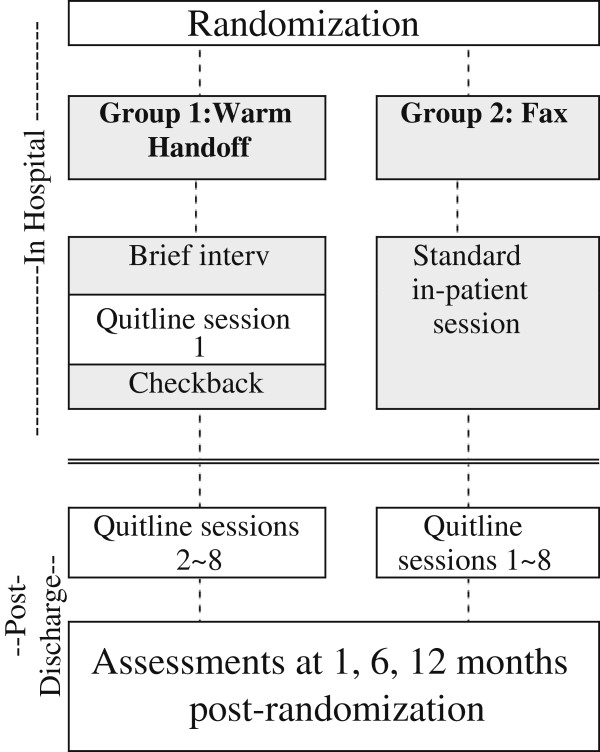
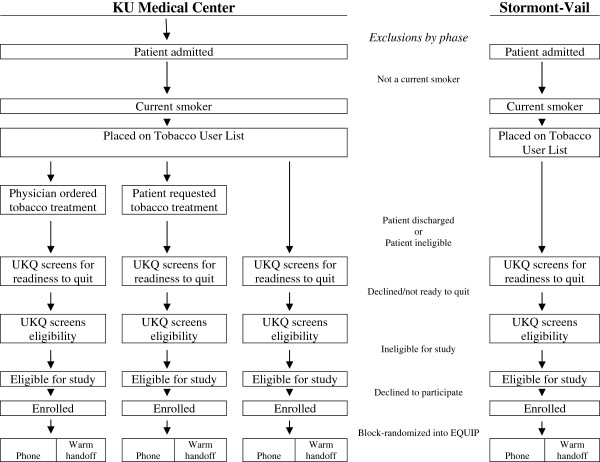
Methods: The aim of this study-"EQUIP" (Enhancing Quitline Utilization among In-Patients)-is to determine the effectiveness, and cost-effectiveness, of warm handoff versus fax referral for linking hospitalized smokers with tobacco quitlines. This study employs a two-arm, individually randomized design. It is set in two large Kansas hospitals that have dedicated tobacco treatment interventionists on staff. At each site, smokers who wish to remain abstinent after discharge will be randomly assigned to groups. For patients in the fax group, staff will provide standard in-hospital intervention and will fax-refer patients to the state tobacco quitline for counseling post-discharge. For patients in the warm handoff group, staff will provide brief in-hospital intervention and immediate warm handoff: staff will call the state quitline, notify them that a warm handoff inpatient from Kansas is on the line, then transfer the call to the patients' mobile or bedside hospital phone for quitline enrollment and an initial counseling session. Following the quitline session, hospital staff provides a brief check-back visit. Outcome measures will be assessed at 1, 6, and 12 months post enrollment. Costs are measured to support cost-effectiveness analyses. We hypothesize that warm handoff, compared to fax referral, will improve care transitions for tobacco treatment, enroll more participants in quitline services, and lead to higher quit rates. We also hypothesize that warm handoff will be more cost-effective from a societal perspective.
Discussion: If successful, this project offers a low-cost solution for more efficiently linking millions of hospitalized smokers with effective outpatient treatment-smokers that might otherwise be lost in the transition to outpatient care.
Trial registration: Clinical Trials Registration NCT01305928.
Figures
References
-
- Rigotti NA, Munafo MR, Stead LF. Interventions for smoking cessation in hospitalised patients. Cochrane Database Syst Rev. 2007;3:CD001837. - PubMed
-
- Stead LF, Perera R, Lancaster T. Telephone counselling for smoking cessation. Cochrane Database Syst Rev. 2006;3:CD002850. - PubMed
-
- Bailey L. An Overview of NAQC. In: National Network of Tobacco Cessation Quitlines -- 2006 Regional Meeting -- Western Region. San Diego, CA; 2006.
Publication types
MeSH terms
Associated data
Grants and funding
LinkOut - more resources
Full Text Sources
Medical
Miscellaneous
