


Common psychiatric disorders and caffeine use, tolerance, and withdrawal: an examination of shared genetic and environmental effects
- PMID: 22854069
- PMCID: PMC3443633
- DOI: 10.1017/thg.2012.25
Common psychiatric disorders and caffeine use, tolerance, and withdrawal: an examination of shared genetic and environmental effects
Abstract
Background: Previous studies examined caffeine use and caffeine dependence and risk for the symptoms, or diagnosis, of psychiatric disorders. The current study aimed to determine if generalized anxiety disorder (GAD), panic disorder, phobias, major depressive disorder (MDD), anorexia nervosa (AN), or bulimia nervosa (BN) shared common genetic or environmental factors with caffeine use, caffeine tolerance, or caffeine withdrawal.
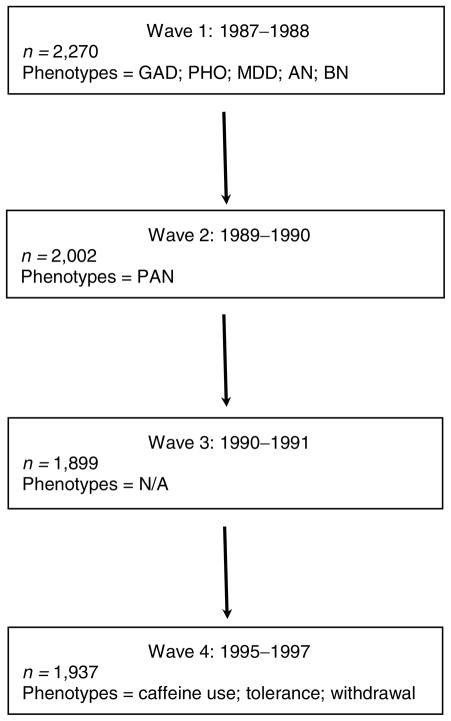
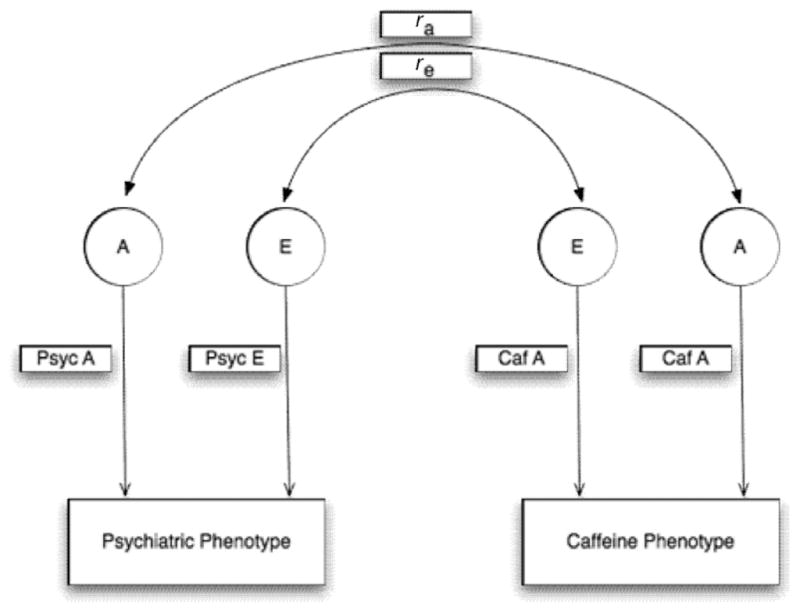
Method: Using 2,270 women from the Virginia Adult Twin Study of Psychiatric and Substance Use Disorders, bivariate Cholesky decomposition models were used to determine if any of the psychiatric disorders shared genetic or environmental factors with caffeine use phenotypes.
Results: GAD, phobias, and MDD shared genetic factors with caffeine use, with genetic correlations estimated to be 0.48, 0.25, and 0.38, respectively. Removal of the shared genetic and environmental parameter for phobias and caffeine use resulted in a significantly worse fitting model. MDD shared unique environmental factors (environmental correlation=0.23) with caffeine tolerance; the genetic correlation between AN and caffeine tolerance and BN and caffeine tolerance were 0.64 and 0.49, respectively. Removal of the genetic and environmental correlation parameters resulted in significantly worse fitting models for GAD, phobias, MDD, AN, and BN, which suggested that there was significant shared liability between each of these phenotypes and caffeine tolerance. GAD had modest genetic correlations with caffeine tolerance, 0.24, and caffeine withdrawal, 0.35.
Conclusions: There was suggestive evidence of shared genetic and environmental liability between psychiatric disorders and caffeine phenotypes. This might inform us about the etiology of the comorbidity between these phenotypes.
Figures
References
-
- Aggen SH, Neale MC, Kendler KS. DSM criteria for major depression: Evaluating symptom patterns using latent-trait item response models. Psychological Medicine. 2005;35:475–487. - PubMed
-
- American Psychiatric Association. Diagnostic and statistical manual of mental disorders. 3. Washington, DC: American Psychiatric Association; 1980.
-
- American Psychiatric Association. Diagnostic and statistical manual for psychiatric disorders. 4. Washington, DC: American Psychiatric Press; 1994. DSM-IV.
-
- Amin N, Byrne E, Johnson J, Chenevix-Trench G, Walter S, Nolte IM, Vink JM, Rawal R, Mangino M, Teumer A, Keers JC, Verwoert G, Baumeister S, Biffar R, Petersmann A, Dahmen N, Doering A, Isaacs A, Broer L, Wray NR, Montgomery GW, Levy D, Psaty BM, Gudnason V, Chakravarti A, Sulem P, Gudbjartsson DF, Kiemeney LA, Thorsteinsdottir U, Stefansson K, van Rooij FJ, Aulchenko YS, Hottenga JJ, Rivadeneira FR, Hofman A, Uitterlinden AG, Hammond CJ, Shin SY, Ikram A, Witteman JC, Janssens AC, Snieder H, Tiemeier H, Wolfenbuttel BH, Oostra BA, Heath AC, Wichmann E, Spector TD, Grabe HJ, Boomsma DI, Martin NG, van Duijn CM. Genome-wide association analysis of coffee drinking suggests association with CYP1A1/CYP1A2 and NRCAM. Moleular Psychiatry. 2011 doi: 10.1038/mp.2011.101. Epub ahead of print. - DOI - PMC - PubMed
