Dexamethasone downregulates the systemic cytokine response in patients with community-acquired pneumonia
- PMID: 22855392
- PMCID: PMC3428389
- DOI: 10.1128/CVI.00423-12
Dexamethasone downregulates the systemic cytokine response in patients with community-acquired pneumonia
Abstract
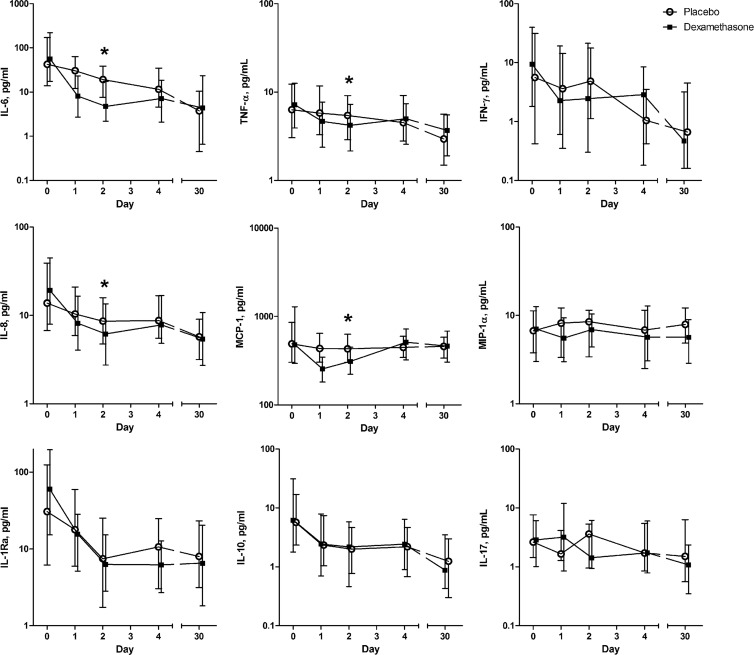
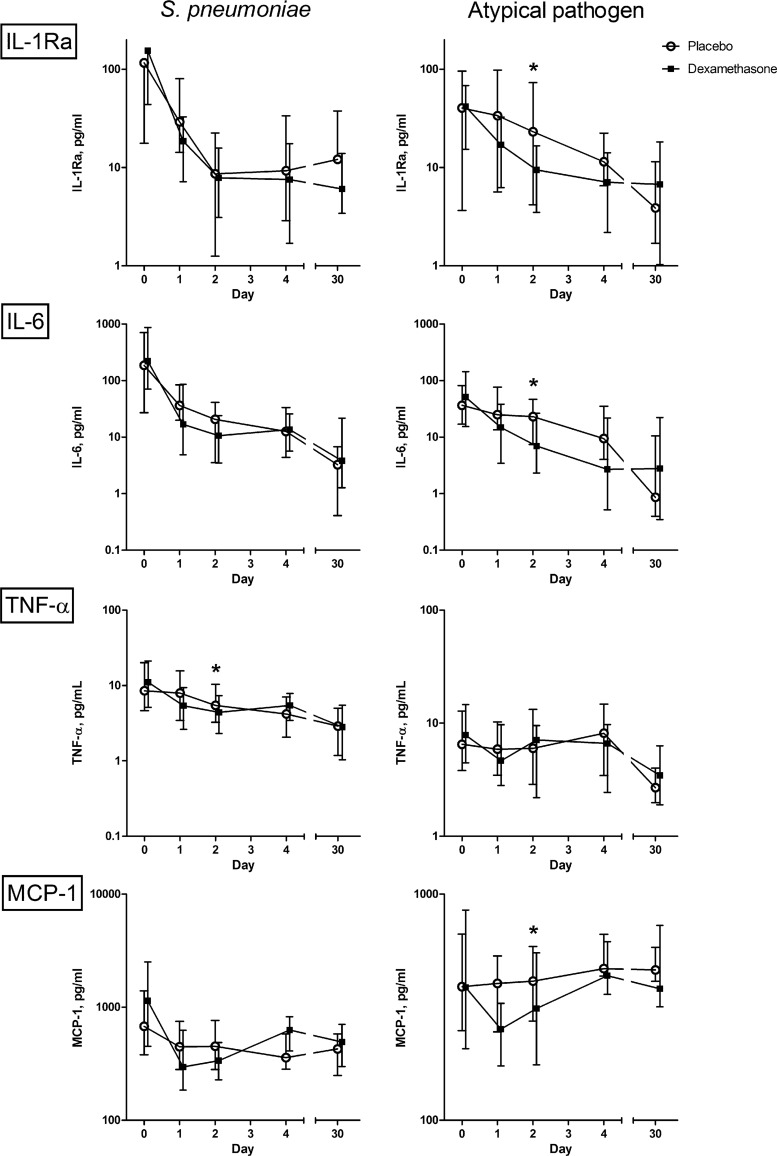
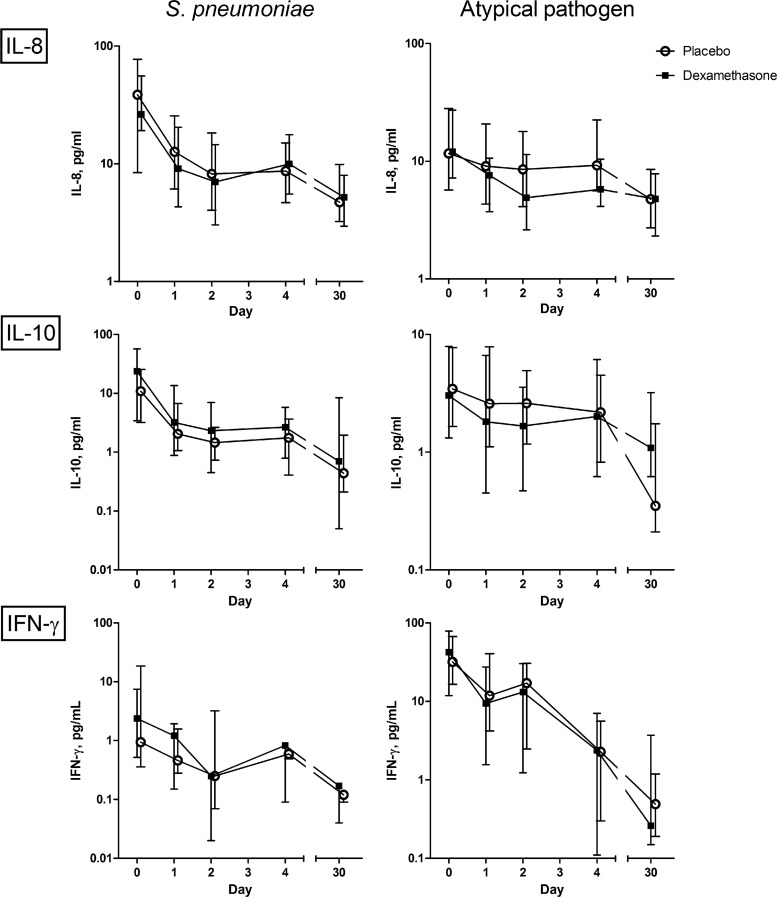
The influence of adjunctive corticosteroids on the cytokine response in community-acquired pneumonia (CAP) is largely unknown. In this study, we analyzed the effect of dexamethasone on the cytokine response in patients with CAP and evaluated whether this effect is dependent on the causative microorganism. We hypothesized that dexamethasone has a larger effect on the cytokine response in patients with pneumococcal pneumonia than in patients with pneumonia caused by an atypical bacterium. A total of 304 hospitalized, nonimmunocompromised patients with CAP were randomized to an adjunctive 4-day course of 5 mg dexamethasone once a day (n = 151) or a placebo (n = 153). Serum concentrations of interleukin-1 receptor antagonist (IL-1Ra), IL-6, IL-8, IL-10, IL-17, tumor necrosis factor alpha (TNF-α), gamma interferon (IFN-γ), macrophage inflammatory protein-1 alpha (MIP-1α), and monocyte chemotactic protein-1 (MCP-1) were measured on days 0, 1, 2, and 4 and at a control visit. Overall, the concentrations of IL-6 (P < 0.01), IL-8 (P < 0.01), MCP-1 (P < 0.01), and TNF-α (P < 0.01) were significantly lower on day 2 in the dexamethasone group than in the placebo group. In patients with pneumococcal pneumonia (n = 72), both treatment groups showed a rapid decrease of cytokine concentrations; only the concentration of TNF-α (P = 0.05) was significantly lower in the dexamethasone group on day 2. In patients with CAP caused by an atypical pathogen (Legionella pneumophila, Chlamydophila species, Coxiella burnetii, or Mycoplasma pneumoniae; n = 58), IL-1Ra (P < 0.01), IL-6 (P < 0.01), and MCP-1 (P = 0.03) decreased more rapidly in the dexamethasone group than in the placebo group. In conclusion, dexamethasone downregulates the cytokine response during CAP. This effect seems to be dependent on the causative microorganism. This study provides insight into which patients with CAP might benefit most from adjunctive dexamethasone.
Figures
References
-
- Annane D, et al. 2002. Effect of treatment with low doses of hydrocortisone and fludrocortisone on mortality in patients with septic shock. JAMA 288:862–871 - PubMed
-
- Bollaert PE, et al. 1998. Reversal of late septic shock with supraphysiologic doses of hydrocortisone. Crit. Care Med. 26:645–650 - PubMed
-
- Briegel J, et al. 1999. Stress doses of hydrocortisone reverse hyperdynamic septic shock: a prospective, randomized, double-blind, single-center study. Crit. Care Med. 27:723–732 - PubMed
-
- Endeman H, et al. 2011. Systemic cytokine response in patients with community-acquired pneumonia. Eur. Respir. J. 37:1431–1438 - PubMed
-
- Fine MJ, et al. 1997. A prediction rule to identify low-risk patients with community-acquired pneumonia. N. Engl. J. Med. 336:243–250 - PubMed
Publication types
MeSH terms
Substances
LinkOut - more resources
Full Text Sources
Research Materials
Miscellaneous