


Meat consumption and risk of lung cancer: evidence from observational studies
- PMID: 22855553
- PMCID: PMC3501234
- DOI: 10.1093/annonc/mds207
Meat consumption and risk of lung cancer: evidence from observational studies
Abstract
Background: A number of epidemiological studies have reported inconsistent findings on the association between meat consumption and lung cancer.
Design: We therefore conducted a systematic review and meta-analysis to investigate the relationship between meat consumption and lung cancer risk in epidemiological studies.
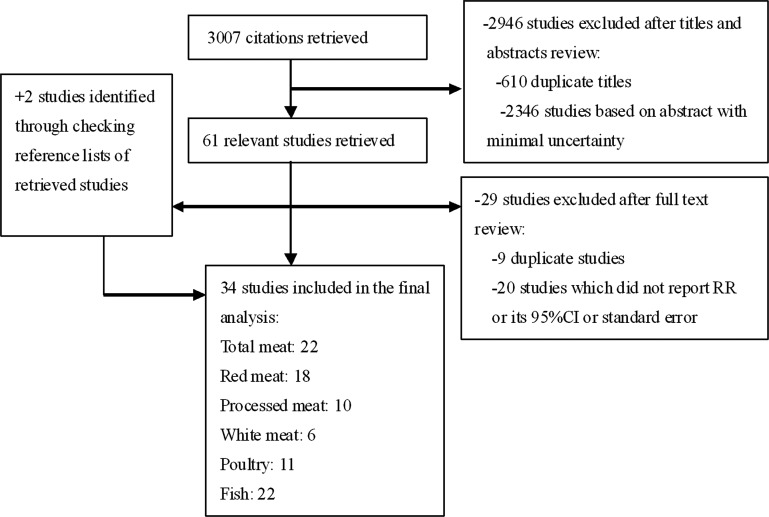
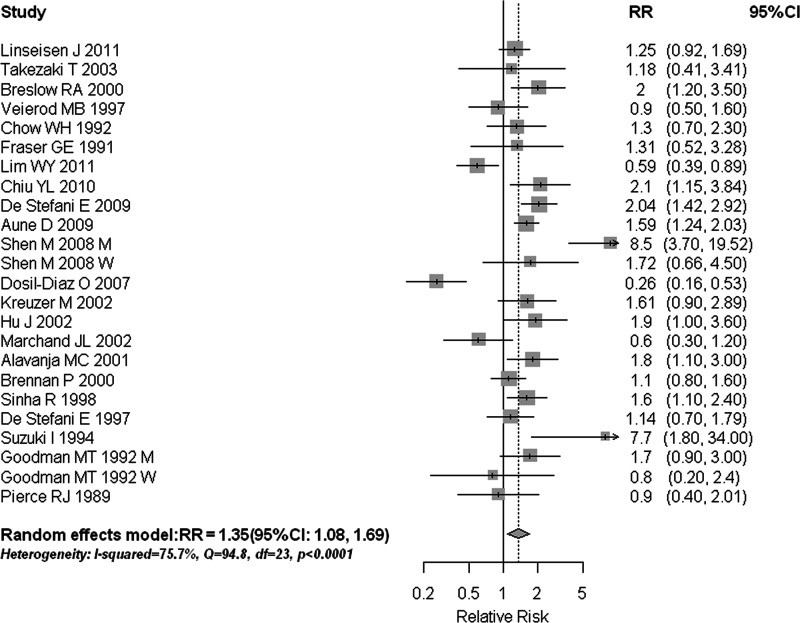
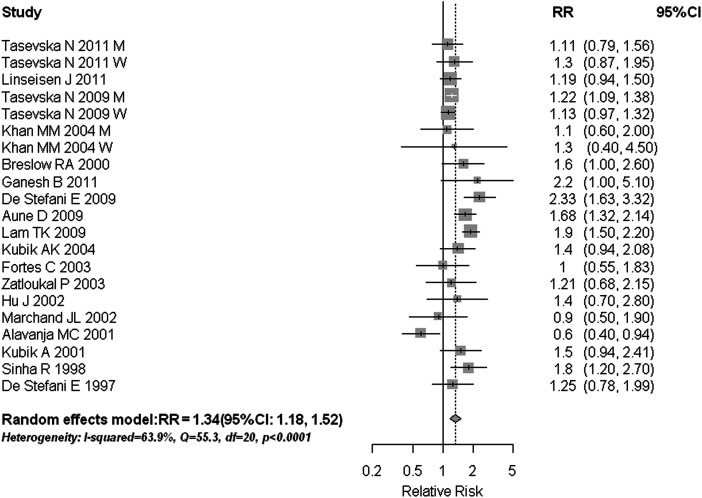
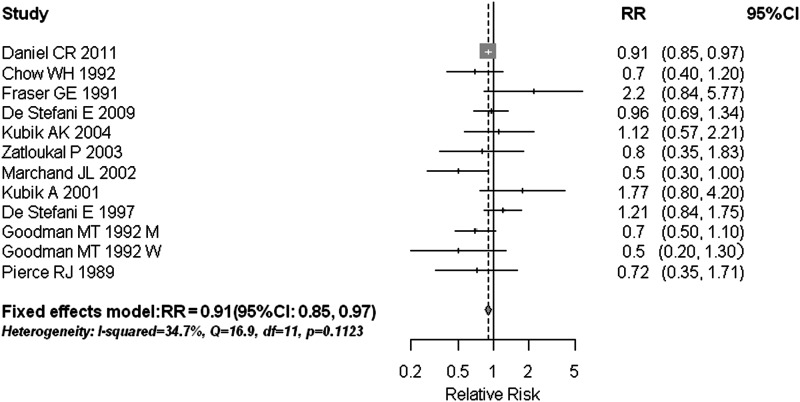
Results: Twenty-three case-control and 11 cohort studies were included. All studies adjusted for smoking or conducted in never smokers. The summary relative risks (RRs) of lung cancer for the highest versus lowest intake categories were 1.35 (95% confidence interval (CI) 1.08-1.69) for total meat, 1.34 (95% CI 1.18-1.52) for red meat, and 1.06 (95% CI 0.90-1.25) for processed meat. An inverse association was found between poultry intake and lung cancer (RR = 0.91, 95% CI 0.85-0.97), but not for total white meat (RR = 1.06, 95% CI 0.82-1.37) or fish (RR = 1.01, 95% CI 0.96-1.07).
Conclusions: The relationship between meat intake and lung cancer risk appears to depend on the types of meat consumed. A high intake of red meat may increase the risk of lung cancer by about 35%, while a high intake of poultry decreases the risk by about 10%. More well-designed cohort studies on meat mutagens or heme iron, meat cooking preferences, and doneness level are needed to fully characterize this meat-lung cancer association.
Figures
Comment in
-
Meat consumption and risk of lung cancer: evidence from observational studies.Ann Oncol. 2013 Jan;24(1):266-7. doi: 10.1093/annonc/mds595. Ann Oncol. 2013. PMID: 23251012 No abstract available.
References
-
- Jemal A, Bray F, Center MM, et al. Global cancer statistics. CA Cancer J Clin. 2011;61:69–90. doi:10.1016/j.jacc.2009.12.014. - DOI - PubMed
-
- Puangsombat K, Gadgil P, Houser TA, et al. Heterocyclic amine content in commercial ready to eat meat products. Meat Sci. 2011;88:227–233. doi:10.1161/CIRCULATIONAHA.109.907402. - DOI - PubMed
-
- Sinha R, Knize MG, Salmon CP, et al. Heterocyclic amine content of pork products cooked by different methods and to varying degrees of doneness. Food Chem Toxicol. 1998;36:289–297. - PubMed
-
- Phillips DH. Polycyclic aromatic hydrocarbons in the diet. Mutat Res. 1999;443:139–147. - PubMed
-
- Kazerouni N, Sinha R, Hsu CH, et al. Analysis of 200 food items for benzo[a]pyrene and estimation of its intake in an epidemiologic study. Food Chem Toxicol. 2001;39:423–436. doi:10.1532/HSF98.20071140. - DOI - PubMed
Publication types
MeSH terms
Grants and funding
LinkOut - more resources
Full Text Sources
Medical
