. 2012 Jul 26:3:118.
doi: 10.3389/fneur.2012.00118. eCollection 2012.

Age-related changes in sleep and circadian rhythms: impact on cognitive performance and underlying neuroanatomical networks

Affiliations

Age-related changes in sleep and circadian rhythms: impact on cognitive performance and underlying neuroanatomical networks

Christina Schmidt et al. Front Neurol. .

Abstract

Circadian and homeostatic sleep-wake regulatory processes interact in a fine tuned manner to modulate human cognitive performance. Dampening of the circadian alertness signal and attenuated deterioration of psychomotor vigilance in response to elevated sleep pressure with aging change this interaction pattern. As evidenced by neuroimaging studies, both homeostatic sleep pressure and circadian sleep-wake promotion impact on cognition-related cortical and arousal-promoting subcortical brain regions including the thalamus, the anterior hypothalamus, and the brainstem locus coeruleus (LC). However, how age-related changes in circadian and homeostatic processes impact on the cerebral activity subtending waking performance remains largely unexplored. Post-mortem studies point to neuronal degeneration in the SCN and age-related modifications in the arousal-promoting LC. Alongside, cortical frontal brain areas are particularly susceptible both to aging and misalignment between circadian and homeostatic processes. In this perspective, we summarize and discuss here the potential neuroanatomical networks underlying age-related changes in circadian and homeostatic modulation of waking performance, ranging from basic arousal to higher order cognitive behaviors.

Keywords: aging; circadian rhythms; cognition; functional magnetic resonance imaging; sleep homeostasis; sleep-wake regulation.


Figures
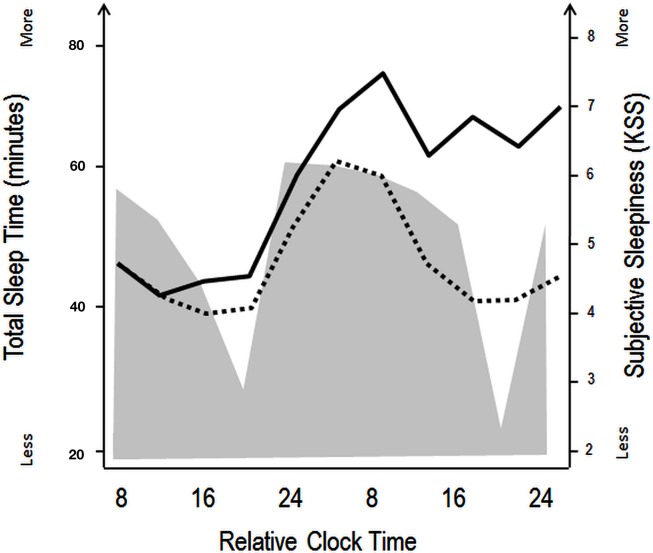
Figure 1
Figure 1
Schematic illustration of the impact of circadian and homeostatic processes on sleep and wakefulness. The filled gray area illustrates variations in total sleep time during a constant routine protocol with regularly occurring naps (150 min of wakefulness followed by 75 min of naps), aiming at investigating circadian rhythm parameters under low homeostatic sleep pressure conditions. Black lines indicate superimposed subjective sleepiness as assessed by the Karolinska Sleepiness Scale over a similar nap (dashed line) and total sleep deprivation (straight line) protocol. The wake maintenance zone can be identified in the naps scheduled in the subjective evening hours, with minimal total sleep time (expressed in minutes). The sleep-promoting signal in the biological night is accompanied by rapid increases in subjective sleepiness in both the low (naps) and high (sleep deprivation) sleep pressure conditions. Over the course of the second biological day, subjective sleepiness decreases, even when homeostatic sleep pressure increases (in the sleep deprivation protocol, straight line), indicating that circadian wake promotion rises or that circadian sleep promotion diminishes [modified from Cajochen et al. (2001) and Münch et al. (2005)].
Figure 2
Figure 2
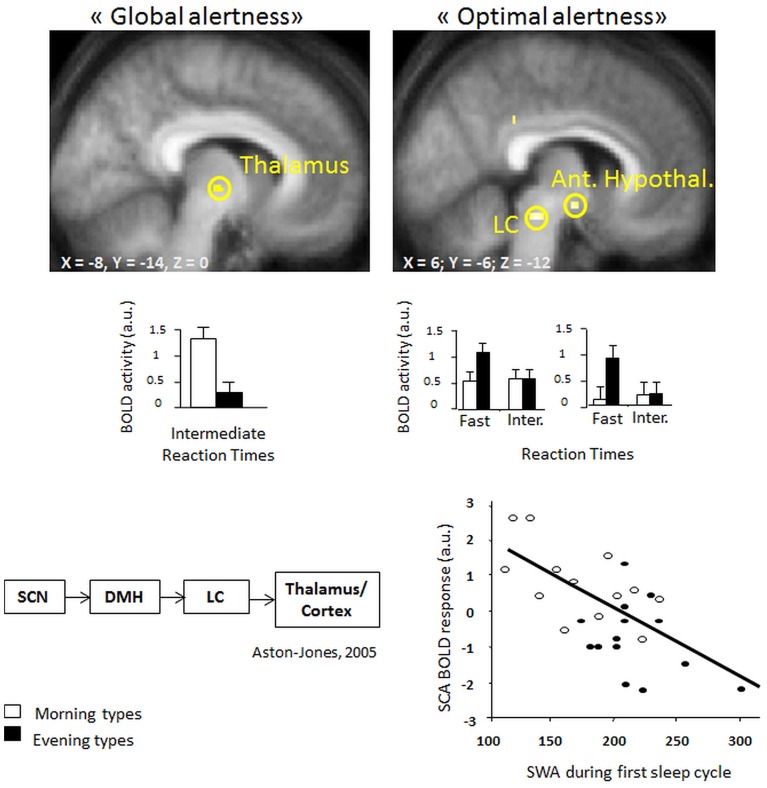
(Left, top panel) higher task-related thalamic activation in morning as compared to evening types for intermediate reaction times (“global alertness”) during the subjective evening hours [modified from Schmidt et al. (2009)] (right, top panel) Higher BOLD activity in locus coeruleus and anterior hypothalamic regions in evening as compared to morning types for “optimal alertness” (10% of fastest reaction times, as compared to intermediate reaction times). (Left, bottom panel) both regions have been implicated in circadian arousal regulation, as illustrated by the model of Aston-Jones et al. (2001). (right, bottom panel) Finally, optimal alertness-related activity in the anterior hypothalamus (i.e., suprachiasmatic area) is negatively related to the amounts of EEG slow wave activity at the beginning of the night, which can be considered as a reliable marker of homeostatic sleep pressure build-up [modified from Schmidt et al. (2009)].
Figure 3
Figure 3
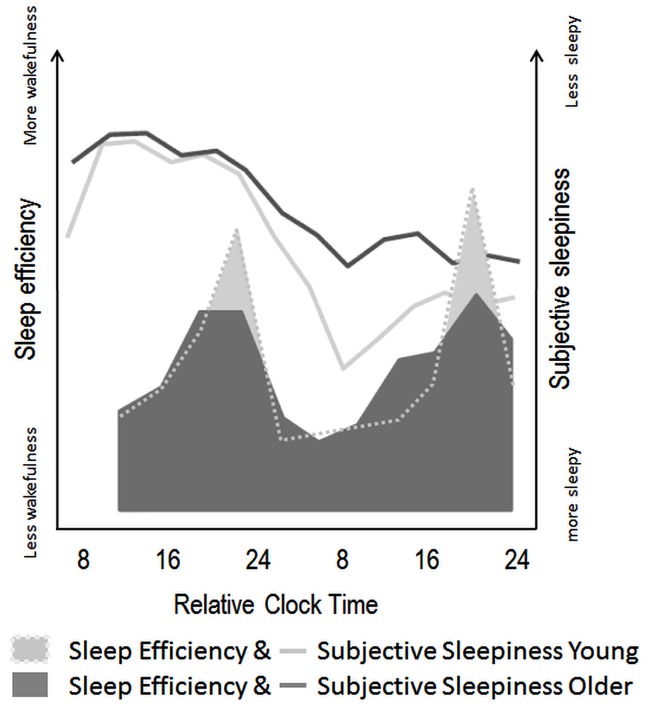
Schematic illustration of age-related modifications in circadian and homeostatic sleep-wake regulation in humans. Filled areas illustrate variations in sleep efficiency over a nap protocol (10 episodes of 150 min of wake, followed by 75 min of scheduled sleep episodes) modified from Münch et al. (2005). Circadian sleep-wake promotion, as expressed by the amount of wakefulness throughout nap episodes seems attenuated in older (dark gray) as compared to young individuals (light gray area). Line plots indicate the superimposed time course of subjective sleepiness over a 40-h sleep deprivation protocol in young (light gray line) and older (dark gray line) adults [modified from Adam et al. (2006)]. These values indicate less pronounced effects of increasing homeostatic sleep pressure on subjective sleepiness in older, as compared to young individuals.
Figure 4
Figure 4
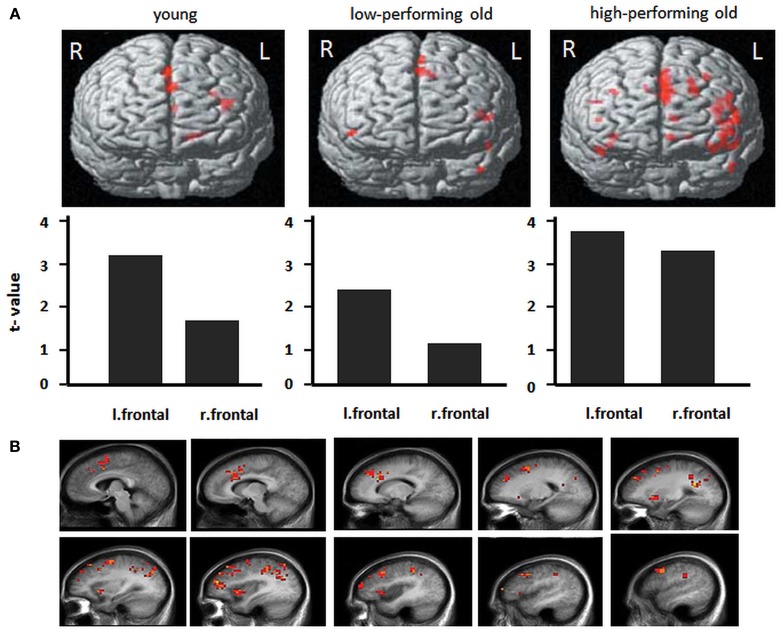
Frontal activity changes in young and older populations. (A) Activations during a memory-encoding task in young adults, low-performing older adults and high-performing older adults. Low-performing older adults exhibit a similar pattern as do young adults, with lower overall levels of activation. High-performing older adults exhibit greater bilateral activation (with permission from Hedden and Gabrieli, 2004). (B) Total sleep deprivation-related patterns of cerebral activation during a verbal learning task. For each of these regions, the memorization of difficult words elicited greater activation after total sleep deprivation than after a night of sleep. Images show left hemisphere slices from 5 to 50 mm [adapted from Drummond et al. (2005b)].

References

    1. Adam M., Retey J. V., Khatami R., Landolt H. P. (2006). Age-related changes in the time course of vigilant attention during 40 hours without sleep in men. Sleep 29, 55–57 - PubMed
    1. Adamantidis A., de Lecea L. (2008). Physiological arousal: a role for hypothalamic systems. Cell. Mol. Life Sci. 65, 1475–1488 10.1007/s00018-008-7521-8 - DOI - PMC - PubMed
    1. Aston-Jones G. (2005). Brain structures and receptors involved in alertness. Sleep Med. 6(Suppl. 1), S3–S7 10.1016/j.sleep.2005.01.001 - DOI - PubMed
    1. Aston-Jones G., Chen S., Zhu Y., Oshinsky M. L. (2001). A neural circuit for circadian regulation of arousal. Nat. Neurosci. 4, 732–738 10.1038/89522 - DOI - PubMed
    1. Bartres-Faz D., Arenaza-Urquijo E. M. (2011). Structural and functional imaging correlates of cognitive and brain reserve hypotheses in healthy and pathological aging. Brain Topogr. 24, 340–357 10.1007/s10548-011-0195-9 - DOI - PubMed