


The influence of type 1 and type 2 diabetes on periodontal disease progression: prospective results from the Study of Health in Pomerania (SHIP)
- PMID: 22855731
- PMCID: PMC3447825
- DOI: 10.2337/dc11-2453
The influence of type 1 and type 2 diabetes on periodontal disease progression: prospective results from the Study of Health in Pomerania (SHIP)
Abstract
Objective: To explore associations between diabetes etiology (type 1 diabetes mellitus [T1DM] vs. T2DM) and glycemic control in the prediction of 5-year periodontal status change.
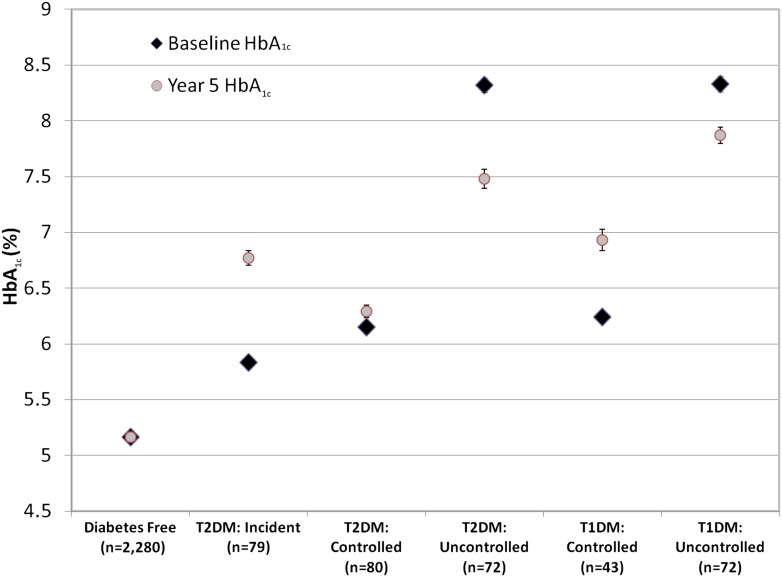
Research design and methods: The Study of Health in Pomerania (SHIP) is a population-based stratified sample of German men and women. Healthy participants and those determined to have T2DM arose from the SHIP cohort, and T1DM participants were recruited from diabetes clinics in the catchment area that gave rise to SHIP. Dentate participants (n = 2,626; 53% women; 20-81 years of age) were included. Diabetes was determined via physician diagnosis and/or HbA(1c) ≥6.5% (uncontrolled diabetes >7.0%). Examiners blinded to diabetes status performed random half-mouth periodontal examinations, assessing probing depth (PD) and attachment loss (AL) (four sites/tooth) at baseline and follow-up. Participants were categorized into six groups as follows: 1) diabetes free (n = 2,280), 2) incident T2DM (n = 79), 3) controlled T2DM (n = 80), 4) uncontrolled T2DM (n = 72), 5) controlled T1DM (n = 43), and 6) uncontrolled T1DM (n = 72). In multivariable regressions, mean PD change (ΔMPD), mean AL change (ΔMAL), or incident tooth-loss values were regressed across the aforementioned diabetes categories.
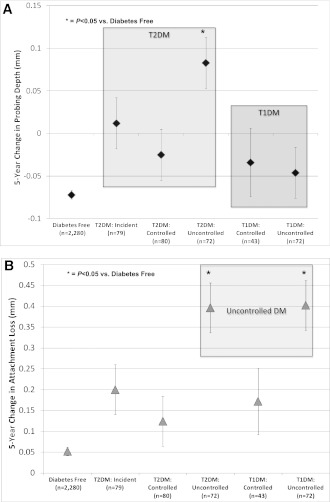
Results: Mean (SD) ΔMPD and ΔMAL values among all participants were -0.08 ± 0.5 mm and 0.08 ± 1.03 mm, respectively, and 34% lost one or more teeth. Relative to diabetes-free participants, those with uncontrolled T2DM experienced greater ΔMPD ± SE (P < 0.05), whereas participants with either uncontrolled T1DM or uncontrolled T2DM realized greater ΔMAL (P < 0.05). Uncontrolled T1DM and T2DM were both associated with an increased risk of future tooth loss (P < 0.05).
Conclusions: Diabetes control, but not etiology, was associated with future tooth loss and accelerated AL progression.
Figures
References
-
- Grossi SG, Zambon JJ, Ho AW, et al. Assessment of risk for periodontal disease. I. Risk indicators for attachment loss. J Periodontol 1994;65:260–267 - PubMed
-
- Grossi SG, Genco RJ, Machtei EE, et al. Assessment of risk for periodontal disease. II. Risk indicators for alveolar bone loss. J Periodontol 1995;66:23–29 - PubMed
-
- Nelson RG, Shlossman M, Budding LM, et al. Periodontal disease and NIDDM in Pima Indians. Diabetes Care 1990;13:836–840 - PubMed
-
- Löe H. Periodontal disease. The sixth complication of diabetes mellitus. Diabetes Care 1993;16:329–334 - PubMed
Publication types
MeSH terms
Grants and funding
LinkOut - more resources
Full Text Sources
Medical
Miscellaneous
