doi: 10.1101/gad.193433.112.
Unraveling the KNOTTED1 regulatory network in maize meristems
Affiliations
- PMID: 22855831
- PMCID: PMC3418586
- DOI: 10.1101/gad.193433.112
Item in Clipboard
Unraveling the KNOTTED1 regulatory network in maize meristems
Genes Dev.
.
Abstract
KNOTTED1 (KN1)-like homeobox (KNOX) transcription factors function in plant meristems, self-renewing structures consisting of stem cells and their immediate daughters. We defined the KN1 cistrome in maize inflorescences and found that KN1 binds to several thousand loci, including 643 genes that are modulated in one or multiple tissues. These KN1 direct targets are strongly enriched for transcription factors (including other homeobox genes) and genes participating in hormonal pathways, most significantly auxin, demonstrating that KN1 plays a key role in orchestrating the upper levels of a hierarchical gene regulatory network that impacts plant meristem identity and function.
Figures
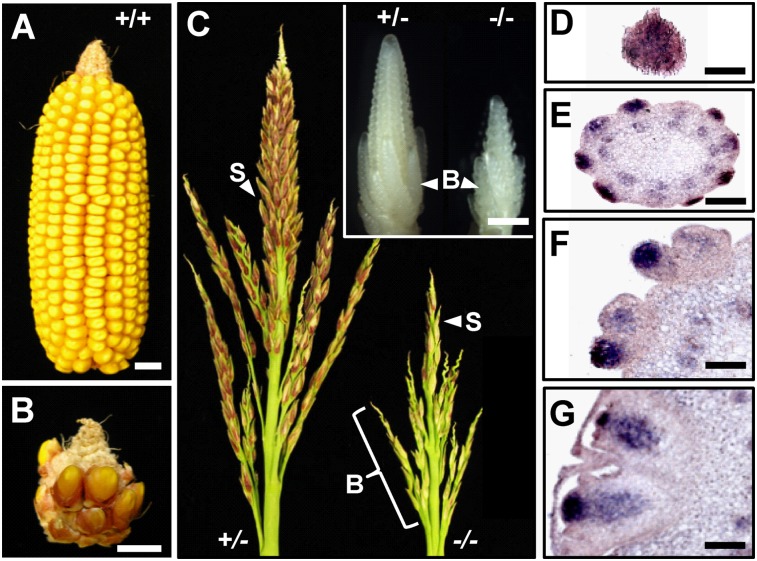
kn1 loss-of-function phenotypes. (A,B) Female inflorescence (ear) from wild-type (+/+) (A) and the null kn1-e1 (−/−) (B) allele, which produces a small cob with poor kernel yield. (C) Male inflorescence (tassel). kn1-e1 tassels have fewer long branches (B) and fewer spikelets (S). (Inset) Immature tassels at the stage used for ChIP and RNA-seq. Immature ears are similar but lack long branches. (D–G) kn1 in situ hybridization in transverse sections of a wild-type ear, going from the tip (D) toward the base (G). A specific signal corresponds to the dark-blue staining. Bars: A–C, 1 cm; C, inset, 1 mm; D–G, 0.1 mm.
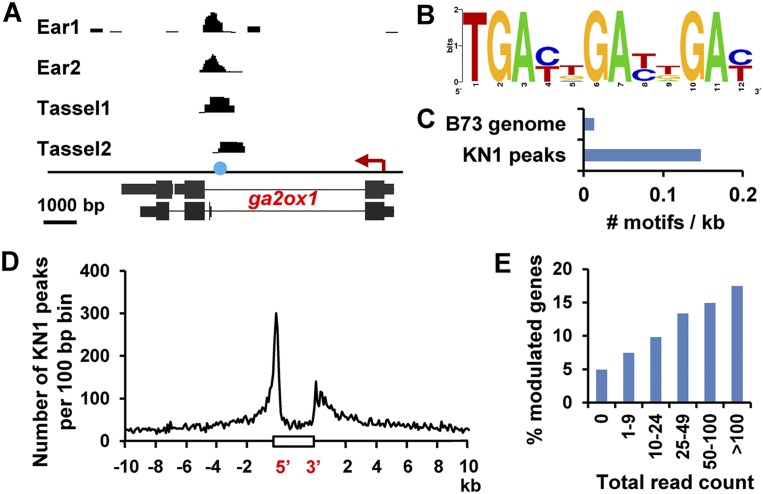
ChIP-seq results. (A) ChIP-seq identified KN1 binding in ga2ox1. The blue circle indicates the position of the previously mapped KN1-binding motif, and the red arrow indicates gene orientation. (B,C) ga2ox1-like binding motif (B) is significantly over-represented (P-value < 1 × 10−100) in KN1-bound loci compared with the B73 genome (C). (D) Distribution of KN1 peaks around transcribed genes. A representative gene is shown as a white box on the X-axis. (E) Relationship between the total read count and the proportion of modulated genes in all tissues.
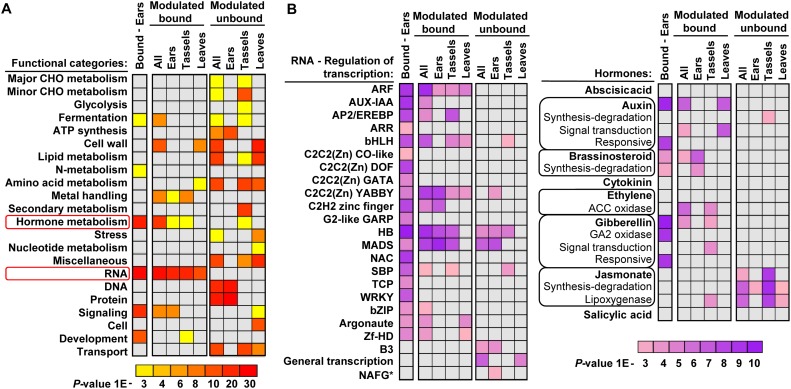
Functional categories of KN1 targets. Distribution of categories is shown for genes located within 10 kb of high-confidence KN1-bound loci (Ears—Bound) and modulated genes (bound vs. unbound). (A) Enrichments for all main categories. (B) Enrichments for subcategories in the “RNA—regulation of transcription” (left) and “hormone metabolism” (right) categories. (*) Nucleosome assembly factor group.
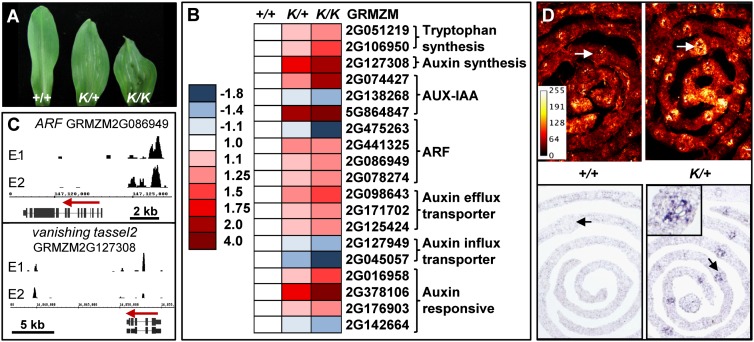
KN1 targets the auxin pathway. (A) Kn1-N phenotype. First leaf from wild type (+/+), Kn1-N heterozygotes (K/+), and homozygotes (K/K) are shown. Kn1-N leaves are shorter and wider, and overall plant height is shorter in homozygotes. (B) Changes in gene expression for selected targets. All differences between homozygotes and wild type are statistically significant at a false discovery rate (FDR) of <0.01. (C) ChIP-seq identified KN1 binding in selected targets. Red arrows indicate gene orientation. Peak traces are shown for the two ear replicates (E1–E2). (D) Confocal images (maximum projection) of DR5rev∷mRFPer (top panels) or KN1 immunolocalization (bottom panels) in Kn1-N/+ plants and wild-type siblings (transverse sections). Increased fluorescence in the lateral veins (arrows) correlates with KN1 misexpression. A look-up table scale of fluorescence intensity in shown in the top left panel.
References
-
- Biggin MD 2011. Animal transcription networks as highly connected, quantitative continua. Dev Cell 21: 611–626 - PubMed
-
- Chapman EJ, Estelle M 2009. Mechanism of auxin-regulated gene expression in plants. Annu Rev Genet 43: 265–285 - PubMed
-
- Chen H, Banerjee AK, Hannapel DJ 2004. The tandem complex of BEL and KNOX partners is required for transcriptional repression of ga20ox1. Plant J 38: 276–284 - PubMed
-
- Doebley J, Stec A, Hubbard L 1997. The evolution of apical dominance in maize. Nature 386: 485–488 - PubMed
Publication types
MeSH terms
Substances
Grants and funding
LinkOut - more resources
Full Text Sources
Other Literature Sources
Medical
Molecular Biology Databases
Research Materials