


Caffeine for treatment of Parkinson disease: a randomized controlled trial
- PMID: 22855866
- PMCID: PMC3414662
- DOI: 10.1212/WNL.0b013e318263570d
Caffeine for treatment of Parkinson disease: a randomized controlled trial
Erratum in
- Neurology. 2012 Oct 16;79(16):1744
Abstract
Objective: Epidemiologic studies consistently link caffeine, a nonselective adenosine antagonist, to lower risk of Parkinson disease (PD). However, the symptomatic effects of caffeine in PD have not been adequately evaluated.
Methods: We conducted a 6-week randomized controlled trial of caffeine in PD to assess effects upon daytime somnolence, motor severity, and other nonmotor features. Patients with PD with daytime somnolence (Epworth >10) were given caffeine 100 mg twice daily ×3 weeks, then 200 mg twice daily ×3 weeks, or matching placebo. The primary outcome was the Epworth Sleepiness Scale score. Secondary outcomes included motor severity, sleep markers, fatigue, depression, and quality of life. Effects of caffeine were analyzed with Bayesian hierarchical models, adjusting for study site, baseline scores, age, and sex.
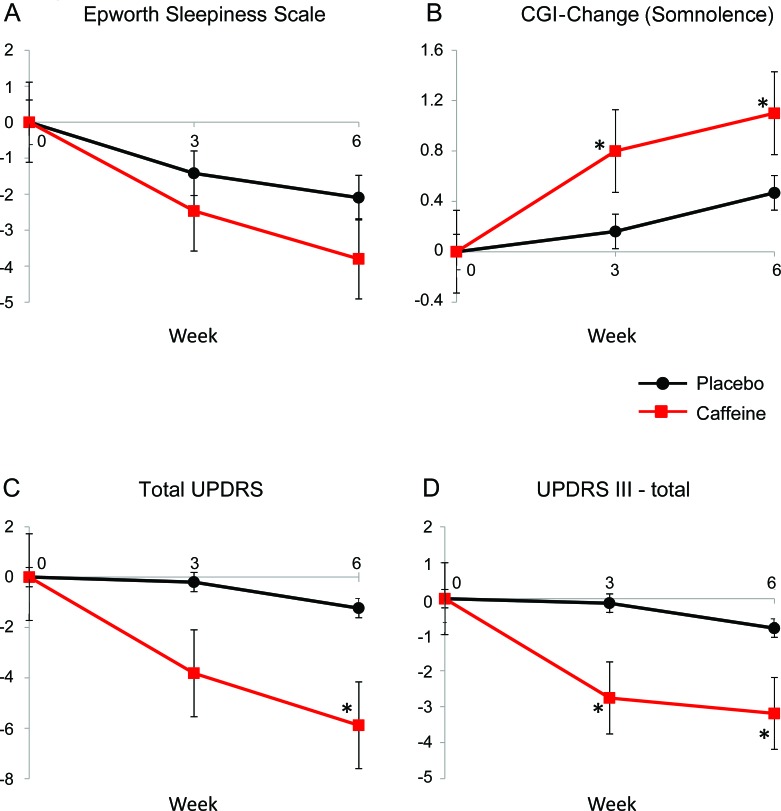
Results: Of 61 patients, 31 were randomized to placebo and 30 to caffeine. On the primary intention-to-treat analysis, caffeine resulted in a nonsignificant reduction in Epworth Sleepiness Scale score (-1.71 points; 95% confidence interval [CI] -3.57, 0.13). However, somnolence improved on the Clinical Global Impression of Change (+0.64; 0.16, 1.13, intention-to-treat), with significant reduction in Epworth Sleepiness Scale score on per-protocol analysis (-1.97; -3.87, -0.05). Caffeine reduced the total Unified Parkinson's Disease Rating Scale score (-4.69 points; -7.7, -1.6) and the objective motor component (-3.15 points; -5.50, -0.83). Other than modest improvement in global health measures, there were no changes in quality of life, depression, or sleep quality. Adverse events were comparable in caffeine and placebo groups.
Conclusions: Caffeine provided only equivocal borderline improvement in excessive somnolence in PD, but improved objective motor measures. These potential motor benefits suggest that a larger long-term trial of caffeine is warranted.
Classification of evidence: This study provides Class I evidence that caffeine, up to 200 mg BID for 6 weeks, had no significant benefit on excessive daytime sleepiness in patients with PD.
Figures

Comment in
-
Caffeine in Parkinson disease: better for cruise control than snooze patrol?Neurology. 2012 Aug 14;79(7):616-8. doi: 10.1212/WNL.0b013e318263580e. Epub 2012 Aug 1. Neurology. 2012. PMID: 22855870 No abstract available.
-
Comment: Caffeine and PD-Time to consider other interventions.Neurology. 2017 Oct 24;89(17):1802. doi: 10.1212/WNL.0000000000004584. Epub 2017 Sep 27. Neurology. 2017. PMID: 28954875 No abstract available.
References
-
- Hernan MA, Takkouche B, Caamano-Isorna F, Gestal-Otero JJ. A meta-analysis of coffee drinking, cigarette smoking, and the risk of Parkinson's disease. Ann Neurol 2002; 52: 276– 284 . - PubMed
-
- Altman RD, Lang AE, Postuma RB. Caffeine in Parkinson's disease: a pilot open-label, dose-escalation study. Mov Disord 2011; 26: 2427– 2431 . - PubMed
-
- Kitagawa M, Houzen H, Tashiro K. Effects of caffeine on the freezing of gait in Parkinson's disease. Mov Disord 2007; 22: 710– 712 . - PubMed
-
- Schwarzschild MA, Chen JF, Ascherio A. Caffeinated clues and the promise of adenosine A(2A) antagonists in PD. Neurology 2002; 58: 1154– 1160 . - PubMed
-
- Xu K, Bastia E, Schwarzschild M. Therapeutic potential of adenosine A(2A) receptor antagonists in Parkinson's disease. Pharmacol Ther 2005; 105: 267– 310 . - PubMed
Publication types
MeSH terms
Substances
Grants and funding
LinkOut - more resources
Full Text Sources
Other Literature Sources
Medical
