. 2012 Aug 2:12:129.
doi: 10.1186/1471-2229-12-129.

Down-regulation of POLYGALACTURONASE1 alters firmness, tensile strength and water loss in apple (Malus x domestica) fruit

Affiliations

Down-regulation of POLYGALACTURONASE1 alters firmness, tensile strength and water loss in apple (Malus x domestica) fruit

Ross G Atkinson et al. BMC Plant Biol. .

Abstract

Background: While there is now a significant body of research correlating apple (Malus x domestica) fruit softening with the cell wall hydrolase ENDO-POLYGALACTURONASE1 (PG1), there is currently little knowledge of its physiological effects in planta. This study examined the effect of down regulation of PG1 expression in 'Royal Gala' apples, a cultivar that typically has high levels of PG1, and softens during fruit ripening.

Results: PG1-suppressed 'Royal Gala' apples harvested from multiple seasons were firmer than controls after ripening, and intercellular adhesion was higher. Cell wall analyses indicated changes in yield and composition of pectin, and a higher molecular weight distribution of CDTA-soluble pectin. Structural analyses revealed more ruptured cells and free juice in pulled apart sections, suggesting improved integrity of intercellular connections and consequent cell rupture due to failure of the primary cell walls under stress. PG1-suppressed lines also had reduced expansion of cells in the hypodermis of ripe apples, resulting in more densely packed cells in this layer. This change in morphology appears to be linked with reduced transpirational water loss in the fruit.

Conclusions: These findings confirm PG1's role in apple fruit softening and suggests that this is achieved in part by reducing cellular adhesion. This is consistent with previous studies carried out in strawberry but not with those performed in tomato. In apple PG1 also appears to influence other fruit texture characters such as juiciness and water loss.


Figures
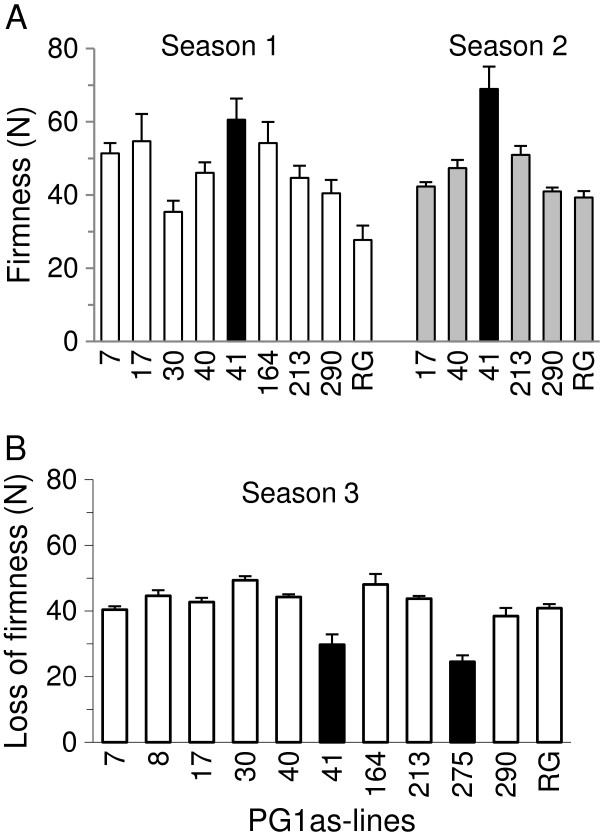
Figure 1
Figure 1
Cortical firmness of transgenic PG1-suppressed and ‘Royal Gala’ control fruit harvested from three seasons.A Cortical firmness of wild-type ‘Royal Gala’ (RG) apple fruit and transgenic PG1-suppressed (PG1as) lines in fruiting seasons 1 and 2. Fruit firmness was measured after ripening for 32 weeks at 5°C (n = 4–10 fruit ± Standard Error). B Mean loss of cortical firmness of transgenic PG1-suppressed and ‘Royal Gala’ fruit in season 3 after ripening for 16 weeks at 5°C. (n = 6–10 fruit ± Standard Error). Lines PG1as-41 and PG1as-275 highlighted in black showed the least change in firmness.
Figure 2
Figure 2
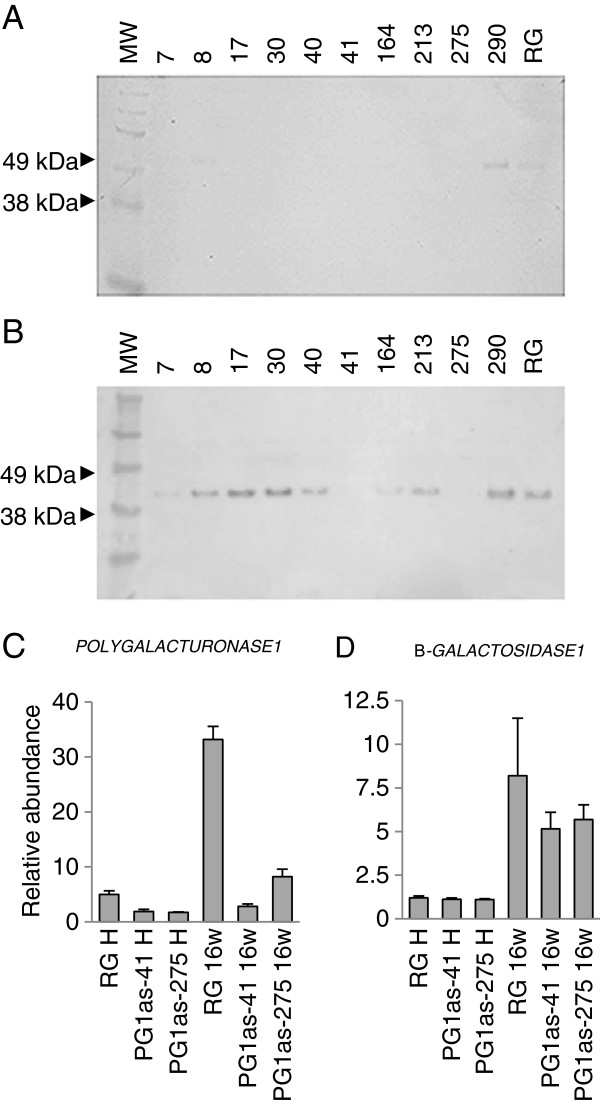
Molecular characterisation of transgenic PG1as apple lines. Western analysis of protein extracts from fruit of transgenic PG1as lines and ‘Royal Gala’ (RG) control after SDS-PAGE (8 μg protein per lane) at harvest (A), and after ripening for 16 weeks at 5°C (B), using a polyclonal antibody raised to recombinant apple PG1. mRNA abundance of PG1(C), and a ripening-related apple β-GALACTOSIDASE gene (D)[38], at harvest (H) and after ripening for 16 weeks at 5°C (16 w). mRNA abundance of the PG1as-41 sample at harvest was set as 1 (n = 4 ± Standard Error).
Figure 3
Figure 3
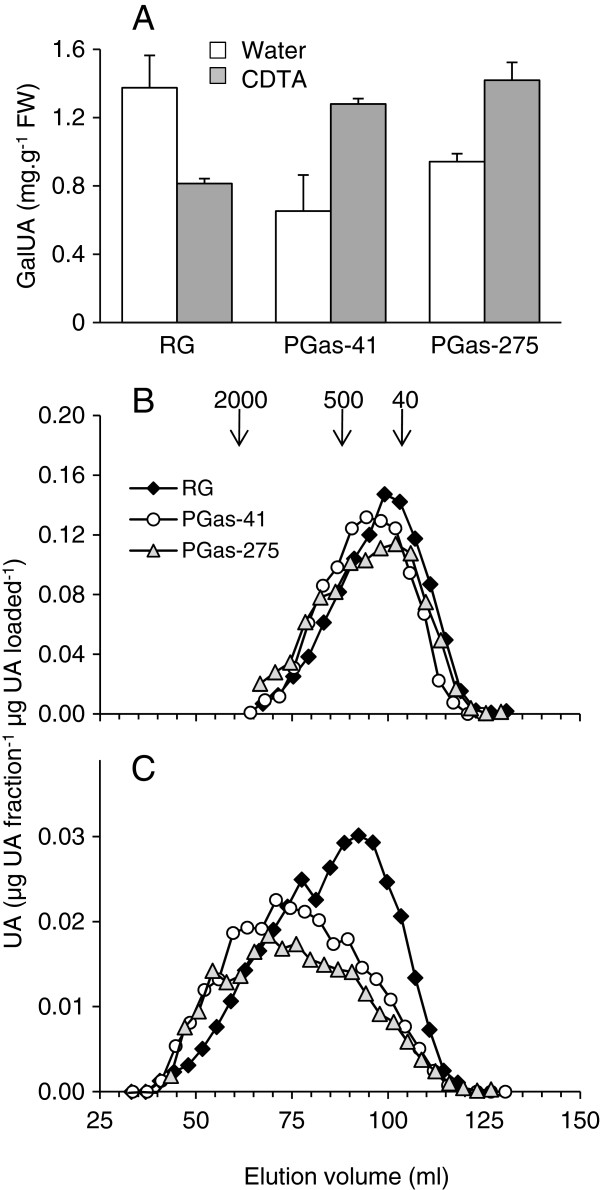
Polyuronide content and size distribution of water-soluble and CDTA-soluble polyuronides from the cell walls of transgenic PG1as and ‘Royal Gala’ (RG) control apple fruit after ripening for 16 weeks at 5°C.A) Polyuronide content, expressed as mg of uronic acid per g fresh weight of tissue, of water-soluble extracts (white bars) and CDTA-soluble extracts (grey bars) (n = 3 ± Standard Deviation). B) Size distribution of water-soluble polyuronides, and (C) CDTA-soluble polyuronides after elution on Sepharose CL-2B (profiles are typical examples from two extractions). Arrows indicate elution of dextran molecular weight markers (kDa).
Figure 4
Figure 4
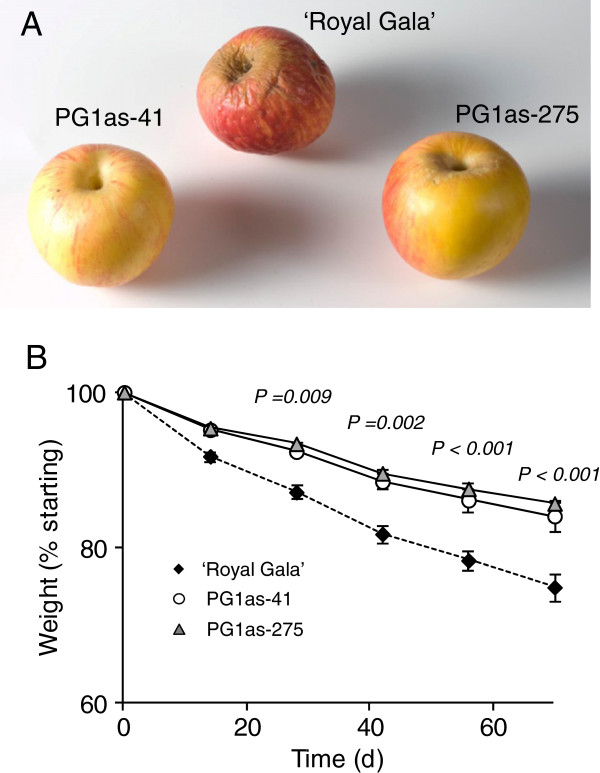
Transpirational water loss in transgenic PG1as and ‘Royal Gala’ control fruit. Fruit were initially ripened at 5°C for 16 weeks then transferred to 20°C for 9 weeks. A) Representative photograph of PG1as-41, PG1as-275 and ‘Royal Gala’ (RG) control fruit after being held for 9 weeks at 20°C. Note how the PG1as-41 and PG1as-275 fruit were substantially less wrinkled than the control. B) Weight loss (representing mainly water loss) was measured every 1–2 weeks for the 9 weeks fruit were held at 20°C. Weight loss is presented as a percentage of starting weight after transfer to 20°C (n = 4–6 ± Standard Error and T-test statistics between apples containing the transgene and untransformed controls are shown).
Figure 5
Figure 5
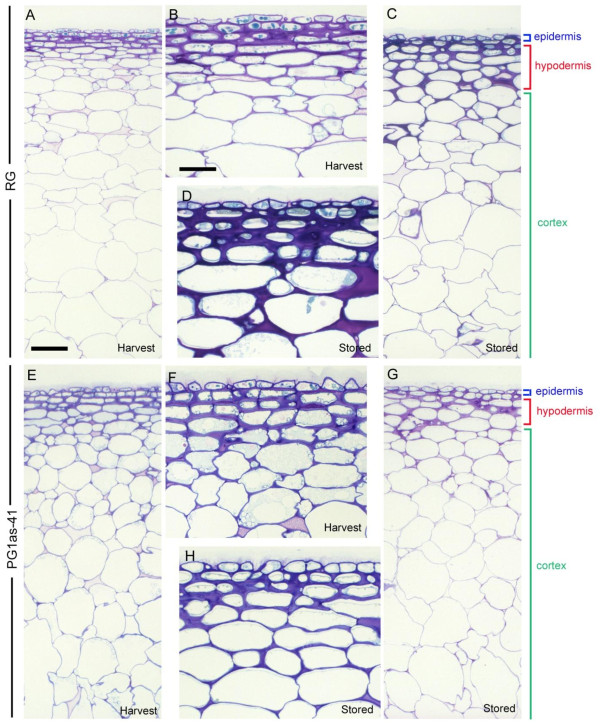
Structural changes occurring in the exocarp and cortex of transgenic PG1as and ‘Royal Gala’ control fruit. Toluidine blue-stained sections from: ‘Royal Gala’ (RG) at harvest (A, B) and following ripening for 16 weeks at 5°C - stored (C, D); PG1as-41 at harvest (E, F) and following ripening for 16 weeks at 5°C - stored (G, H). Coloured lines show the approximate extent of the epidermis/cuticle (blue), hypodermal cell layers (red) and cortex (green). Note the thickening of the hypodermal layers observed in the control (C, D) does not occur in the suppressed PG1as-41 line (G, H). Scale bars = 100 μm (A, C, E, G) and 50 μm (B, D, F, H).
Figure 6
Figure 6
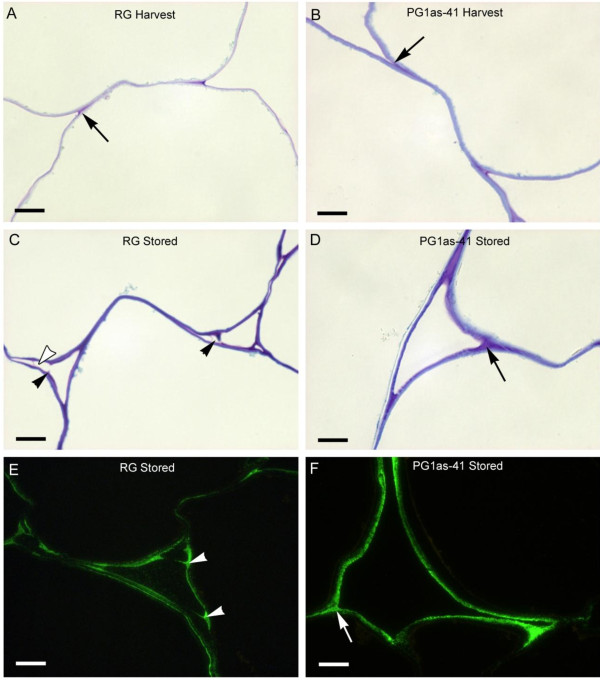
Intercellular adhesion in the cortex tissue of ‘Royal Gala’ (RG) control (A, C, E) and transgenic PG1as-41 (B, D, F) fruit. Toluidine blue-stained sections of cell wall boundaries at harvest (A, B); and following ripening for 16 weeks at 5°C - stored (C, D). Immunolocalisation of a pectin epitope with a low degree of esterification in the cell walls of apple fruit after ripening for 16 weeks at 5°C visualised using the antibody JIM5 (E, F). Arrows indicate materials filling the space where two cells join (A, B, D, F). In (C) and (E), solid arrowheads indicate remnants of cell wall material protruding into the intercellular space. In (C) the open arrowhead indicates a region where material has been lost between adjacent cells. Bar = 10 μm.
Figure 7
Figure 7
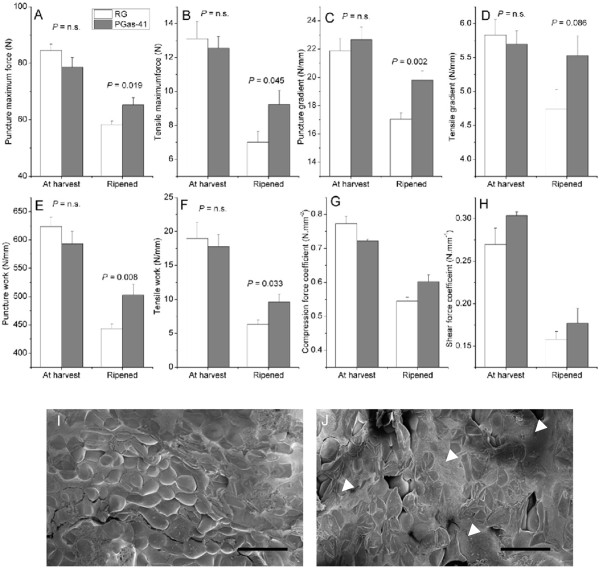
Differences in puncture maximum force (A), tensile maximum force (B), puncture gradient calculated from stress–strain curve (C), tensile gradient calculated from stress–strain curve (D), puncture work calculated from area of stress–strain curve (E), tensile work calculated from area of stress–strain curve (F), compression force coefficient (G), and shear force coefficient (H), between transgenic PG1as-41 and ‘Royal Gala’ (RG) control fruit at harvest and following ripening at 0.5°C for 10 weeks (n = 15 ± Standard Deviation). Statistics for A-F were performed using a T-test. The coefficients and standard errors in (G) and (H) were determined using non-linear regression. Scanning electron microscope views are of a ‘Royal Gala’ section (I) and a PG1as-41 section (J) taken after tensile tests from fruit following ripening. White arrow heads show the presence of ruptured cells. Scale bar represents 500 μm.

References

    1. Shackel KA, Greve C, Labavitch JM, Ahmadi H. Cell turgor changes associated with ripening in tomato pericarp tissue. Plant Physiol. 1991;97:814–816. doi: 10.1104/pp.97.2.814. - DOI - PMC - PubMed
    1. Brummell DA. Cell wall disassembly in ripening fruit. Funct Plant Biol. 2006;33:103–119. doi: 10.1071/FP05234. - DOI - PubMed
    1. Saladié M, Matas AJ, Isaacson T, Jenks MA, Goodwin SM, Niklas KJ, Xiaolin R, Labavitch JM, Shackel KA, Fernie AR. et al. A reevaluation of the key factors that influence tomato fruit softening and integrity. Plant Physiol. 2007;144:1012–1028. doi: 10.1104/pp.107.097477. - DOI - PMC - PubMed
    1. Ghiani A, Onelli E, Aina R, Cocucci M, Citterio S. A comparative study of melting and non-melting flesh peach cultivars reveals that during fruit ripening endo-polygalacturonase (endo-PG) is mainly involved in pericarp textural changes, not in firmness reduction. J Exp Bot. 2011;62:4043–4054. doi: 10.1093/jxb/err109. - DOI - PubMed
    1. Caffall KH, Mohnen D. The structure, function, and biosynthesis of plant cell wall pectic polysaccharides. Carbohydr Res. 2009;344:1879–1900. doi: 10.1016/j.carres.2009.05.021. - DOI - PubMed

Publication types

MeSH terms

LinkOut - more resources