


Water consumption patterns and factors contributing to water consumption in arsenic affected population of rural West Bengal, India
- PMID: 22858413
- PMCID: PMC4089211
- DOI: 10.1016/j.scitotenv.2012.06.057
Water consumption patterns and factors contributing to water consumption in arsenic affected population of rural West Bengal, India
Abstract
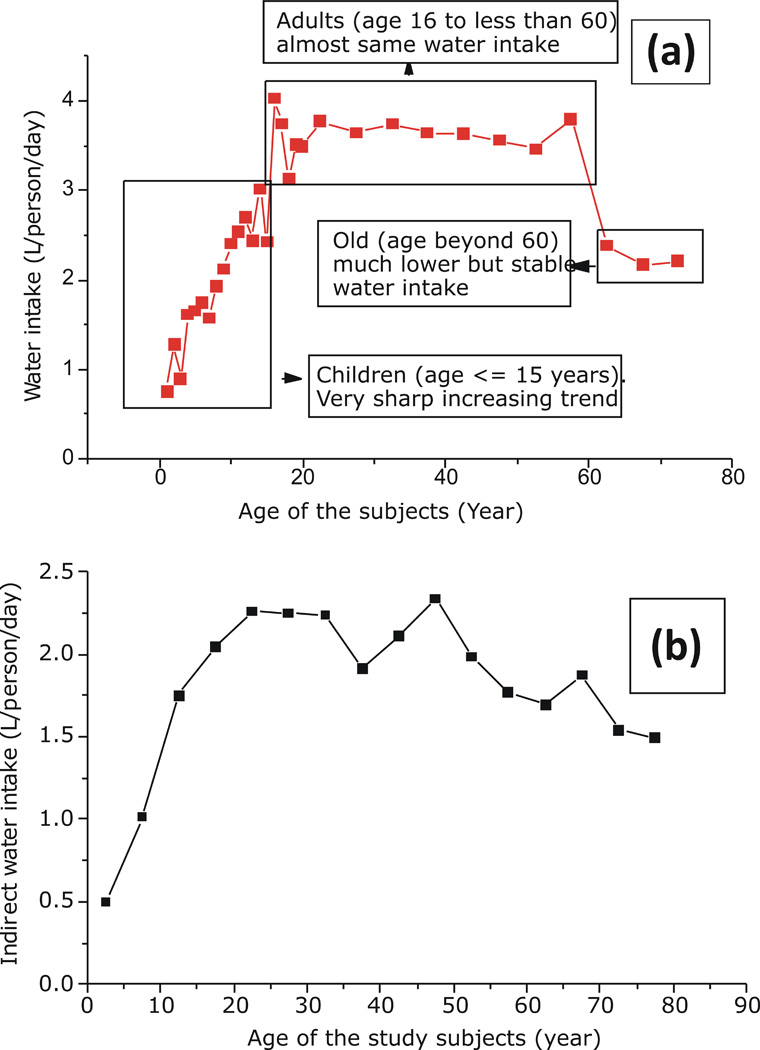
A direct water intake study was conducted for one year, involving 423 individuals from three arsenic (As) affected villages of West Bengal, India. Average direct water intake per person and per unit body weight was found to be 3.12±1.17 L/day and 78.07±47.08 mL/kg/day (± SD), respectively. Average direct water intakes for adult males, adult females and children (age <15 years) were 3.95, 3.03 and 2.14 L/day, respectively. Significant sex differentials were observed between ages 16-55 years. For all participants, a sharp increase in water intake up to 15 years of age was observed followed by a plateau at a higher intake level. Significant monthly, seasonal, regional, and occupational variability was also observed. Another study involving 413 subjects determined the amount of indirect water intake. Average indirect water intake per person was 1.80±0.64 L/day; for adult males, adult females and children, intake was 2.15, 1.81, and 1.10 L/day, respectively. Average total (direct + indirect) water intake was 4.92 L/person/day; for adult males, adult females and children, total intake was 6.10, 4.84, and 3.24 L/person/day, respectively. The overall contribution of indirect water intake to total water consumption was 36.6% for all participants. This study additionally elucidated several factors that contribute to variable water intake, which can lead to better risk characterization of subpopulations and water contaminant ingestion. The study reveals that the water intake rates in the three studied populations in West Bengal are greater than the assumed water intake rates utilized by the World Health Organization (WHO) in the establishment of drinking water quality guidelines; therefore, these assumed intake values may be inappropriate for the study population as well as similar ones.
Keywords: Arsenic-affected population of rural West Bengal; Direct and indirect water consumption; Factors contributing to water consumption; WHO guideline value; Water consumption patterns.
Copyright © 2012 Elsevier B.V. All rights reserved.
Figures
References
-
- Abernathy C, Marcus W, Chen C, Gibb H, White P Report on Arsenic (As) Work Group Meetings. Office of Drinking Water, Office of Research and Development, U.S. Environmental Protection Agency. 1989. Memorandum to Cork, P., Preuss, P., Office of Regulatory Support and Scientific Management, U.S. Environmental Protection Agency.
-
- Ahsan H, Chen Y, Parvz F, Argos M, Hussain AZMI, Momotaj H, et al. Health effects of arsenic longitudinal study (HEALS): Description of a multidisciplinary epidemiologic investigation. J Exp Sci Environ Epidemiol. 2006;16:191–205. - PubMed
-
- Binkowitz BS, Wartenberg D. Disparity in quantitative risk assessment: a review of input distributions. Risk Anal. 2001;21:75–90. - PubMed
-
- BIS. Draft Indian Standard. Drinking Water Specification (Second Revision of IS 10500) 2009 Doc: FAD 25(2047) C. Last Date for Comments: 24/12/2009.
-
- Chakraborti D, Das B, Rahman MM, Chowdhury UK, Biswas B, Goswami AB, et al. Status of groundwater arsenic contamination in the state of West Bengal, India: A 20-year study report. Mol Nutr Food Res. 2009;53:542–551. - PubMed
MeSH terms
Grants and funding
LinkOut - more resources
Full Text Sources
Other Literature Sources
Medical
Research Materials
