


Thermal acclimation of interactions: differential responses to temperature change alter predator-prey relationship
- PMID: 22859598
- PMCID: PMC3427582
- DOI: 10.1098/rspb.2012.1277
Thermal acclimation of interactions: differential responses to temperature change alter predator-prey relationship
Abstract
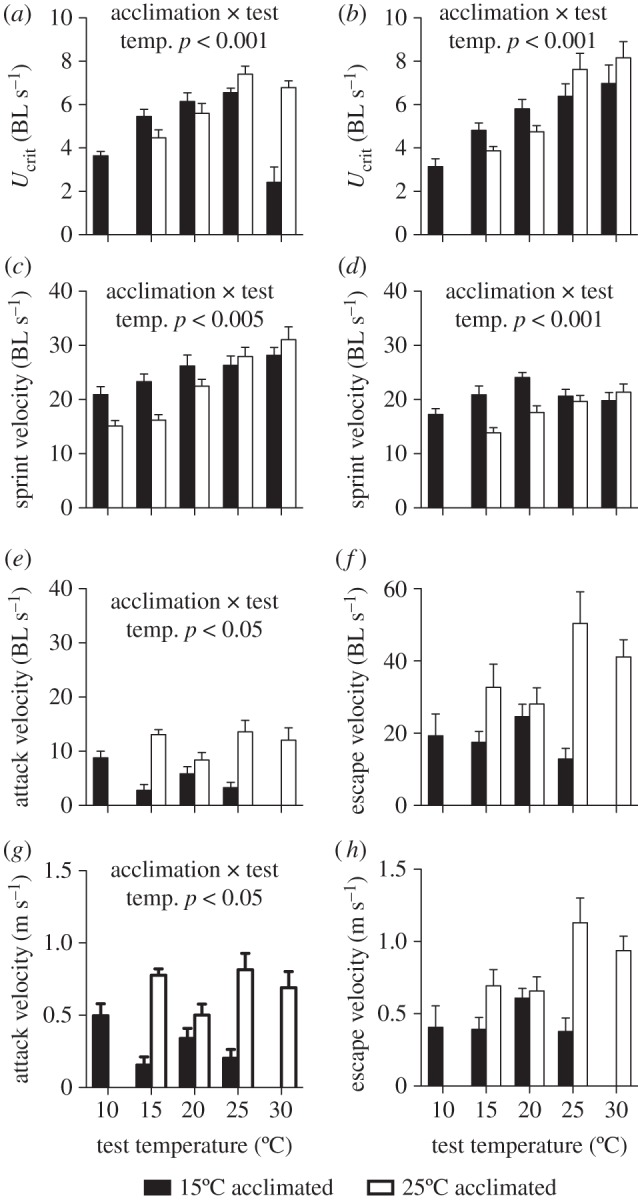
Different species respond differently to environmental change so that species interactions cannot be predicted from single-species performance curves. We tested the hypothesis that interspecific difference in the capacity for thermal acclimation modulates predator-prey interactions. Acclimation of locomotor performance in a predator (Australian bass, Macquaria novemaculeata) was qualitatively different to that of its prey (eastern mosquitofish, Gambusia holbrooki). Warm (25°C) acclimated bass made more attacks than cold (15°C) acclimated fish regardless of acute test temperatures (10-30°C), and greater frequency of attacks was associated with increased prey capture success. However, the number of attacks declined at the highest test temperature (30°C). Interestingly, escape speeds of mosquitofish during predation trials were greater than burst speeds measured in a swimming arena, whereas attack speeds of bass were lower than burst speeds. As a result, escape speeds of mosquitofish were greater at warm temperatures (25°C and 30°C) than attack speeds of bass. The decline in the number of attacks and the increase in escape speed of prey means that predation pressure decreases at high temperatures. We show that differential thermal responses affect species interactions even at temperatures that are within thermal tolerance ranges. This thermal sensitivity of predator-prey interactions can be a mechanism by which global warming affects ecological communities.
Figures

References
-
- Huey R. B., Berrigan D., Gilchrist G. W., Herron J. C. 1999. Testing the adaptive significance of acclimation: a strong inference approach. Am. Zool. 39, 323–336
-
- Wilson R. S., Franklin C. E. 2002. Testing the beneficial acclimation hypothesis. Trends Ecol. Evol. 17, 66–7010.1016/S0169-5347(01)02384-9 (doi:10.1016/S0169-5347(01)02384-9) - DOI - DOI
-
- Seebacher F., Davison W., Lowe C. J., Franklin C. E. 2005. A falsification of the thermal specialization paradigm: compensation for elevated temperatures in Antarctic fishes. Biol. Lett. 1, 151–15410.1098/rsbl.2004.0280 (doi:10.1098/rsbl.2004.0280) - DOI - DOI - PMC - PubMed
-
- Franklin C. E., Davison W., Seebacher F. 2007. Antarctic fish can compensate for rising temperatures: thermal acclimation of cardiac performance in Pagothenia borchgrevinki. J. Exp. Biol. 210, 3068–307410.1242/Jeb.003137 (doi:10.1242/Jeb.003137) - DOI - DOI - PubMed
-
- Chown S. L., Gaston K. J., van Kleunen M., Clusella-Trullas S. 2010. Population responses within a landscape matrix: a macrophysiological approach to understanding climate change impacts. Evol. Ecol. 24, 601–61610.1007/s10682-009-9329-x (doi:10.1007/s10682-009-9329-x) - DOI - DOI
Publication types
MeSH terms
LinkOut - more resources
Full Text Sources
Research Materials
