Review
. 2011 Aug 17;2(8):450-70.
doi: 10.1021/cn2000519. Epub 2011 Jun 27.

Progress toward positive allosteric modulators of the metabotropic glutamate receptor subtype 5 (mGluR5)

Affiliations
Review

Progress toward positive allosteric modulators of the metabotropic glutamate receptor subtype 5 (mGluR5)

Shaun R Stauffer. ACS Chem Neurosci. .

Abstract

This Review describes recent trends in the development of small molecule mGlu(5) positive allosteric modulators (PAMs). A large body of pharmacological, genetic, electrophysiological, and in vivo behavioral evidence has accumulated over the past decade which continues to support the hypothesis and rationale for the activation of the metabotropic glutamate receptor subtype 5 (mGlu(5)) as a viable and promising target for the development of novel antipsychotics. Until recently, functionally efficacious and potent mGlu(5) PAMs have been somewhat structurally limited in scope and slow to emerge. This Review will discuss efforts since late 2008 which have provided novel mGlu(5) PAM chemotypes, offering ligands with a diverse range of pharmacological, physicochemical, and DMPK properties that were previously unavailable. In addition, significant biological studies of importance in the past few years using the well established PAMs known as DFB, CPPHA, CDPPB, and ADX-47273 will be discussed.

Keywords: ADX-47273; CDPPB; CPPHA; DFB; Metabotropic; allosteric; glutamate; mGlu5; positive allosteric modulator; schizophrenia.


Figures
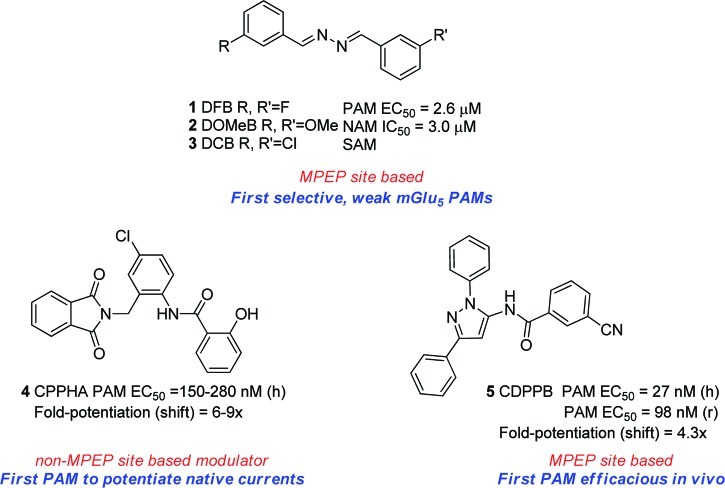
Figure 1
Figure 1
First-generation mGlu5 PAMs: DFB (1), CPPHA (4) and CDPPB (5). Within DFB series “molecular switches” were identified to afford a NAM (DOMeB, 2) and a SAM (DCB, 3). DFB (1–3) and CDPPB series (5) share the same NAM binding site characterized by MPEP, whereas CPPHA (4) binds at a distinct, non-MPEP site.
Figure 2
Figure 2
Piperidinylazole-based mGlu5 PAMs developed by Addex: ADX-47273 (9), N-linked tetrazole (10), isoxazole amide (11), and regioisomeric oxadiazole (12) reported in patent applications as being efficacious in reversal of amphetamine and/or PCP models of locomotion.
Figure 3
Figure 3
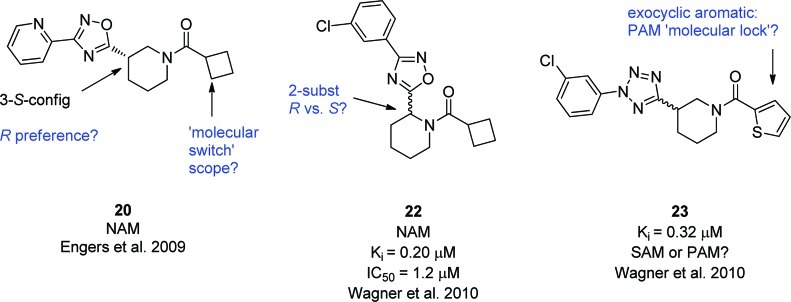
Pipiperidinyl cyclobutyl amides and hypotheses for “molecular switch/lock”: Addex inspired cyclobutyl amide as “molecular switch” (20), 2-piperidinyl oxadiazole HTS NAM lead reported by Gedeon Richter (22), and functionally “inactive” thiophene amide (23).
Figure 4
Figure 4
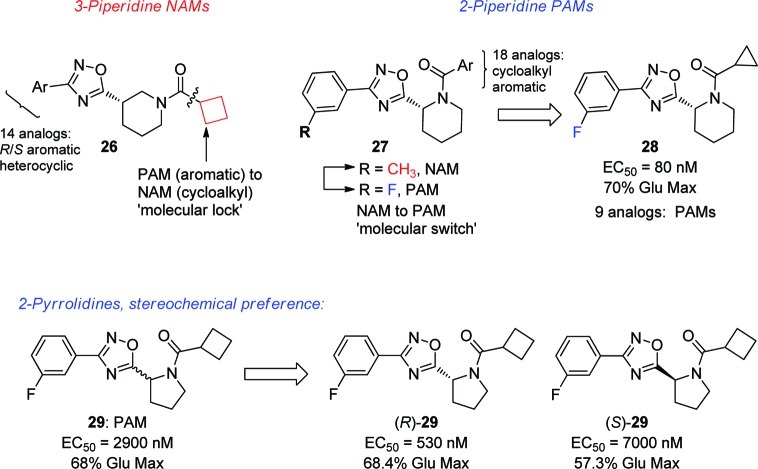
Structures of ADX-47273 analogues with “molecular locks” and subtle “molecular switches”: 2- vs 3-substituted piperidines (2628), transfer of “molecular switch” to 2-substituted pyrrolidine ring system and stereochemical preference (29).
Figure 5
Figure 5
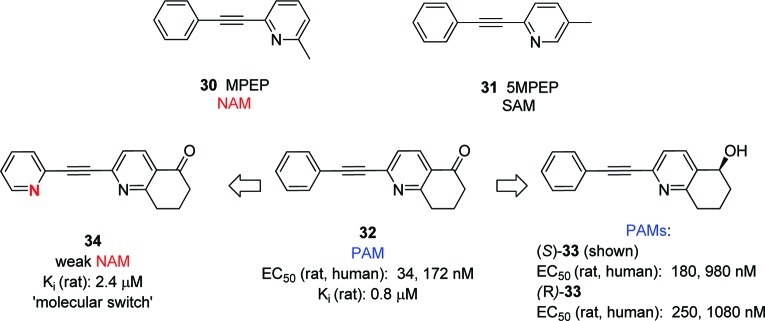
Structures of MPEP and 5MPEP (30, 31), first reported MPEP-based mGlu5 PAMs (32, 33) and example of “molecular switch” within dihydroquinolinone scaffold (34) reported by Merz.
Figure 6
Figure 6
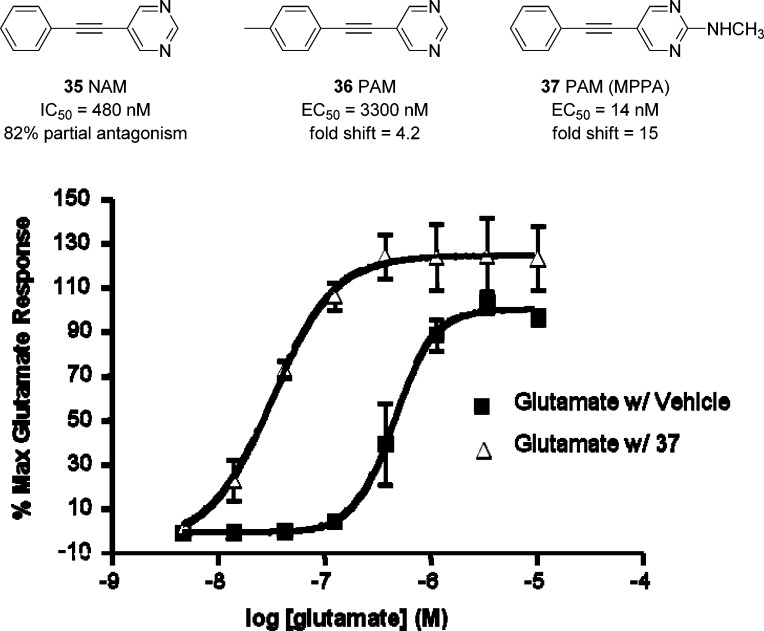
Acetylenic pyrimidine mGlu5 modulators: (top panel) partial antagonist discovered from Vanderbilt HTS (35), 4-methyl substituted PAM (36), and optimized 2-aminomethyl PAM (37). (bottom panel) PAM 37 potentiates the response of the glutamate concentration response curve 15-fold and increases agonist sensitivity.
Figure 7
Figure 7
Phenyl and naphthridinone acetylenic PAMs disclosed by VCNND in 2008 as active in vivo using an amphetamine based antipsychotic model.
Figure 8
Figure 8
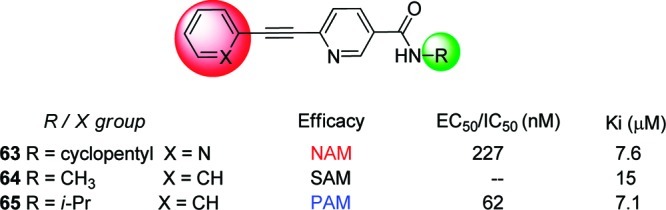
First report of PAM to NAM/SAM mode switching within monocyclic MPEP scaffold.
Figure 9
Figure 9
N-Aryl piperazines disclosed in patent literature as mGlu5 PAMs.
Figure 10
Figure 10
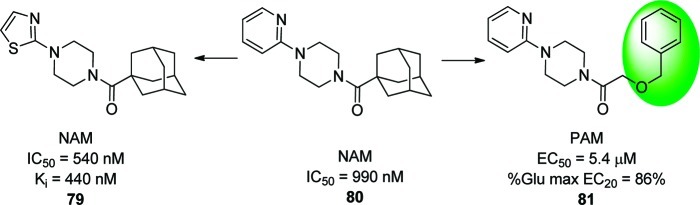
Vanderbilt piperazine based PAM 81 from NAM 80.
Figure 11
Figure 11
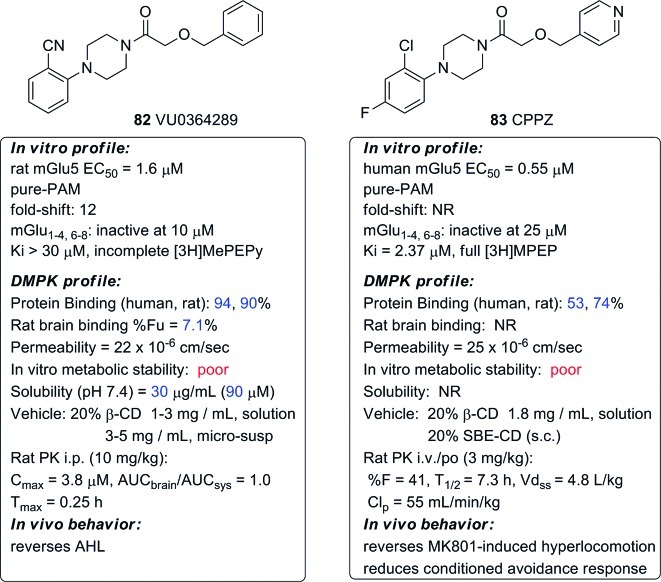
Optimized N-aryl piperazines 82 and 83 recently utilized in vivo.
Figure 12
Figure 12
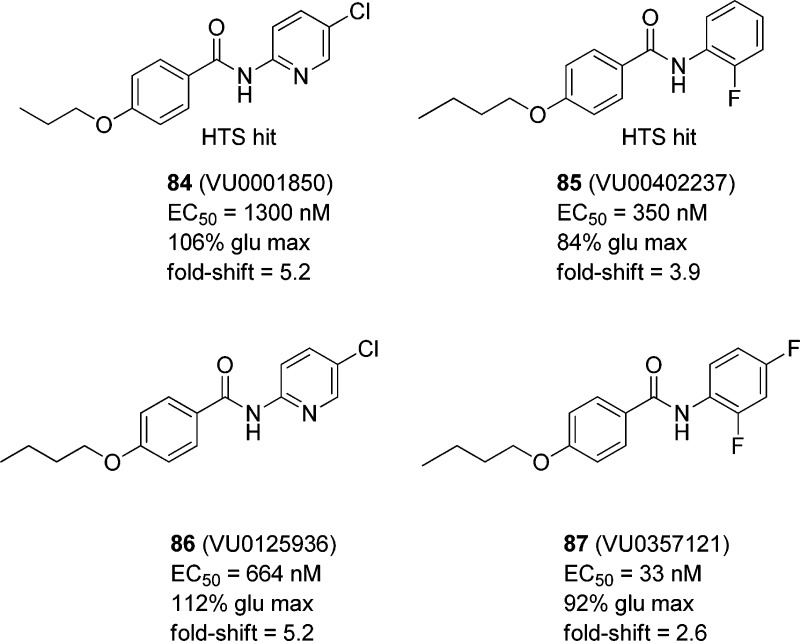
Non-MPEP site VCNDD HTS benzamide hits containing an ether linker 84 and 85 and evolved PAMs 86 and 87 from parallel synthesis.
Figure 13
Figure 13
Neutral or silent allosteric modulators (SAMs) for mGlu5.,
Figure 14
Figure 14
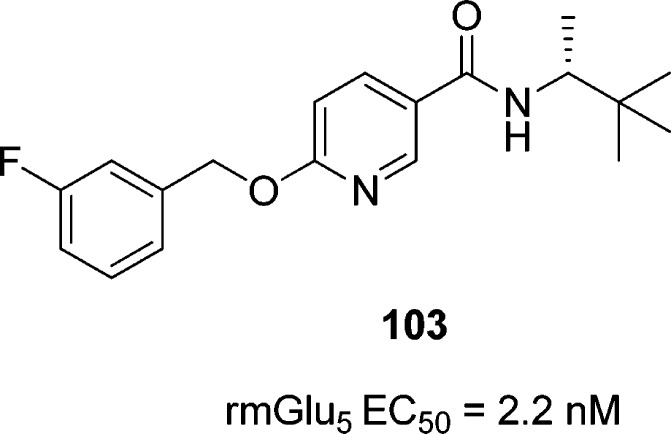
Ether containing mGlu5 PAM (103) disclosed by VCNDD as active in AHL.

References

    1. Featherstone D. E. (2010) Intercellular Glutamate Signaling in the Nervous System and Beyond. ACS Chem. Neurosci. 1, 4–12. - PMC - PubMed
    1. Kew J. N.; Kemp J. A. (2005) Ionotropic and metabotropic glutamate receptor structure and pharmacology. Psychopharmacology (Heidelberg, Ger.) 179, 4–29. - PubMed
    1. Marino M. J.; Conn P. J. (2006) Glutamate-based therapeutic approaches: allosteric modulators of metabotropic glutamate receptors. Curr. Opin. Pharmacol. 6, 98–102. - PubMed
    1. Shipe W. D.; Wolkenberg S. E.; Williams D. L. Jr.; Lindsley C. W. (2005) Recent advances in positive allosteric modulators of metabotropic glutamate receptors. Curr. Opin. Drug Discovery Dev. 8, 449–457. - PubMed
    1. Conn P. J.; Lindsley C. W.; Jones C. K. (2009) Activation of metabotropic glutamate receptors as a novel approach for the treatment of schizophrenia. Trends Pharmacol. Sci. 30, 25–31. - PMC - PubMed

Publication types

MeSH terms

Substances