


Experimentally induced psoriatic lesion associates with interleukin (IL)-6 in mast cells and appearance of dermal cells expressing IL-33 and IL-6 receptor
- PMID: 22861371
- PMCID: PMC3445008
- DOI: 10.1111/j.1365-2249.2012.04618.x
Experimentally induced psoriatic lesion associates with interleukin (IL)-6 in mast cells and appearance of dermal cells expressing IL-33 and IL-6 receptor
Abstract
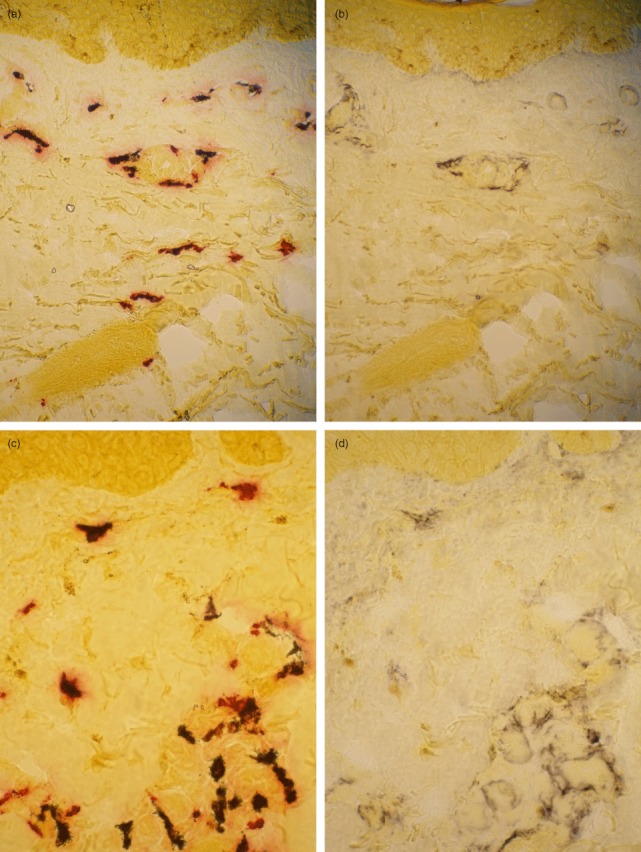
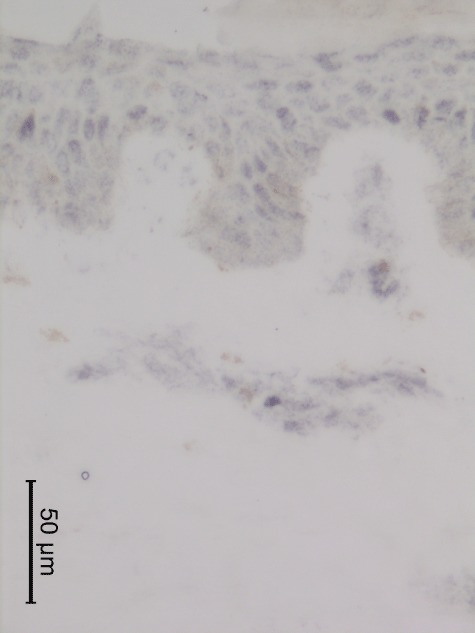
Mast cells are involved in the development of psoriatic lesion, but it is not known how mast cells are activated or whether mast cell cytokines are expressed during the lesion development. In this study, the Köbner reaction was induced in uninvolved psoriatic skin of 18 patients using the tape-stripping technique, and a sequence of biopsies was collected at 0 days, 2 h and 3 days or at 0 days, 1 day and 7 days for histochemical analysis. Eight patients developed the Köbner reaction verified at the follow-up visit 2-2·5 weeks later. No significant differences were observed in total tryptase(+) mast cells, psoriasis area and severity index and age/sex. Instead, the percentage of tryptase(+) mast cells showing interleukin (IL)-6 immunoreactivity was significantly higher in biopsies from Köbner-positive patients than in those from Köbner-negative patients. IL-33 is a known inducer of IL-6 in mast cells, and the number of IL-33(+) cells increased significantly in Köbner-positive dermal skin at days 3-7. The number of dermal cells with IL-6 receptor (IL-6R, CD126) also increased in Köbner-positive skin at days 3-7. Unexpectedly, the number of IL-6R(+) cells was even higher in Köbner-negative skin at days 3-7. In the chronic plaque of 10 other psoriatic patients, the numbers of IL-6(+) mast cells and dermal cells showing IL-6R were higher than those in the non-lesional skin. In conclusion, the positive Köbner reaction is associated with IL-6 in mast cells and appearance of IL-6R(+) and IL-33(+) dermal cells. This suggests that a previously unrecognized vicious circle may develop in the early psoriatic lesion.
© 2012 The Authors. Clinical and Experimental Immunology © 2012 British Society for Immunology.
Figures

References
-
- Harvima IT, Nilsson G, Suttle M-M, Naukkarinen A. Is there a role for mast cells in psoriasis? Arch Dermatol Res. 2008;300:461–78. - PubMed
-
- Galli SJ, Nakae S, Tsai M. Mast cells in the development of adaptive immune responses. Nat Immunol. 2005;6:135–42. - PubMed
-
- Henz BM, Maurer M, Lippert U, Worm M, Babina M. Mast cells as initiators of immunity and host defense. Exp Dermatol. 2001;10:1–10. - PubMed
-
- Harvima IT, Naukkarinen A, Paukkonen K, et al. Mast cell tryptase and chymase in developing and mature psoriatic lesions. Arch Dermatol Res. 1993;285:184–92. - PubMed
-
- Diaconu N-C, Kaminska R, Naukkarinen A, Harvima RJ, Harvima IT. The increase in tryptase- and chymase-positive mast cells is associated with partial inactivation of chymase and increase in protease inhibitors in basal cell carcinoma. J Eur Acad Dermatol Venereol. 2007;21:908–15. - PubMed
Publication types
MeSH terms
Substances
LinkOut - more resources
Full Text Sources
Medical
Research Materials
