. 2012 Sep;137(1):1-19.
doi: 10.1111/j.1365-2567.2012.03591.x.

Regulation of TCR signalling by tyrosine phosphatases: from immune homeostasis to autoimmunity

Affiliations

Regulation of TCR signalling by tyrosine phosphatases: from immune homeostasis to autoimmunity

Stephanie M Stanford et al. Immunology. 2012 Sep.

Abstract

More than half of the known protein tyrosine phosphatases (PTPs) in the human genome are expressed in T cells, and significant progress has been made in elucidating the biology of these enzymes in T-cell development and function. Here we provide a systematic review of the current understanding of the roles of PTPs in T-cell activation, providing insight into their mechanisms of action and regulation in T-cell receptor signalling, the phenotypes of their genetically modified mice, and their possible involvement in T-cell-mediated autoimmune disease. Our projection is that the interest in PTPs as mediators of T-cell homeostasis will continue to rise with further functional analysis of these proteins, and PTPs will be increasingly considered as targets of immunomodulatory therapies.


Figures

Figure 1
Figure 1
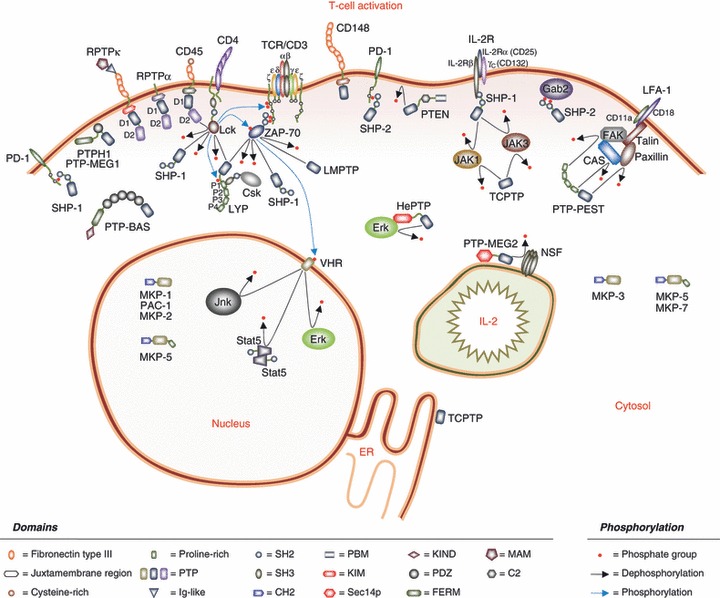
Schematic representation of the diverse functions of the protein tyrosine phosphatases (PTPs) regulating T-cell activation. The activation of a T cell involves tyrosine phosphorylation at multiple levels, and PTPs play diverse roles that work in concert together to cause the response of the T cell to the extracellular environment, to cause T-cell mobilization and to cause the production and response to cytokines such as interleukin-2 (IL-2). PTPs involved in these processes include transmembrane PTPs and intracellular membrane-proximal, cytosolic and nuclear PTPs. The initial response of a T cell to the external environment is finely tuned by PTPs regulating the early wave of phosphorylation events immediately proximal to the T-cell receptor (TCR), and many of the PTPs are found near the plasma membrane. These PTPs control the phosphorylation status of the Src family kinases (SFKs), the immunoreceptor tyrosine-based activation motifs (ITAMS) of the ζ chains and ZAP-70. Further downstream, PTPs control both membrane-proximal and cytosolic signalling effectors. Activation of mitogen-activated protein kinases (MAPKs) is spatially regulated by classical and dual-specific PTPs localized to the cytosol and/or nucleus. T-cell mobility is controlled by cytoskeletal rearrangements, involving multiple PTPs with protein–protein interaction domains and FERM (band 4.1–ezrin–radixin–moesin) domains that allow their association with complexes regulating the cytoskeleton and/or the plasma membrane. Post-transcriptionally, secretion of cytokines such as IL-2 requires phosphotyrosine-mediated vesicle formation. The autocrine response of T cells to extracellular IL-2 is mediated through tyrosine phosphorylation of signalling molecules downstream from the IL-2 receptor. An additional layer of modulation of the T-cell response is added through triggering of inhibitory receptors, whose function is mediated by cytosolic PTPs that can bind to the inhibitory motifs on these receptors.
Figure 2
Figure 2
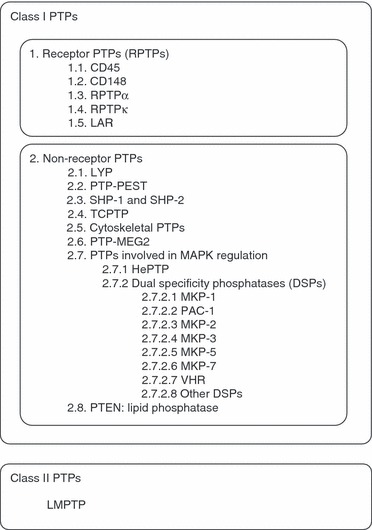
Classification scheme of the protein tyrosine phosphatases (PTPs) described in this review.

References

    1. van der Merwe PA, Dushek O. Mechanisms for T cell receptor triggering. Nat Rev. 2011;11:47–55. - PubMed
    1. Smith-Garvin JE, Koretzky GA, Jordan MS. T cell activation. Annu Rev Immunol. 2009;27:591–619. - PMC - PubMed
    1. Acuto O, Di Bartolo V, Michel F. Tailoring T-cell receptor signals by proximal negative feedback mechanisms. Nat Rev. 2008;8:699–712. - PubMed
    1. Weiss A. The right team at the right time to go for a home run: tyrosine kinase activation by the TCR. Nat Immunol. 2010;11:101–4. - PubMed
    1. Davis SJ, van der Merwe PA. The kinetic-segregation model: TCR triggering and beyond. Nat Immunol. 2006;7:803–9. - PubMed

Publication types

Substances

LinkOut - more resources