Case Reports
. 2012 Aug 10;91(2):343-8.
doi: 10.1016/j.ajhg.2012.06.005. Epub 2012 Aug 2.

A single recurrent mutation in the 5'-UTR of IFITM5 causes osteogenesis imperfecta type V

Affiliations
Case Reports

A single recurrent mutation in the 5'-UTR of IFITM5 causes osteogenesis imperfecta type V

Tae-Joon Cho et al. Am J Hum Genet. .

Abstract

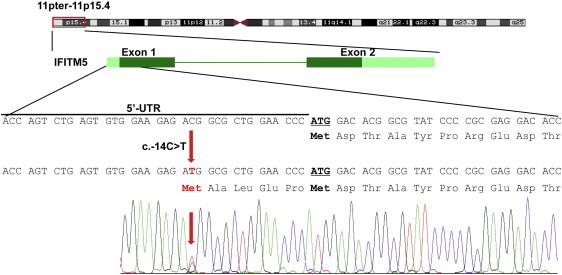
Osteogenesis imperfecta (OI) is a heterogenous group of genetic disorders of bone fragility. OI type V is an autosomal-dominant disease characterized by calcification of the forearm interosseous membrane, radial head dislocation, a subphyseal metaphyseal radiodense line, and hyperplastic callus formation; the causative mutation involved in this disease has not been discovered yet. Using linkage analysis in a four-generation family and whole-exome sequencing, we identified a heterozygous mutation of c.-14C>T in the 5'-untranslated region of a gene encoding interferon-induced transmembrane protein 5 (IFITM5). It completely cosegregated with the disease in three families and occurred de novo in five simplex individuals. Transfection of wild-type and mutant IFITM5 constructs revealed that the mutation added five amino acids (Met-Ala-Leu-Glu-Pro) to the N terminus of IFITM5. Given that IFITM5 expression and protein localization is restricted to the skeletal tissue and IFITM5 involvement in bone formation, we conclude that this recurrent mutation would have a specific effect on IFITM5 function and thus cause OI type V.


Figures

Figure 1
Figure 1
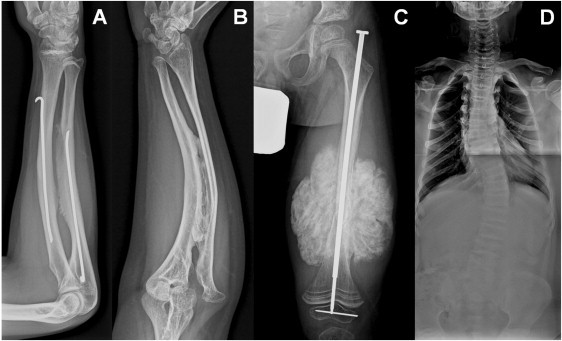
Radiologic Findings for OI Type V (A) The forearm of individual II:1 from family 9 at 15 years of age shows calcification of the interosseous membrane without radial-head dislocation. (B) The forearm of individual II:2 from family 3 at 27 years of age shows calcification of the interosseous membrane with radial-head dislocation. (C) The left femur i of individual II:1 from family 4 at 7 years of age. Note hyperplastic callus after open reduction of the femur shaft fracture. (D) Scoliosis and vertebral body collapse in individual IV:6 from family 1 at 11 years of age.
Figure 2
Figure 2
Mutation of IFITM5 in OI Type V Schematic representation of IFITM5 is shown under the linked region (11pter-11p15.4). Dark green boxes indicate coding exons, and bright green boxes indicate UTRs. The mutation (c.−14C>T) is indicated by the red arrow, and the additional five amino acids generated by this mutation are shown under the gene sequence. The sequencing chromatogram of an affected individual is shown below.
Figure 3
Figure 3
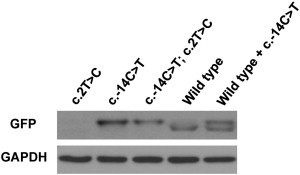
In Vitro Translation Assay Total cell lysates of HEK293 cells transfected with three mutated cDNAs (c.2T>C, c.−14C>T, and both), wild-type, or wild-type along with c.−14C>T cDNA were immunoblotted with GFP antibody. When the original start codon was mutated (c.2T>C), no translation was observed. Translation started at the start codon generated by the mutation (c. −14C>T) regardless of the status of the original start codon. Its translaton product was slightly larger than that of the wild-type. Cotransfection with wild-type and c.−14C>T-mutated constructs produced double bands. GAPDH was used as an internal control.

References

    1. Sillence D.O., Senn A., Danks D.M. Genetic heterogeneity in osteogenesis imperfecta. J. Med. Genet. 1979;16:101–116. - PMC - PubMed
    1. Rauch F., Glorieux F.H. Osteogenesis imperfecta. Lancet. 2004;363:1377–1385. - PubMed
    1. Becker J., Semler O., Gilissen C., Li Y., Bolz H.J., Giunta C., Bergmann C., Rohrbach M., Koerber F., Zimmermann K. Exome sequencing identifies truncating mutations in human SERPINF1 in autosomal-recessive osteogenesis imperfecta. Am. J. Hum. Genet. 2011;88:362–371. - PMC - PubMed
    1. Morello R., Bertin T.K., Chen Y., Hicks J., Tonachini L., Monticone M., Castagnola P., Rauch F., Glorieux F.H., Vranka J. CRTAP is required for prolyl 3- hydroxylation and mutations cause recessive osteogenesis imperfecta. Cell. 2006;127:291–304. - PubMed
    1. Cabral W.A., Chang W., Barnes A.M., Weis M., Scott M.A., Leikin S., Makareeva E., Kuznetsova N.V., Rosenbaum K.N., Tifft C.J. Prolyl 3-hydroxylase 1 deficiency causes a recessive metabolic bone disorder resembling lethal/severe osteogenesis imperfecta. Nat. Genet. 2007;39:359–365. - PMC - PubMed

Publication types

Supplementary concepts