. 2012 Aug 3;8(1):13.
doi: 10.1186/1710-1492-8-13.

Feasibility of exercising adults with asthma: a randomized pilot study

Affiliations

Feasibility of exercising adults with asthma: a randomized pilot study

Amy Boyd et al. Allergy Asthma Clin Immunol. .

Abstract

Background: Aerobic exercise appears to have clinical benefits for many asthmatics, yet a complete understanding of the mechanisms underlying these benefits has not been elucidated at this time.

Purpose: The objective of this study was to determine feasibility for a larger, future study that will define the effect of aerobic exercise on cellular, molecular, and functional measures in adults with mild-moderate asthma.

Design: Recruited subjects were randomized into usual care (sedentary) or usual care with moderate intensity aerobic exercise treatment groups.

Setting / participants: Nineteen adults with mild-moderate asthma but without a recent history of exercise were recruited at the UAB Lung Health Center, Birmingham, AL.

Intervention: The exercise group underwent a 12 week walking program exercising at 60 - 75% of maximum heart rate (HRmax). Subjects self-monitored HRmax levels using heart rate monitors; exercise diaries and recreation center sign-in logs were also used.

Main outcome measures: Functional measures, including lung function and asthma control scores, were evaluated for all subjects at pre- and post-study time-points; fitness measures were also assessed for subjects in the exercise group. Peripheral blood and nasal lavage fluid were collected from all subjects at pre- and post-study visits in order to evaluate cellular and molecular measures, including cell differentials and eosinophilic cationic protein (ECP).

Results: Sixteen subjects completed the prescribed protocol. Results show that subjects randomized to the exercise group adhered well (80%) to the exercise prescription and exhibited a trend toward improved fitness levels upon study completion. Both groups exhibited improvements in ACQ scores. No changes were observed in lung function (FEV1, FEV1/FVC), cell differentials, or ECP between groups.

Conclusions: Results indicate that a moderate intensity aerobic exercise training program may improve asthma control and fitness levels without causing asthma deterioration in adult asthmatics. As such, these findings demonstrate the feasibility of the study protocol in preparation for a larger, clinical trial that will elucidate the functional consequences of aerobic exercise on asthmatic cellular and molecular responses.


Figures
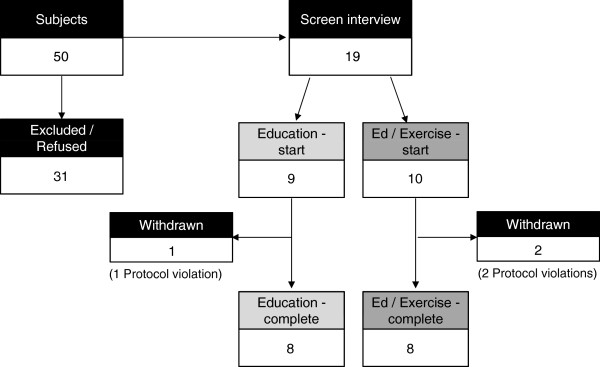
Figure 1
Figure 1
CONSORT figure of subject screening and recruitment. Fifty subjects were interviewed; thirty-one were excluded or refused. The remaining subjects were randomized into education and education with exercise treatment groups. A total of three subjects (1 – education; 2 – education/exercise) were withdrawn from the study because of protocol violations.
Figure 2
Figure 2
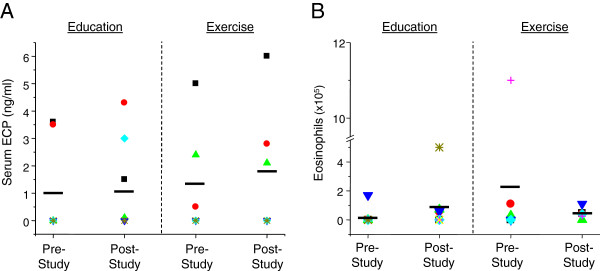
Changes in circulating ECP and eosinophils between sedentary and exercise treatment groups. Serum samples were collected from sedentary and exercise subjects at pre- and post-study timepoints. ECP levels in serum (A) were measured via ECP-specific ELISA. Cells were harvested from the peripheral blood at pre- and post-study timepoints. Differential cell counts for (B) eosinophils were performed as described in the text. Results are reported as percent of total peripheral blood immune cells. Black bars indicate average measurements in each group (education: n = 8; exercise: n = 6).
Figure 3
Figure 3
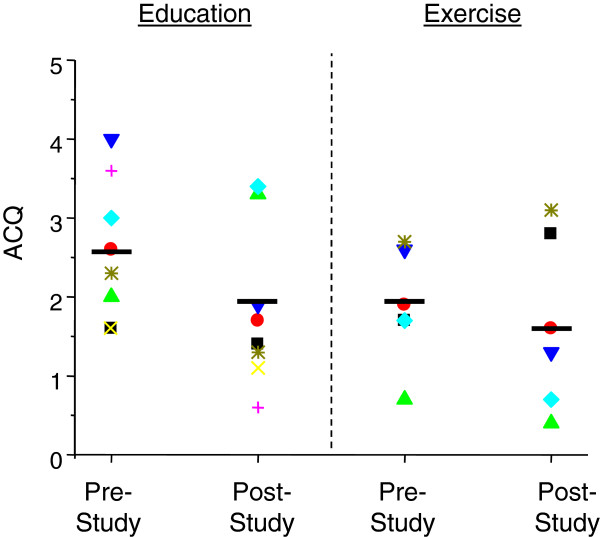
Changes in asthma control between sedentary and exercise treatment groups. Changes in asthma control were measured using the Asthma Control Questionnaire (ACQ). Black bars indicate average responses in each group (education: n = 8; exercise: n = 6).
Figure 4
Figure 4
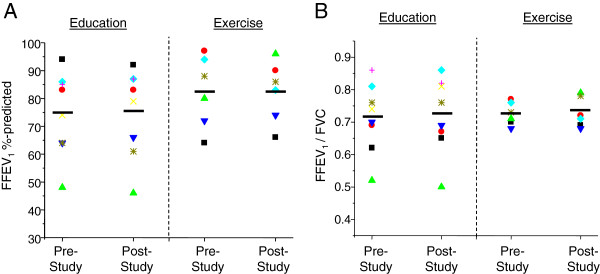
Changes in lung function between sedentary and exercise treatment groups. (A) FEV1 and (B) FEV1/FVC parameters were measured via spirometry in sedentary and exercise subjects at pre- and post-study timepoints. Results are reported as either percent predicted (FEV1) or percent actual (FEV1/FVC). Black bars indicate respective averages in each group (education: n = 8; exercise: n = 6).
Figure 5
Figure 5
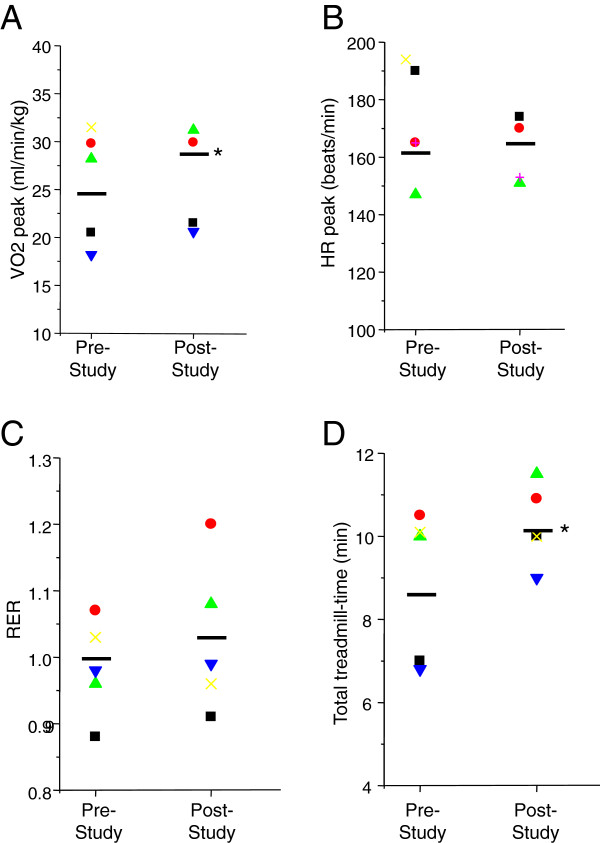
Changes in fitness levels in exercise subjects. Subjects randomized to the exercise treatment group performed a mandated graded treadmill test to volitional fatigue using a modified version of the Bruce protocol both before and upon protocol completion. Fitness measures included A) VO2 peak, B) HR peak, C) respiratory exchange ratio (RER), and D) total treadmill-time. Black bars indicate average responses in each group (*p ≤ 0.04 as compared with pre-study measurements; education: n = 8; exercise: n = 6).

References

    1. Koh G, Shek L, Go D, Van Bever H, Koh D. Eosinophil cationic protein: Is it useful in asthma? A systematic review. Respir Med. 2007;101:696. doi: 10.1016/j.rmed.2006.08.012. - DOI - PubMed
    1. Sorkness C, McGill K, Busse W. Evaluation of serum eosinophil cationic protein as a predictive marker for asthma exacerbation in patients with persisten disease. Clin Exp All. 2002;32:1355. doi: 10.1046/j.1365-2222.2002.01471.x. - DOI - PubMed
    1. Lucas S, Platts-Mills T. Physical activity and exercise with asthma: Relevance to etiology and treatment. J All Clin Immunol. 2005;115:928. doi: 10.1016/j.jaci.2005.01.033. - DOI - PubMed
    1. Pastva A, Estell K, Schoeb T, Atkinson T, Schwiebert L. Aerobic exercise attenuates airway inflammatory responses in a mouse model of atopic asthma. J Immunol. 2004;172:4520. - PMC - PubMed
    1. Lowder T, Dugger K, Deshane J, Estell K, Schwiebert L. Repeated bouts of aerobic exercise enhance regulatory T cell responses in a murine asthma model. Brain Behav Immun. 2010;24:153. doi: 10.1016/j.bbi.2009.09.011. - DOI - PMC - PubMed