


Ovarian cancer and smoking: individual participant meta-analysis including 28,114 women with ovarian cancer from 51 epidemiological studies
- PMID: 22863523
- PMCID: PMC3431503
- DOI: 10.1016/S1470-2045(12)70322-4
Ovarian cancer and smoking: individual participant meta-analysis including 28,114 women with ovarian cancer from 51 epidemiological studies
Abstract
Background: Smoking has been linked to mucinous ovarian cancer, but its effects on other ovarian cancer subtypes and on overall ovarian cancer risk are unclear, and the findings from most studies with relevant data are unpublished. To assess these associations, we review the published and unpublished evidence.
Methods: Eligible epidemiological studies were identified by electronic searches, review articles, and discussions with colleagues. Individual participant data for 28,114 women with and 94,942 without ovarian cancer from 51 epidemiological studies were analysed centrally, yielding adjusted relative risks (RRs) of ovarian cancer in smokers compared with never smokers.
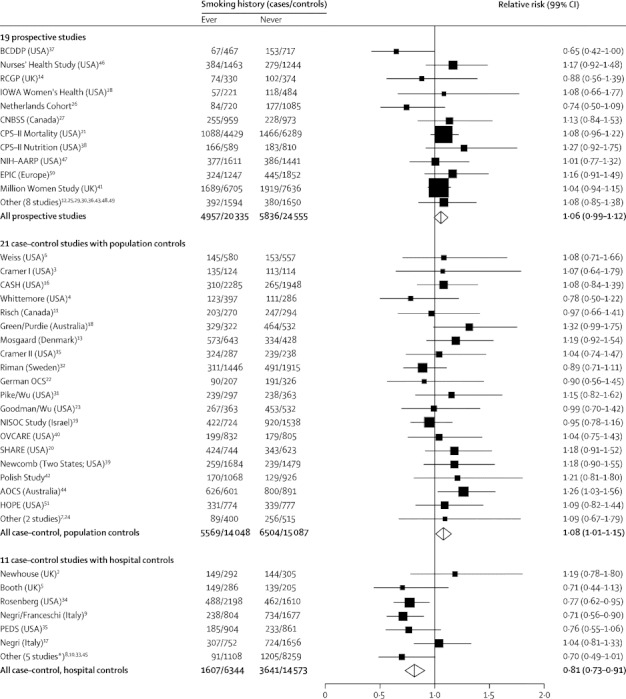
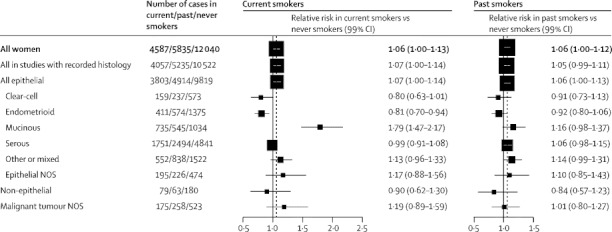
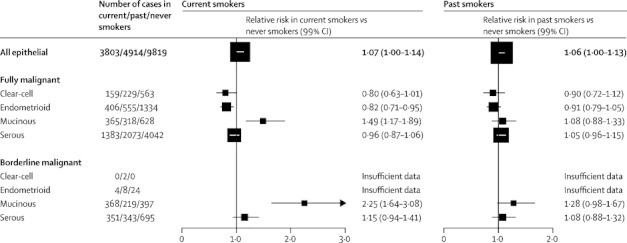
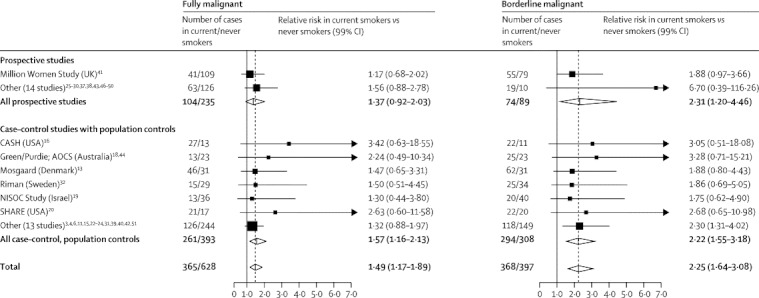
Findings: After exclusion of studies with hospital controls, in which smoking could have affected recruitment, overall ovarian cancer incidence was only slightly increased in current smokers compared with women who had never smoked (RR 1·06, 95% CI 1·01-1·11, p=0·01). Of 17,641 epithelial cancers with specified histology, 2314 (13%) were mucinous, 2360 (13%) endometrioid, 969 (5%) clear-cell, and 9086 (52%) serous. Smoking-related risks varied substantially across these subtypes (p(heterogeneity)<0·0001). For mucinous cancers, incidence was increased in current versus never smokers (1·79, 95% CI 1·60-2·00, p<0·0001), but the increase was mainly in borderline malignant rather than in fully malignant tumours (2·25, 95% CI 1·91-2·65 vs 1·49, 1·28-1·73; p(heterogeneity)=0·01; almost half the mucinous tumours were only borderline malignant). Both endometrioid (0·81, 95% CI 0·72-0·92, p=0·001) and clear-cell ovarian cancer risks (0·80, 95% CI 0·65-0·97, p=0·03) were reduced in current smokers, and there was no significant association for serous ovarian cancers (0·99, 95% CI 0·93-1·06, p=0·8). These associations did not vary significantly by 13 sociodemographic and personal characteristics of women including their body-mass index, parity, and use of alcohol, oral contraceptives, and menopausal hormone therapy.
Interpretation: The excess of mucinous ovarian cancers in smokers, which is mainly of tumours of borderline malignancy, is roughly counterbalanced by the deficit of endometrioid and clear-cell ovarian cancers. The substantial variation in smoking-related risks by tumour subtype is important for understanding ovarian carcinogenesis.
Funding: Cancer Research UK and MRC.
Copyright © 2012 Elsevier Ltd. All rights reserved.
Figures
Comment in
-
Learning from disease heterogeneity.Lancet Oncol. 2012 Sep;13(9):862-3. doi: 10.1016/S1470-2045(12)70365-0. Epub 2012 Aug 3. Lancet Oncol. 2012. PMID: 22863524 No abstract available.
References
-
- Secretan B, Straif K, Baan R, on behalf of the WHO International Agency for Research on Cancer Monograph Working Group A review of human carcinogens—Part E: tobacco, areca nut, alcohol, coal smoke, and salted fish. Lancet Oncol. 2009;10:1033–1034. - PubMed
-
- Cramer DW, Welch WR, Scully RE, Wojciechowski CA. Ovarian cancer and talc: a case-control study. Cancer. 1982;50:372–376. - PubMed
-
- Whittemore A, Wu M, Paffenbarger R. Personal and environmental characteristics related to epithelial ovarian cancer. II. Exposures to talcum powder, tobacco, alcohol and coffee. Am J Epidemiol. 1988;128:1228–1240. - PubMed
Publication types
MeSH terms
Grants and funding
LinkOut - more resources
Full Text Sources
Medical
