


STAT6 regulates natural helper cell proliferation during lung inflammation initiated by Alternaria
- PMID: 22865552
- PMCID: PMC3469584
- DOI: 10.1152/ajplung.00174.2012
STAT6 regulates natural helper cell proliferation during lung inflammation initiated by Alternaria
Abstract
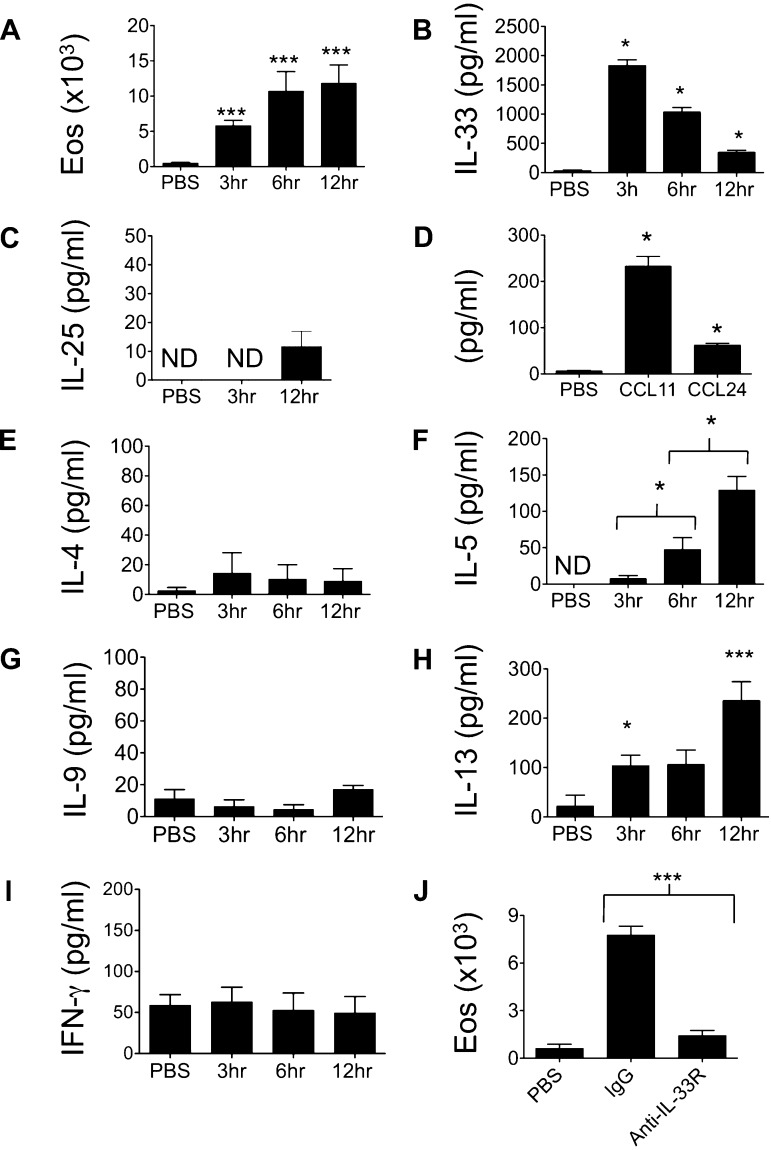
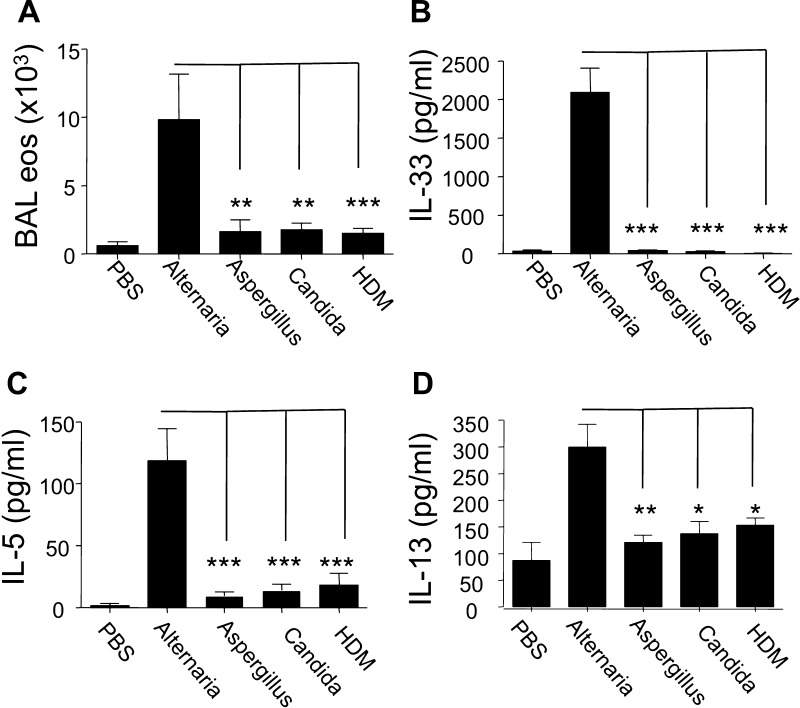
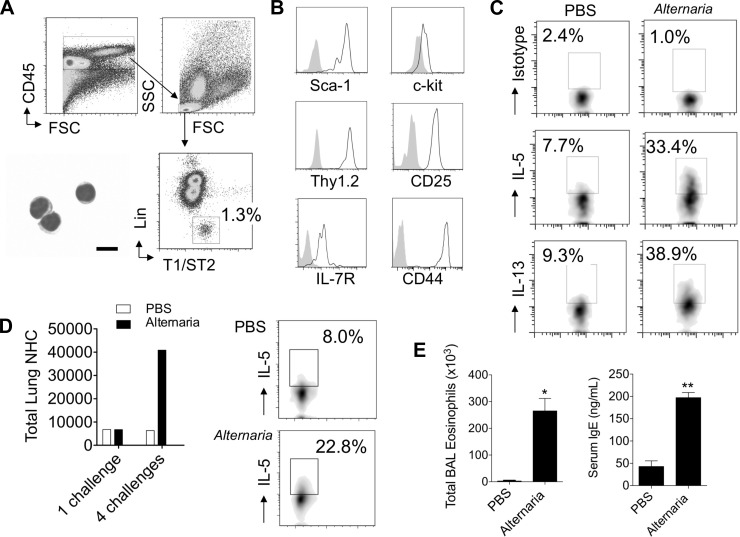
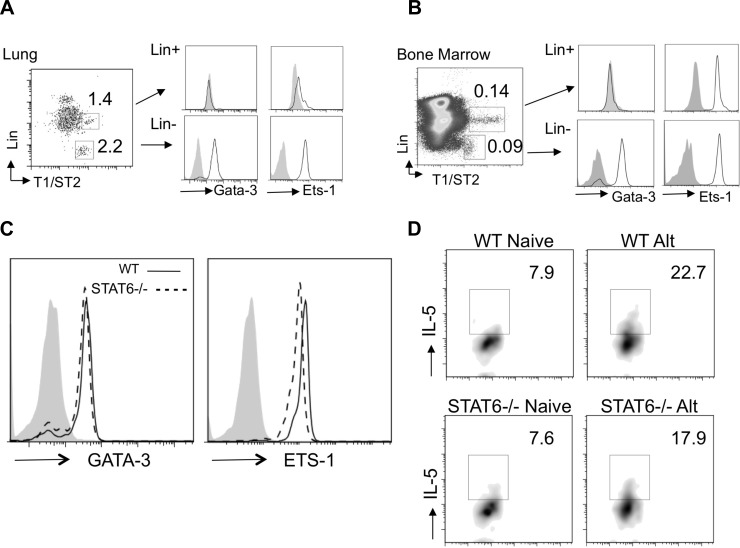
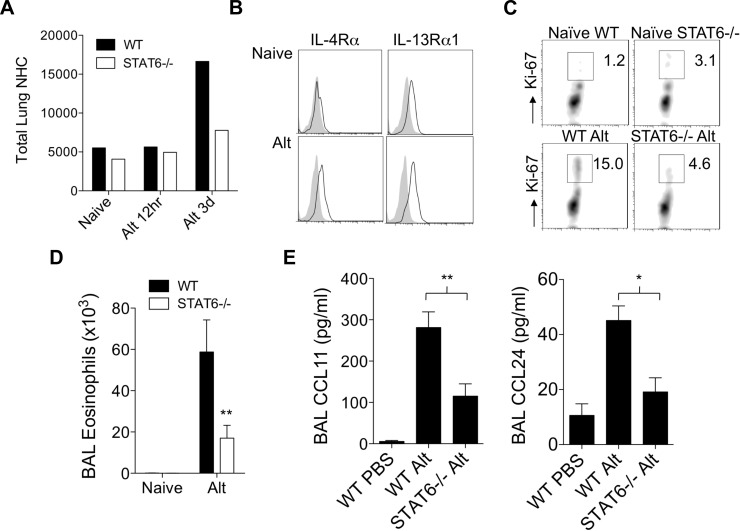
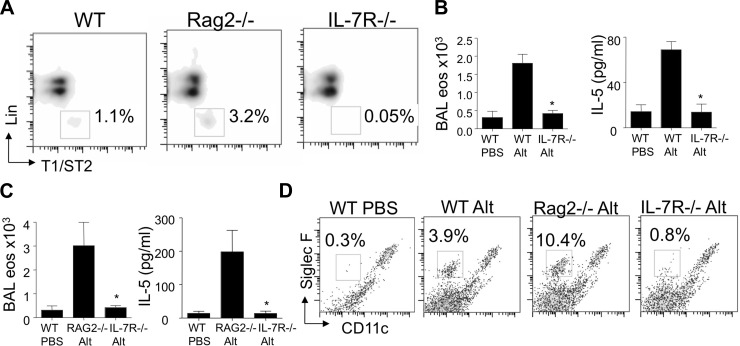
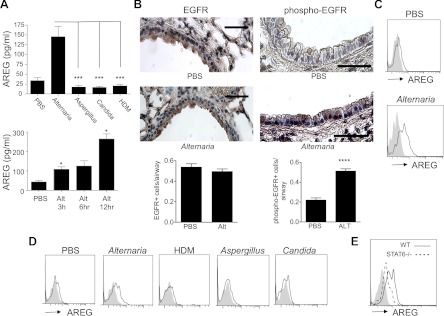
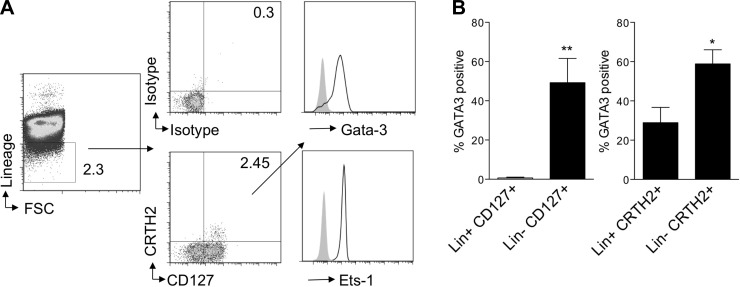
Asthma exacerbations can be caused by a number of factors, including the fungal allergen Alternaria, which is specifically associated with severe and near-fatal attacks. The mechanisms that trigger lung responses are unclear and might vary between allergens. A comparison between Alternaria, Aspergillus, Candida, and house dust mite, all allergens in humans, showed that only Alternaria promoted immediate innate airway eosinophilia within 12 h of inhalation in nonsensitized mice. Alternaria, but not the other allergens, induced a rapid increase in airway levels of IL-33, accompanied by IL-33 receptor (IL-33R)-positive natural helper cell (NHC) production of IL-5 and IL-13. NHCs in the lung and bone marrow constitutively expressed transcription factors [GATA-3 and E26 transformation-specific sequence-1 (ETS-1)] that could allow for rapid induction of T helper type 2 (Th2) cytokines. Lung NHC numbers and proliferation (%Ki-67), but not IL-5 or GATA-3 expression, were significantly reduced in STAT6-deficient mice 3 days after one challenge with Alternaria. Alternaria induced NHC expression of the EGF receptor ligand amphiregulin (partially dependent on STAT6), as well as EGF receptor signaling in the airway epithelium. Finally, human peripheral blood NHCs (CRTH2(+)CD127(+) lineage-negative lymphocytes) from allergic individuals highly expressed GATA-3 and ETS-1, similar to lung NHCs in mice. In summary, Alternaria-induced lung NHC proliferation and expression of amphiregulin are regulated by STAT6. In addition, NHCs in mouse and humans are primed to express Th2 cytokines through constitutive expression of GATA-3 and ETS-1. Thus several transcription factor pathways (STAT6, GATA-3, and ETS-1) may contribute to NHC proliferation and Th2-type responses in Alternaria-induced asthma.
Figures
Similar articles
-
Alternaria induces STAT6-dependent acute airway eosinophilia and epithelial FIZZ1 expression that promotes airway fibrosis and epithelial thickness.J Immunol. 2012 Mar 15;188(6):2622-9. doi: 10.4049/jimmunol.1101632. Epub 2012 Feb 10. J Immunol. 2012. PMID: 22327070 Free PMC article.
-
Transfer of in vivo primed transgenic T cells supports allergic lung inflammation and FIZZ1 and Ym1 production in an IL-4Rα and STAT6 dependent manner.BMC Immunol. 2011 Oct 20;12:60. doi: 10.1186/1471-2172-12-60. BMC Immunol. 2011. PMID: 22014099 Free PMC article.
-
Alternaria-derived serine protease activity drives IL-33-mediated asthma exacerbations.J Allergy Clin Immunol. 2014 Sep;134(3):583-592.e6. doi: 10.1016/j.jaci.2014.02.002. Epub 2014 Mar 15. J Allergy Clin Immunol. 2014. PMID: 24636086 Free PMC article.
-
Cytokine profiles in allergic rhinitis.Curr Allergy Asthma Rep. 2014 May;14(5):435. doi: 10.1007/s11882-014-0435-7. Curr Allergy Asthma Rep. 2014. PMID: 24633619 Review.
-
STAT6 and lung inflammation.JAKSTAT. 2013 Oct 1;2(4):e25301. doi: 10.4161/jkst.25301. Epub 2013 Jun 10. JAKSTAT. 2013. PMID: 24416647 Free PMC article. Review.
Cited by
-
Type 2 innate lymphoid cell suppression by regulatory T cells attenuates airway hyperreactivity and requires inducible T-cell costimulator-inducible T-cell costimulator ligand interaction.J Allergy Clin Immunol. 2017 May;139(5):1468-1477.e2. doi: 10.1016/j.jaci.2016.08.034. Epub 2016 Oct 4. J Allergy Clin Immunol. 2017. PMID: 27717665 Free PMC article.
-
T cells and ILC2s are major effector cells in influenza-induced exacerbation of allergic airway inflammation in mice.Eur J Immunol. 2019 Jan;49(1):144-156. doi: 10.1002/eji.201747421. Epub 2018 Jun 11. Eur J Immunol. 2019. PMID: 29762870 Free PMC article.
-
Type 2 Innate Lymphoid Cells in Allergic Disease.Curr Immunol Rev. 2013 Nov;9(4):214-221. doi: 10.2174/1573395510666140304235916. Curr Immunol Rev. 2013. PMID: 24876829 Free PMC article.
-
Innate Defense against Fungal Pathogens.Cold Spring Harb Perspect Med. 2014 Nov 10;5(6):a019620. doi: 10.1101/cshperspect.a019620. Cold Spring Harb Perspect Med. 2014. PMID: 25384766 Free PMC article. Review.
-
Type 2 innate lymphoid cells: friends or foes-role in airway allergic inflammation and asthma.J Allergy (Cairo). 2012;2012:130937. doi: 10.1155/2012/130937. Epub 2012 Nov 11. J Allergy (Cairo). 2012. PMID: 23209480 Free PMC article.
References
-
- Barlow JL, Bellosi A, Hardman CS, Drynan LF, Wong SH, Cruickshank JP, McKenzie AN. Innate IL-13-producing nuocytes arise during allergic lung inflammation and contribute to airways hyperreactivity. J Allergy Clin Immunol 129: 191–198, 2012 - PubMed
-
- Bush RK, Prochnau JJ. Alternaria-induced asthma. J Allergy Clin Immunol 113: 227–234, 2004 - PubMed
Publication types
MeSH terms
Substances
Grants and funding
LinkOut - more resources
Full Text Sources
Other Literature Sources
Medical
Research Materials
Miscellaneous
