


Two open access, high-quality datasets from anesthetic records
- PMID: 22865672
- PMCID: PMC3555334
- DOI: 10.1136/amiajnl-2012-001087
Two open access, high-quality datasets from anesthetic records
Abstract
Objective: To provide a set of high-quality time-series physiologic and event data from anesthetic cases formatted in an easy-to-use structure.
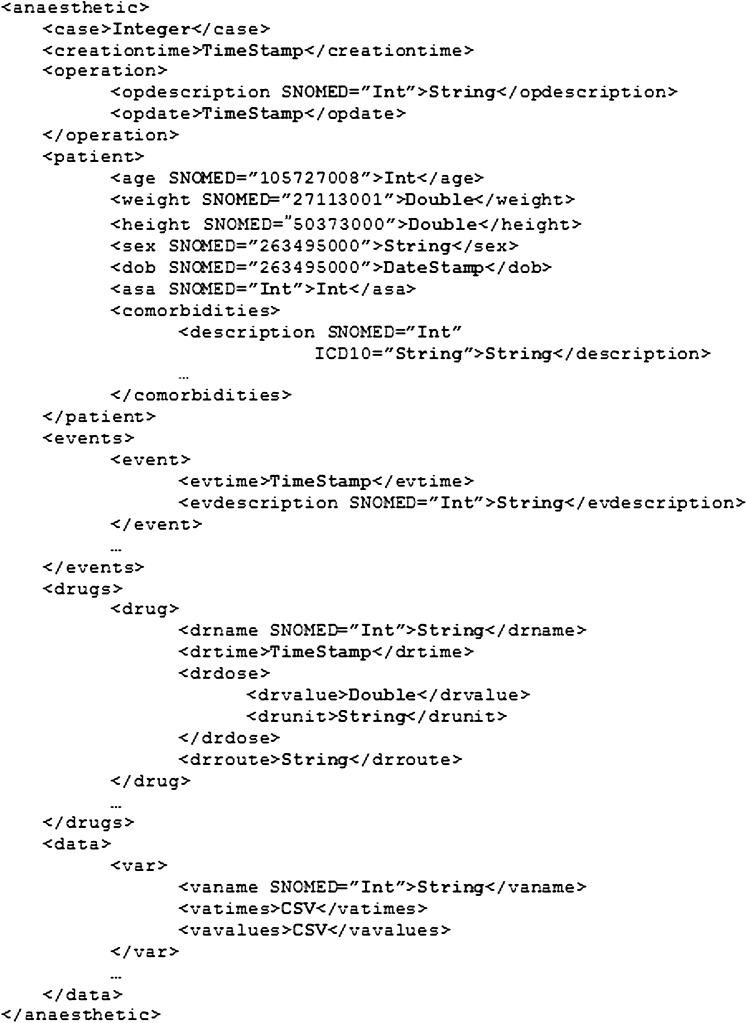
Materials and methods: With ethics committee approval, data from surgical operations under general anesthesia were collected, including physiologic data, drug administrations, events, and clinicians' comments. These data were de-identified, formatted in a combined CSV/XML structure and made publicly available.
Results: Two separate datasets were collected containing physiologic time-series data and time-stamped events for 34 patients. For 20 patients, the data included 400 physiologic signals collected over 20 h, 274 events, and 597 drug administrations. For 14 patients, the data included 23 physiologic signals collected over 69 h, with 286 time stamped comments.
Discussion: Data reuse potentially saves significant time and financial costs. However, there are few high-quality repositories for accessible physiologic data and clinical interventions from surgical cases. De-identifying records assists with overcoming problems of privacy and storing the data in a format which is easily manipulated with computing resources facilitates access by the wider research community. It is hoped that additional high-quality data will be added. Future work includes developing tools to explore and visualize the data more efficiently, and establishing quality control measures.
Conclusion: An approach to collecting and storing high-quality datasets from surgical operations under anesthesia such that they can be easily accessed by others for use in research has been demonstrated.
Conflict of interest statement
Figures
Similar articles
-
iGAS: A framework for using electronic intraoperative medical records for genomic discovery.J Biomed Inform. 2017 Mar;67:80-89. doi: 10.1016/j.jbi.2017.02.005. Epub 2017 Feb 11. J Biomed Inform. 2017. PMID: 28193464
-
Public preferences for electronic health data storage, access, and sharing - evidence from a pan-European survey.J Am Med Inform Assoc. 2016 Nov;23(6):1096-1106. doi: 10.1093/jamia/ocw012. Epub 2016 Apr 23. J Am Med Inform Assoc. 2016. PMID: 27107445 Free PMC article.
-
A Generic Method for Assessing the Quality of De-Identified Health Data.Stud Health Technol Inform. 2016;228:312-6. Stud Health Technol Inform. 2016. PMID: 27577394
-
Update on Data Reuse in Health Care.Yearb Med Inform. 2017 Aug;26(1):24-27. doi: 10.15265/IY-2017-013. Epub 2017 Sep 11. Yearb Med Inform. 2017. PMID: 29063535 Free PMC article. Review.
-
Considerations for Integration of Perioperative Electronic Health Records Across Institutions for Research and Quality Improvement: The Approach Taken by the Multicenter Perioperative Outcomes Group.Anesth Analg. 2020 May;130(5):1133-1146. doi: 10.1213/ANE.0000000000004489. Anesth Analg. 2020. PMID: 32287121 Free PMC article. Review.
References
-
- Balust J, Macario A. Can anesthesia information management systems improve quality in the surgical suite? Curr Opin Anaesthesiol 2009;22:215–22 - PubMed
-
- Tremper KK. Anesthesia information systems: developing the physiologic phenotype database. Anesth Analg 2005;101:620–1 - PubMed
-
- Benson M, Junger A, Fuchs C, et al. Use of an anesthesia information management system (AIMS) to evaluate the physiologic effects of hypnotic agents used to induce anesthesia. J Clin Monit Comput 2000;16:183–90 - PubMed
-
- Kush RD, Helton E, Rockhold FW, et al. Electronic health records, medical research, and the Tower of Babel. N Engl J Med 2008;358:1738–40 - PubMed
-
- Weiss YG, Cotev S, Drenger B, et al. Patient data management system in anaesthesia: an emerging technology. Can J Anesth 1995;42:914–21 - PubMed
Publication types
MeSH terms
LinkOut - more resources
Full Text Sources
Other Literature Sources
Medical
