The effectiveness of national guidance in changing analgesic prescribing in primary care from 2002 to 2009: an observational database study
- PMID: 22865816
- PMCID: PMC3592995
- DOI: 10.1002/j.1532-2149.2012.00189.x
The effectiveness of national guidance in changing analgesic prescribing in primary care from 2002 to 2009: an observational database study
Abstract
Background: Numerous national guidelines have been issued to assist general practitioners' safe analgesic prescribing. Their effectiveness is unclear. The objective of this study was to examine trends in general practitioners' prescribing behaviour in relation to national guidelines.
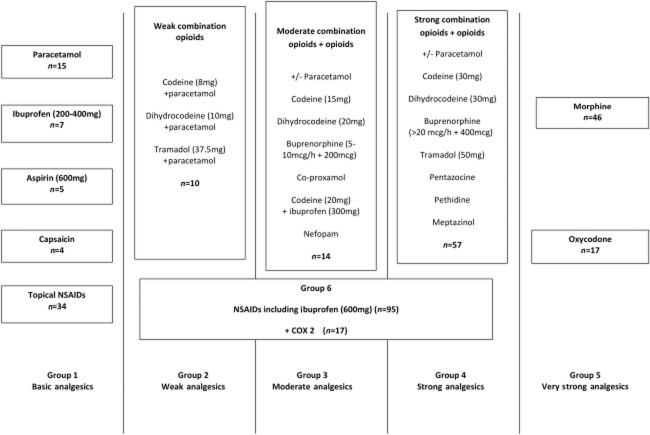
Methods: This was a retrospective observational database study of registered adult patients prescribed an analgesic (2002-2009) from the Consultations in Primary Care Archive--12 North Staffordshire general practices. Prescribing guidance from the UK Medicines Regulatory Health Authority (MHRA) regarding non-steroidal anti-inflammatory drugs (NSAIDs) and co-proxamol, and the National Institute for Health and Clinical Excellence (NICE) osteoarthritis (OA) management guidelines were considered. Analgesic prescribing rates were examined, arranged according to a classification of six equipotent medication groups: (1) basic analgesics; (2)-(5) increasingly potent opioids and (6) NSAIDs. In each quarter from 2002 to 2009, the number of patients per 10,000 registered population receiving a prescription for the first time from each group was determined. Quarters associated with significant changes in the underlying prescribing trend were determined using joinpoint regression.
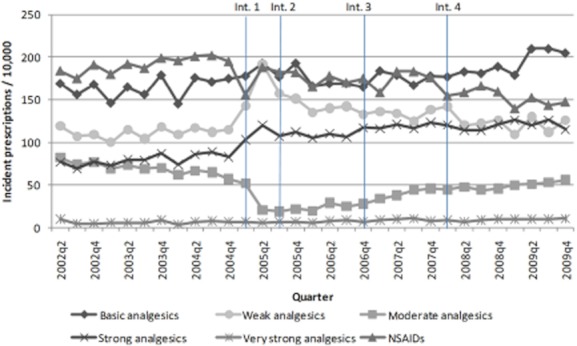
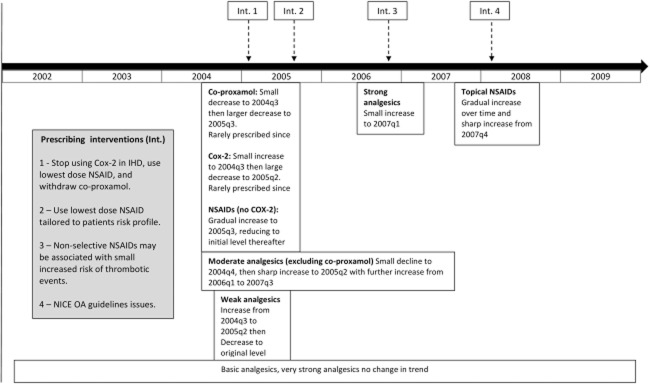
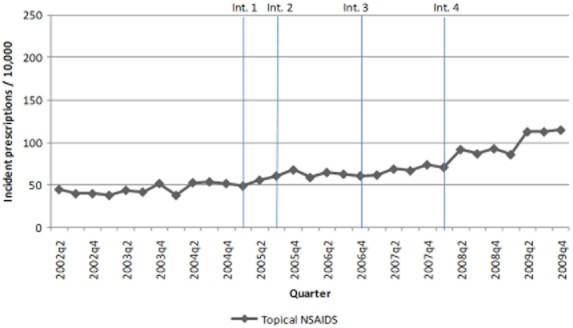
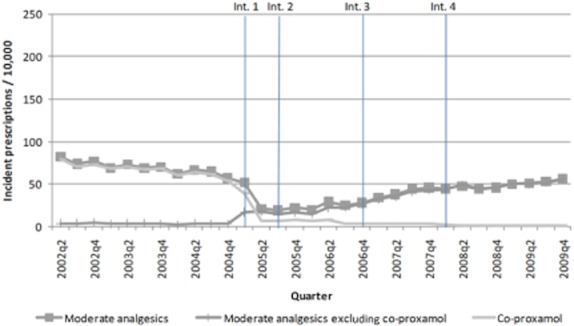
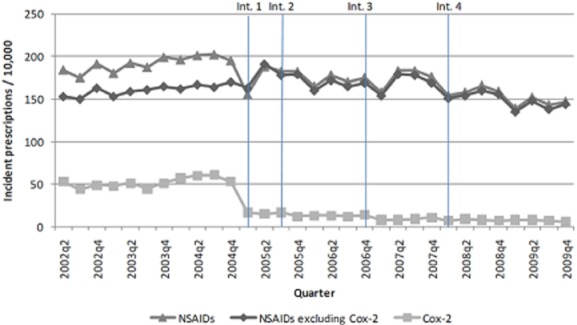
Results: A significant decrease in incident co-proxamol and Cox-2 prescribing occurred around the time of the first MHRA advice to stop using them and were rarely prescribed thereafter. The new prescribing of weak analgesics (e.g., co-codamol 8/500) increased at this same time. Initiating topical NSAIDs significantly increased around the time of the NICE OA guidelines.
Conclusions: Significant prescribing changes occurred when national advice and guidelines were issued. The effectiveness of this advice may vary depending upon the content and method of dissemination. Further evaluation of the optimal methods for delivering prescribing guidance is required.
© 2012 European Federation of International Association for the Study of Pain Chapters.
Figures
References
-
- Bandolier. Topical NSAIDs. 2011. http://www.medicine.ox.ac.uk/bandolier/band110/b110-6.html#Heading7 (accessed 14 November 2011)
-
- Bedson J, Martino OL, Jordan KP. Determining analgesic prescribing rates in primary care using a consensus model of prescribing from general practice. Rheumatology. 2010;49(S1):i147–i152. doi: 10.1093/rheumatology/keq733. - DOI
-
- Bevan S, Quadrello T, McGee R, Mhdon M, Vavrovsky A, Barham L. Fit for work? Musculoskeletal Disorders in the European Workforce. 2009. The Work Foundation, 1. http://www.fitforworkeurope.eu/Website-Documents/Fit%20for%20Work%20pan-... (last accessed 13 June 2012)
-
- BNF. British National Formulary. 61st edn. London: BMJ Group; 2011.
-
- Braybrook S, Walker R. Influencing NSAID prescribing in primary care using different feedback strategies. Pharm World Sci. 2000;22:39–46. - PubMed
Publication types
MeSH terms
Substances
Grants and funding
LinkOut - more resources
Full Text Sources
Research Materials