


Ureteral injury in laparoscopic gynecologic surgery
- PMID: 22866190
- PMCID: PMC3410510
Item in Clipboard
Ureteral injury in laparoscopic gynecologic surgery
Rev Obstet Gynecol.
2012.
Abstract
The introduction of laparoscopy to gynecologic surgery has allowed for both innovative advancements and new challenges in the field. As the complexity of laparoscopically approached gynecologic cases continues to increase, it is imperative for surgeons to be aware of the risk of ureteral injury. Although rare, ureteral complications with gynecologic surgery may be quite morbid; therefore, knowledge about their prevention, diagnosis, and management is of the utmost importance.
Keywords: Hysterectomy; Intraoperative cystoscopy; Laparoscopy; Ureteral injury.
Figures
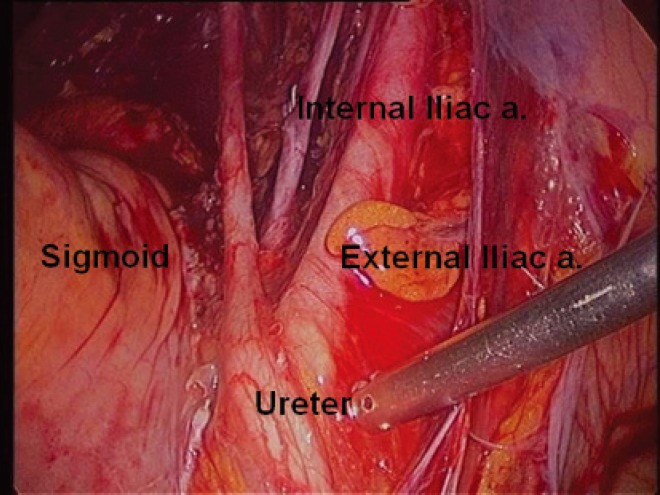
The ureter descends over the pelvic brim as it courses over the iliac vessels at the bifurcation of the common iliac artery into the external and internal iliac arteries.
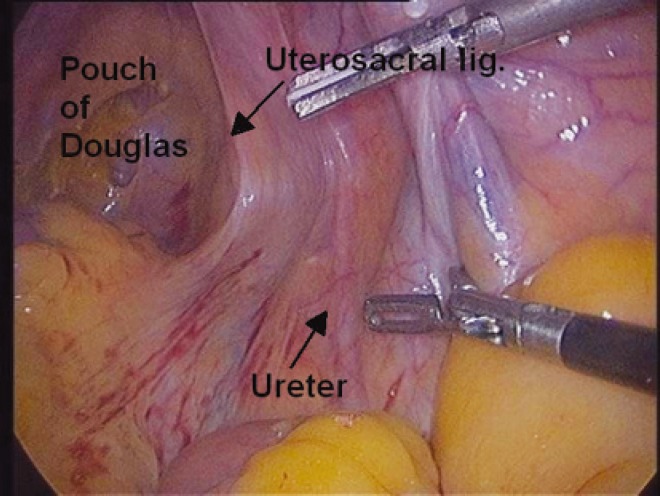
In cases of laparoscopic adnexectomy, the ureter can be identified transperitoneally as it courses over the pelvic brim.
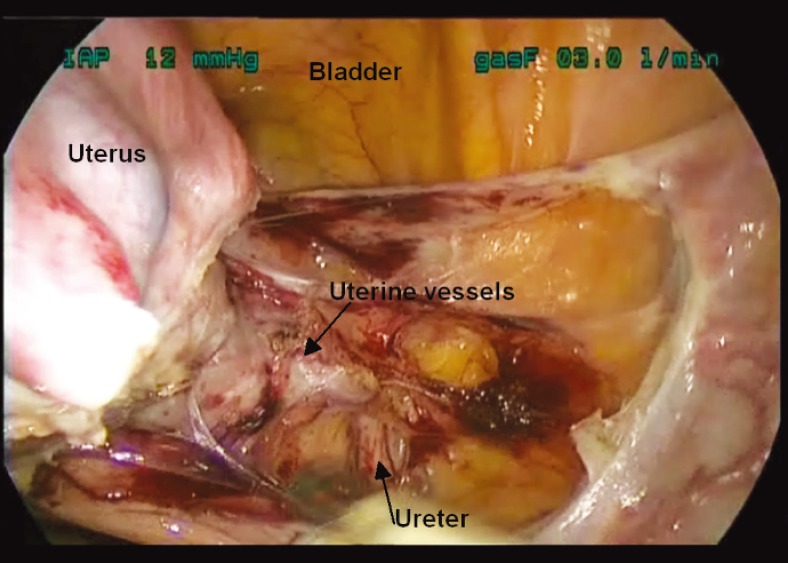
Some surgeons prefer to use upward traction on the uterine specimen with a laparoscopic tenaculum in lieu of a uterine manipulator. Either approach will ensure the distance from the ureter to the ascending uterine artery is increased substantially and the vascular pedicle can be safely controlled. increased substantially and the vascular pedicle can be safely controlled.
References
-
- Engel T, Reid RA, Thompson HE. Laparoscopy in gynecology. Rocky Mt Med J. 1971;68:11–16. - PubMed
-
- Tamussino KF, Lang PF, Breinl E. Ureteral complications with operative gynecologic laparoscopy. Am J Obstet Gynecol. 1998;178:967–970. - PubMed
-
- Saidi MH, Sadler RK, Vancaillie TG, et al. Diagnosis and management of serious urinary complications after major operative laparoscopy. Obstet Gynecol. 1996;87:272–276. - PubMed
-
- Gao JS, Leng JH, Liu ZF, et al. Ureteral injury during gynecological laparoscopic surgeries: report of twelve cases. Chin Med Sci J. 2007;22:13–16. - PubMed
-
- Ostrzenski A, Radolinski B, Ostrzenska KM. A review of laparoscopic ureteral injury in pelvic surgery. Obstet Gynecol Surv. 2003;58:794–799. - PubMed
LinkOut - more resources
Full Text Sources
Research Materials