Clinical efficacy in the treatment of overactive bladder refractory to anticholinergics by posterior tibial nerve stimulation
- PMID: 22866220
- PMCID: PMC3406195
- DOI: 10.4111/kju.2012.53.7.483
Clinical efficacy in the treatment of overactive bladder refractory to anticholinergics by posterior tibial nerve stimulation
Abstract
Purpose: Overactive bladder (OAB) is a clinical syndrome that is currently treated initially with anticholinergics, although some other therapeutic alternatives exist, such as neuromodulation, botulinum toxin, and posterior tibial nerve stimulation (PTNS). The purpose of this study was to assess the efficacy of PTNS in patients with OAB refractory to anticholinergics.
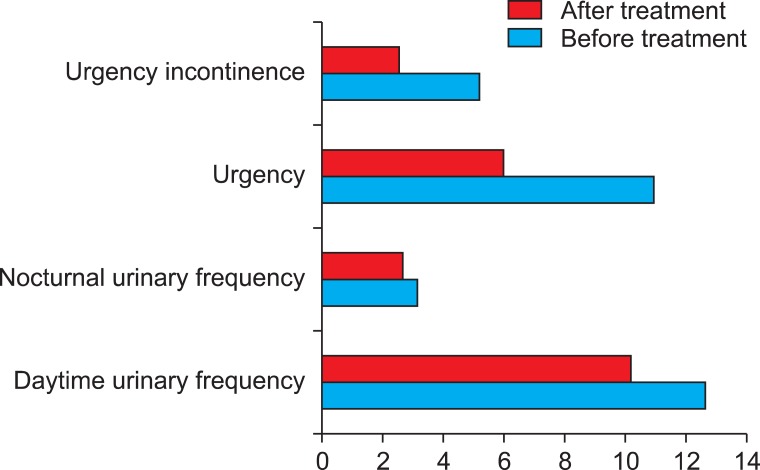
Materials and methods: We present a cohort study of 14 women with OAB to whom we applied PTNS. We assessed (before and after the treatment) the diurnal micturitional frequency, the nocturnal micturitional frequency, urgency episodes, and urge incontinence episodes. Results were analyzed by using the Wilcoxon test for nonparametric samples.
Results: We observed statistically significant improvement in the diurnal micturitional frequency (p=0.05), in episodes of micturitional urgency (p=0.03), and in episodes of urge incontinence (p=0.004). A total of 50% of the patients felt subjective improvement from their pathology.
Conclusions: PTNS is a valid, minimally invasive treatment option with minimum morbidity for patients with OAB refractory to treatment with anticholinergics.
Keywords: Cholinergics antagonist; Tibial nerve; Urinary bladder overactive.
Conflict of interest statement
The authors have nothing to disclose.
Figures
References
-
- Abrams P, Cardozo L, Fall M, Griffiths D, Rosier P, Ulmsten U, et al. The standardisation of terminology of lower urinary tract function: report from the Standardisation Sub-committee of the International Continence Society. Neurourol Urodyn. 2002;21:167–178. - PubMed
-
- Milsom I, Abrams P, Cardozo L, Roberts RG, Thuroff J, Wein AJ. How widespread are the symptoms of an overactive bladder and how are they managed? A population-based prevalence study. BJU Int. 2001;87:760–766. - PubMed
-
- Stewart WF, Van Rooyen JB, Cundiff GW, Abrams P, Herzog AR, Corey R, et al. Prevalence and burden of overactive bladder in the United States. World J Urol. 2003;20:327–336. - PubMed
-
- Irwin DE, Milsom I, Hunskaar S, Reilly K, Kopp Z, Herschorn S, et al. Population-based survey of urinary incontinence, overactive bladder, and other lower urinary tract symptoms in five countries: results of the EPIC study. Eur Urol. 2006;50:1306–1314. - PubMed
-
- Andersson KE, Wein AJ. Pharmacology of the lower urinary tract: basis for current and future treatments of urinary incontinence. Pharmacol Rev. 2004;56:581–631. - PubMed
LinkOut - more resources
Full Text Sources
Other Literature Sources