. 2012 Oct 31;384(1-2):92-102.
doi: 10.1016/j.jim.2012.07.013. Epub 2012 Jul 31.

Isolation and characterization of pharmaceutical grade human pentraxins, serum amyloid P component and C-reactive protein, for clinical use

Affiliations

Isolation and characterization of pharmaceutical grade human pentraxins, serum amyloid P component and C-reactive protein, for clinical use

Mark B Pepys et al. J Immunol Methods. .

Abstract

The human pentraxin proteins, serum amyloid P component (SAP) and C-reactive protein (CRP) are important in routine clinical diagnosis, SAP for systemic amyloidosis and CRP for monitoring the non-specific acute phase response. They are also targets for novel therapies currently in development but their roles in health and disease are controversial. Thus, both for clinical use and to rigorously elucidate their functions, structurally and functionally intact, pharmaceutical grade preparations of the natural, authentic proteins are required. We report here the production from normal human donor plasma and the characterization of the first such preparations. Importantly, we demonstrate that, contrary to reports using recombinant proteins and less well characterized preparations, neither CRP nor SAP stimulate the release by human peripheral blood mononuclear cells in vitro of any TNFα, IL-6 or IL-8, nor does SAP cause release of IL-1β or IL-10. Furthermore neither of our preparations was pro-inflammatory in mice in vivo.


Figures

Fig. 1
Fig. 1
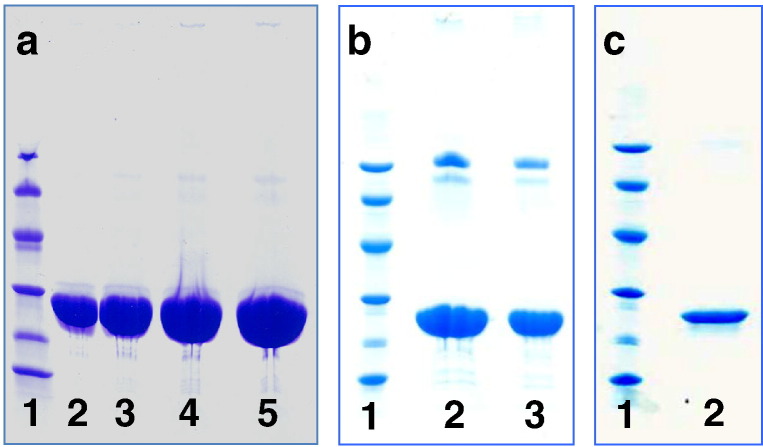
SDS 8-18% PAGE of reduced samples of GMP human pentraxins. a, GMP human SAP. Lane 1, molecular weight marker proteins: 94 kD, 67 kD, 43 kD, 30 kD, 20.1 kD, 14.4 kD; lane 2, SAP 25 μg; lane 3, SAP 50 μg; lane 4, SAP 75 μg; lane 5, SAP 100 μg. b, GMP human CRP. Lane 1, marker proteins; lane 2, CRP 60 μg; lane 3, CRP 30 μg. The trace higher molecular weight impurities identified by proteomic analysis as IgM μ chain and plasmin/plasminogen respectively are seen in lanes 2 and 3. c, GMP human CRP. Lane 1, marker proteins; lane 2, CRP 5 μg.
Fig. 2
Fig. 2
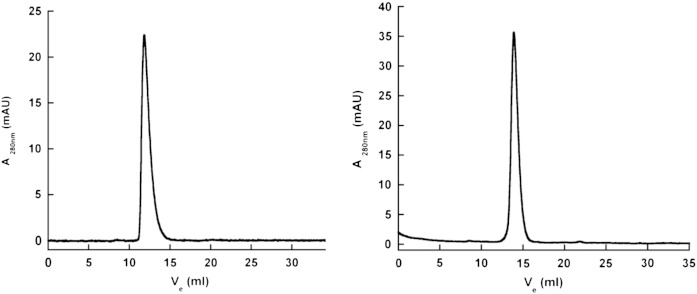
Size exclusion chromatography of GMP human pentraxins on Superdex 200. Both SAP (left) and CRP (right) gave single sharp peaks corresponding to their known molecular masses under the conditions used, in which SAP runs as stable decameric assemblies of pairs of the native pentameric structure and CRP runs as a single native pentamer.
Fig. 3
Fig. 3
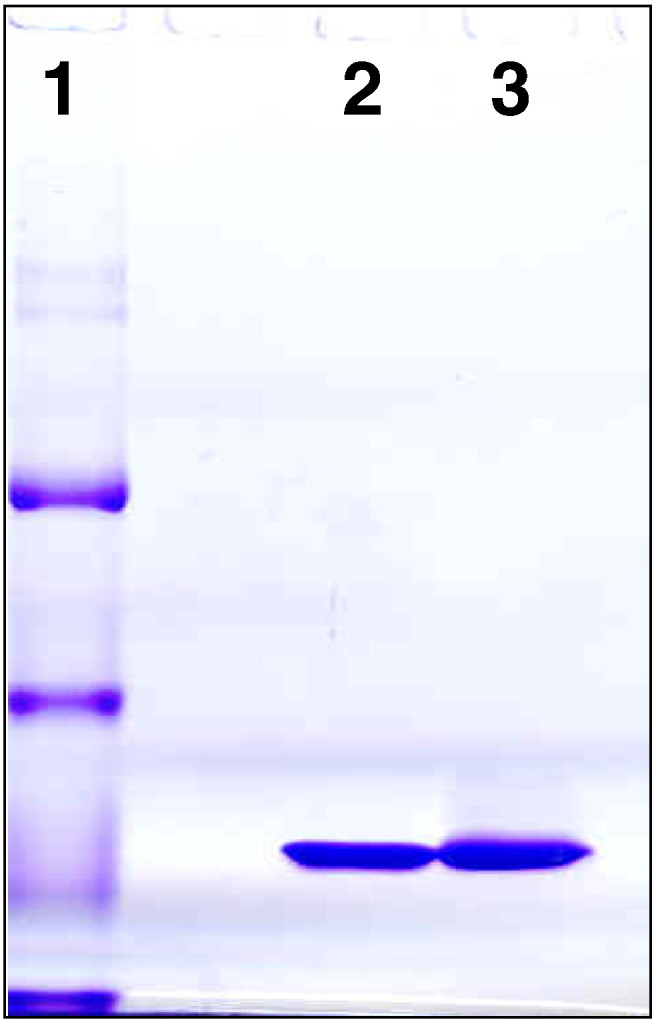
Native non‐denatured 3-18% gradient PAGE of human SAP. Lane 1, molecular weight marker proteins: 669 kD, 440 kD, 232 kD, 140 kD; lane 2, GMP human SAP 13 μg; lane 3, non‐GMP human SAP for comparison 13 μg. Human SAP is known to run as a stable decamer, mass 254,620, under these conditions (de Beer et al., 1982).
Fig. 4
Fig. 4
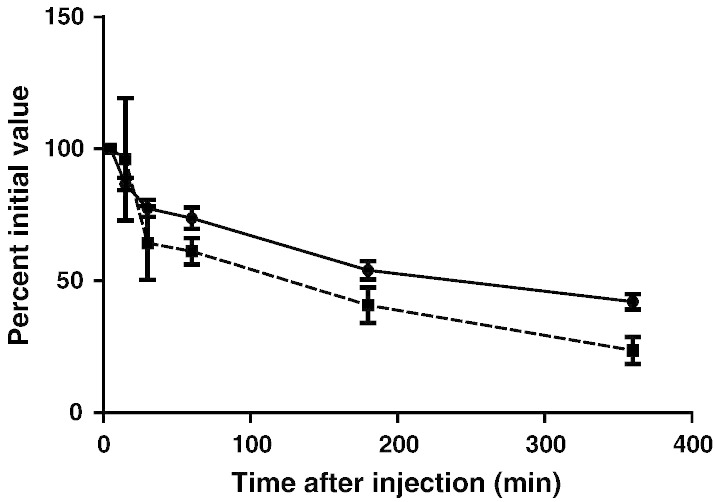
Blood clearance of tracer 125I‐GMP SAP (● ●) and abundant (1 mg/mouse) unlabeled non‐GMP SAP (■---■) administered simultaneously IV to adult C57BL/6 mice (n = 3). Each point represents the mean (SD) of measurements in 3 mice. The initial elimination of a larger proportion of the non‐GMP material probably reflects the presence of aggregated molecules not present in the GMP product but the subsequent clearance kinetics are essentially the same for the two preparations confirming that the labeled GMP SAP behaves like the intact native protein.
Fig. 5
Fig. 5
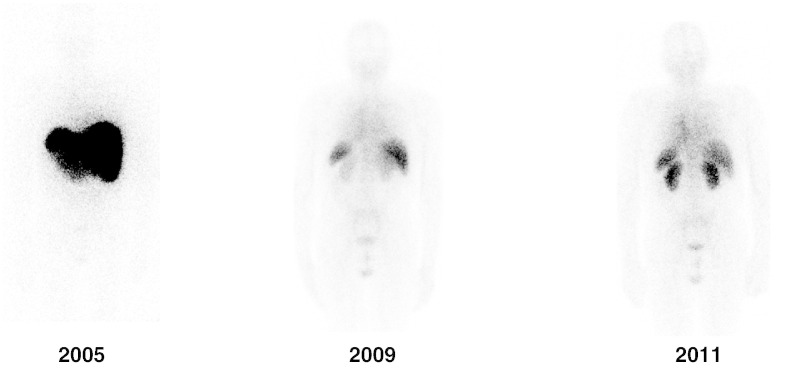
Posterior whole body images of SAP scintigraphy scans of a patient with systemic monoclonal immunoglobulin type (AL) amyloidosis who presented with major liver involvement and proteinuria in 2005. He responded well to chemotherapy with substantial regression of amyloid by 2009 when his liver and renal function had returned to normal. The underlying plasma cell dyscrasia then gradually relapsed during 2009-11 leading to recurrence of proteinuria caused by reaccumulation of renal amyloid shown in the 2011 scan.
Fig. 6
Fig. 6
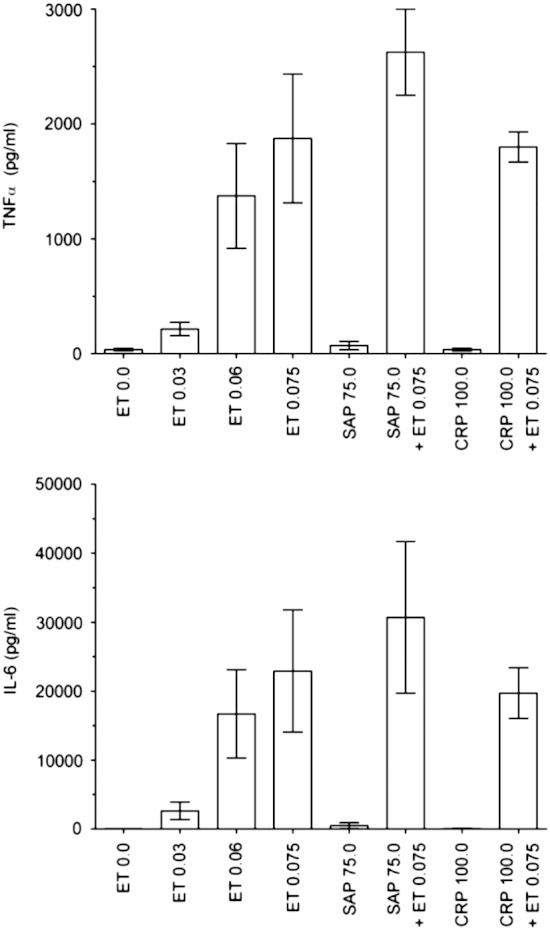
Absence of cytokine responses to hu man CRP and SAP. Bars show mean (SEM) of cytokine release by peripheral blood mononuclear cells from 4 individual donors cultured with endotoxin (ET, EU/mL), CRP or SAP (μg/mL).
Fig. 7
Fig. 7
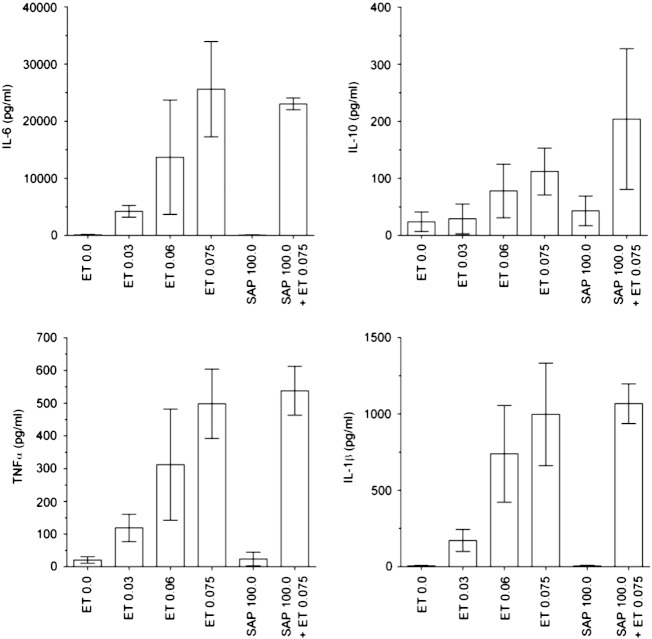
Absence of cytokine responses to hu man SAP. Bars show mean (SEM) of cytokine release by peripheral blood mononuclear cells from 4 individual donors cultured with endotoxin (ET, EU/mL) or SAP (μg/mL).

References

    1. Ballou S.P., Lozanski G. Induction of inflammatory cytokine release from cultured human monocytes by C‐reactive protein. Cytokine. 1992;4:361. - PubMed
    1. Baltz M.L., Rowe I.F., Pepys M.B. In vivo studies of the clearance of C‐reactive protein. Clin. Exp. Immunol. 1985;59:243. - PMC - PubMed
    1. Bickerstaff M.C.M., Botto M., Hutchinson W.L., Herbert J., Tennent G.A., Bybee A., Mitchell D.A., Cook H.T., Butler P.J.G., Walport M.J., Pepys M.B. Serum amyloid P component controls chromatin degradation and prevents antinuclear autoimmunity. Nat. Med. 1999;5:694. - PubMed
    1. Bisoendial R.J., Kastelein J.J.P., Levels J.H.M., Zwaginga J.J., van den Bogaard B., Reitsma P.H., Meijers J.C.M., Hartman D., Levi M., Stroes E.S.G. Activation of inflammation and coagulation after infusion of C‐reactive protein in humans. Circ. Res. 2005;96:714. - PubMed
    1. Bisoendial R.J., Kastelein J.J.P., Peters S.L.M., Levels J.H.M., Birjmohun R., Rotmans J.I., Hartman D., Meijers J.C.M., Levi M., Stroes E.S.G. Effects of CRP infusion on endothelial function and coagulation in normocholesterolemic and hypercholesterolemic subjects. J. Lipid Res. 2007;48:952. - PubMed

Publication types

MeSH terms