Physiotherapy intervention in Parkinson's disease: systematic review and meta-analysis
- PMID: 22867913
- PMCID: PMC3412755
- DOI: 10.1136/bmj.e5004
Physiotherapy intervention in Parkinson's disease: systematic review and meta-analysis
Abstract
Objective: To assess the effectiveness of physiotherapy compared with no intervention in patients with Parkinson's disease.
Design: Systematic review and meta-analysis of randomised controlled trials.
Data sources: Literature databases, trial registries, journals, abstract books, and conference proceedings, and reference lists, searched up to the end of January 2012.
Review methods: Randomised controlled trials comparing physiotherapy with no intervention in patients with Parkinson's disease were eligible. Two authors independently abstracted data from each trial. Standard meta-analysis methods were used to assess the effectiveness of physiotherapy compared with no intervention. Tests for heterogeneity were used to assess for differences in treatment effect across different physiotherapy interventions used. Outcome measures were gait, functional mobility and balance, falls, clinician rated impairment and disability measures, patient rated quality of life, adverse events, compliance, and economic analysis outcomes.
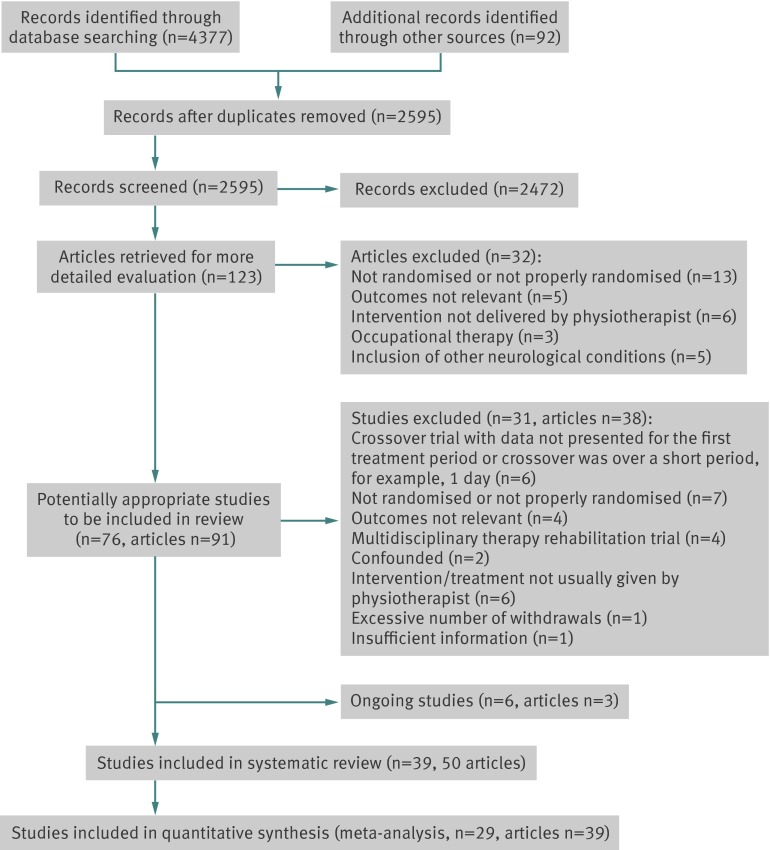
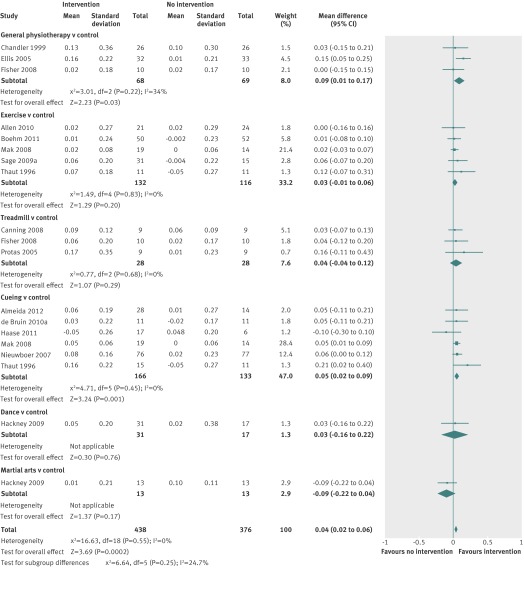
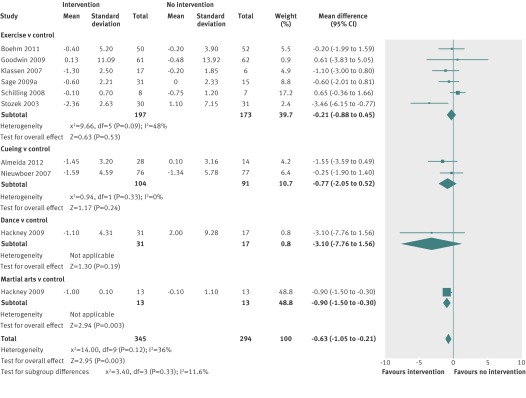
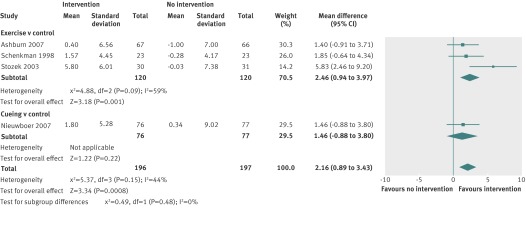
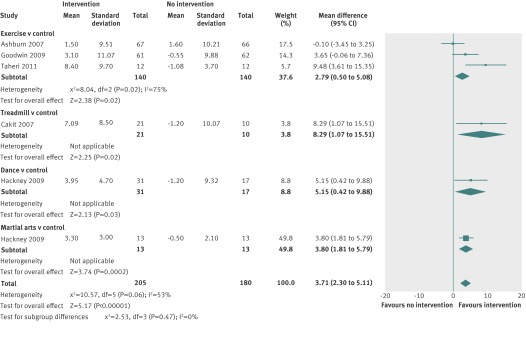
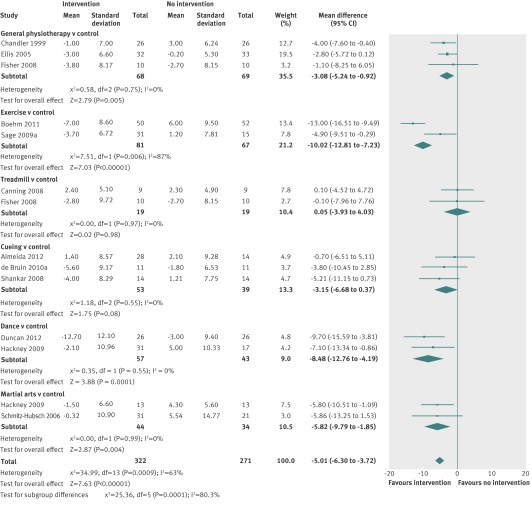
Results: 39 trials of 1827 participants met the inclusion criteria, of which 29 trials provided data for the meta-analyses. Significant benefit from physiotherapy was reported for nine of 18 outcomes assessed. Outcomes which may be clinically significant were speed (0.04 m/s, 95% confidence interval 0.02 to 0.06, P<0.001), Berg balance scale (3.71 points, 2.30 to 5.11, P<0.001), and scores on the unified Parkinson's disease rating scale (total score -6.15 points, -8.57 to -3.73, P<0.001; activities of daily living subscore -1.36, -2.41 to -0.30, P=0.01; motor subscore -5.01, -6.30 to -3.72, P<0.001). Indirect comparisons of the different physiotherapy interventions found no evidence that the treatment effect differed across the interventions for any outcomes assessed, apart from motor subscores on the unified Parkinson's disease rating scale (in which one trial was found to be the cause of the heterogeneity).
Conclusions: Physiotherapy has short term benefits in Parkinson's disease. A wide range of physiotherapy techniques are currently used to treat Parkinson's disease, with little difference in treatment effects. Large, well designed, randomised controlled trials with improved methodology and reporting are needed to assess the efficacy and cost effectiveness of physiotherapy for treating Parkinson's disease in the longer term.
Conflict of interest statement
Competing interests: All authors have completed the Unified Competing Interest form at
Figures
References
-
- Rubenis J. A rehabilitational approach to the management of Parkinson’s disease. Parkinsonism & Relat Dis 2007;13:S495-7. - PubMed
-
- Rascol O, Payoux P, Ferreira J, Brefel-Courbon C. The management of patients with early Parkinson’s disease. Parkinsonism & Relat Dis 2002;9:61-7. - PubMed
-
- Nijkrake MJ, Keus SH, Kalf JG, Sturkenboom IH, Munneke M, Kappalle AC, et al. Allied health care interventions and complementary therapies in Parkinson’s disease [abstract]. Parkinsonism & Relat Dis 2007;13(suppl 3):S488-94. - PubMed
-
- Schrag A, Jahanshahi M, Quinn N. How does Parkinson’s disease affect quality of life? A comparison with quality of life in the general population. Mov Disord 2000;15:1112-8. - PubMed
Publication types
MeSH terms
Grants and funding
LinkOut - more resources
Full Text Sources
Medical
Miscellaneous