


Effective dose conversion coefficients for radionuclides exponentially distributed in the ground
- PMID: 22868400
- PMCID: PMC3478507
- DOI: 10.1007/s00411-012-0432-y
Effective dose conversion coefficients for radionuclides exponentially distributed in the ground
Abstract
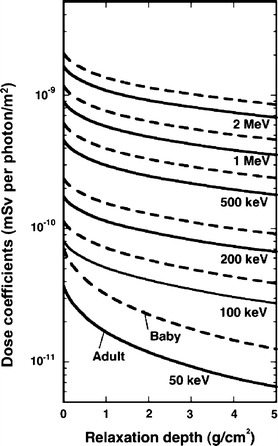
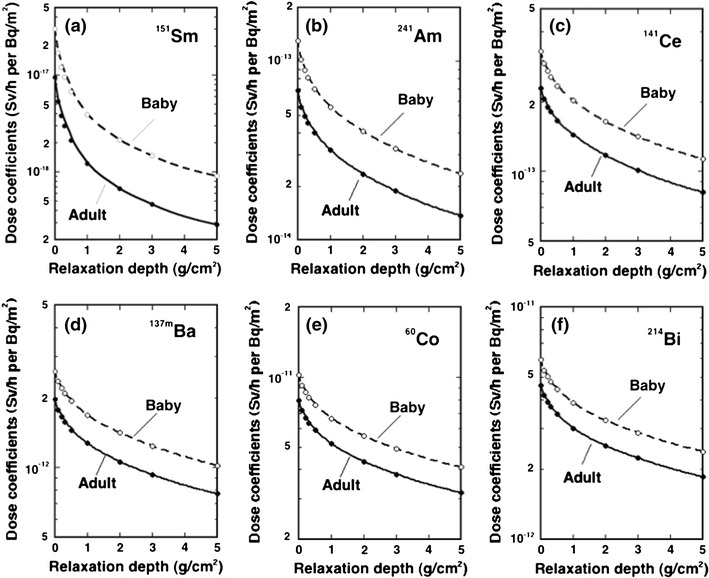
In order to provide fundamental data required for dose evaluation due to environmental exposures, effective dose conversion coefficients, that is, the effective dose rate per unit activity per unit area, were calculated for a number of potentially important radionuclides, assuming an exponential distribution in ground, over a wide range of relaxation depths. The conversion coefficients were calculated for adults and a new-born baby on the basis of dosimetric methods that the authors and related researchers have previously developed, using Monte Carlo simulations and anthropomorphic computational phantoms. The differences in effective dose conversion coefficients due to body size between the adult and baby phantoms were found to lie within 50 %, for most cases; however, for some low energies, differences could amount to a factor of 3. The effective dose per unit source intensity per area was found to decrease by a factor of 2-5, for increasing relaxation depths from 0 to 5 g/cm(2), above a source energy of 50 keV. It is also shown that implementation of the calculated coefficients into the computation of the tissue weighting factors and the adult reference computational phantoms of ICRP Publication 103 does not significantly influence the effective dose conversion coefficients of the environment. Consequently, the coefficients shown in this paper could be applied for the evaluation of effective doses, as defined according to both recommendations of ICRP Publications 103 and 60.
Figures


References
-
- DOE (1988) External dose-rate conversion factors for calculation of dose to the public. DOE/EH-0070. Department of energy, Washington
-
- Eckerman KF, Ryan JC. External exposure to radionuclides in air, water, and soil. Federal guidance report no. 12. Oak Ridge: Oak Ridge National Laboratory; 1993.
-
- IAEA . Environmental consequences of the Chernobyl accident and their remediation: twenty years of experience. Vienna: International Atomic Energy Agency; 2006.
MeSH terms
Substances
LinkOut - more resources
Full Text Sources
