


Sequencing papaya X and Yh chromosomes reveals molecular basis of incipient sex chromosome evolution
- PMID: 22869747
- PMCID: PMC3427123
- DOI: 10.1073/pnas.1207833109
Sequencing papaya X and Yh chromosomes reveals molecular basis of incipient sex chromosome evolution
Abstract
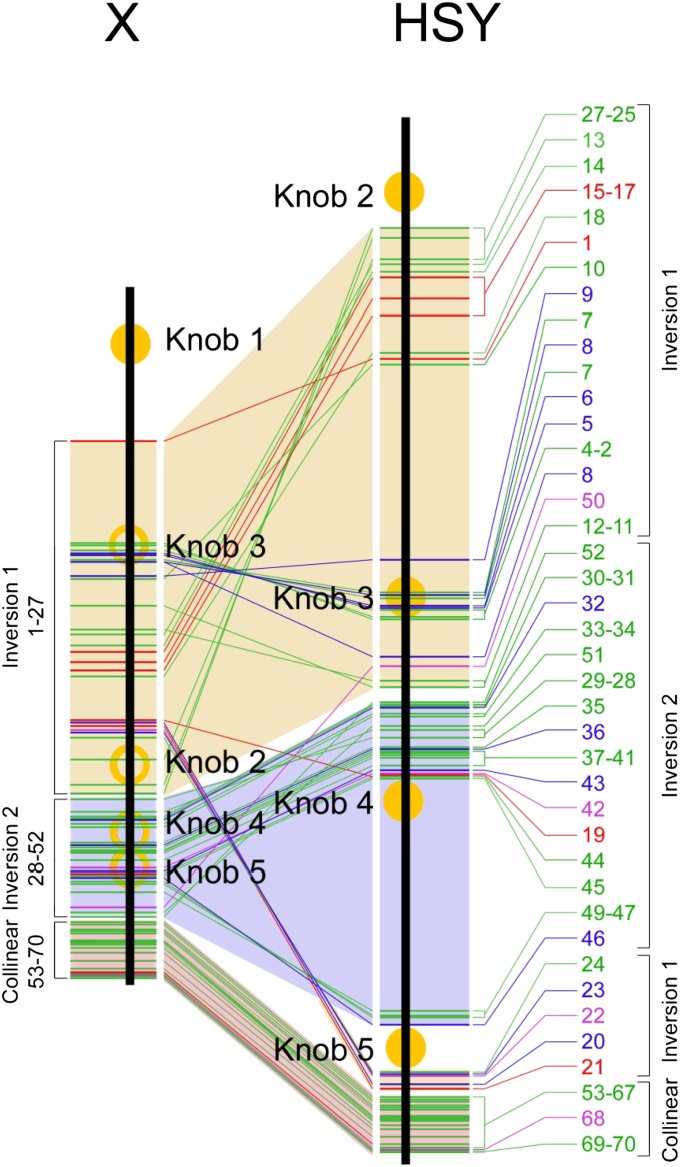
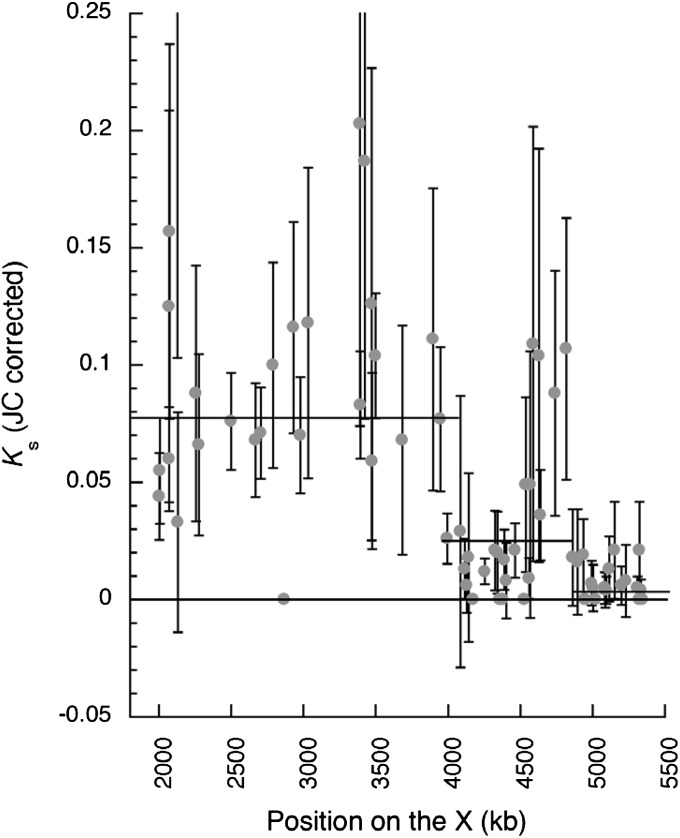
Sex determination in papaya is controlled by a recently evolved XY chromosome pair, with two slightly different Y chromosomes controlling the development of males (Y) and hermaphrodites (Y(h)). To study the events of early sex chromosome evolution, we sequenced the hermaphrodite-specific region of the Y(h) chromosome (HSY) and its X counterpart, yielding an 8.1-megabase (Mb) HSY pseudomolecule, and a 3.5-Mb sequence for the corresponding X region. The HSY is larger than the X region, mostly due to retrotransposon insertions. The papaya HSY differs from the X region by two large-scale inversions, the first of which likely caused the recombination suppression between the X and Y(h) chromosomes, followed by numerous additional chromosomal rearrangements. Altogether, including the X and/or HSY regions, 124 transcription units were annotated, including 50 functional pairs present in both the X and HSY. Ten HSY genes had functional homologs elsewhere in the papaya autosomal regions, suggesting movement of genes onto the HSY, whereas the X region had none. Sequence divergence between 70 transcripts shared by the X and HSY revealed two evolutionary strata in the X chromosome, corresponding to the two inversions on the HSY, the older of which evolved about 7.0 million years ago. Gene content differences between the HSY and X are greatest in the older stratum, whereas the gene content and order of the collinear regions are identical. Our findings support theoretical models of early sex chromosome evolution.
Conflict of interest statement
The authors declare no conflict of interest.
Figures
References
-
- Graves JAM, Shetty S. Sex from W to Z: Evolution of vertebrate sex chromosomes and sex determining genes. J Exp Zool. 2001;290:449–462. - PubMed
-
- Ming R, Bendahmane A, Renner SS. Sex chromosomes in land plants. Annu Rev Plant Biol. 2011;62:485–514. - PubMed
-
- Liu Z, et al. A primitive Y chromosome in papaya marks incipient sex chromosome evolution. Nature. 2004;427:348–352. - PubMed
-
- Peichel CL, et al. The master sex-determination locus in threespine sticklebacks is on a nascent Y chromosome. Curr Biol. 2004;14:1416–1424. - PubMed
-
- Spigler RB, Lewers KS, Main DS, Ashman TL. Genetic mapping of sex determination in a wild strawberry, Fragaria virginiana, reveals earliest form of sex chromosome. Heredity (Edinb) 2008;101:507–517. - PubMed
Publication types
MeSH terms
Substances
Grants and funding
LinkOut - more resources
Full Text Sources
Other Literature Sources
Miscellaneous
