Bortezomib-based graft-versus-host disease prophylaxis in HLA-mismatched unrelated donor transplantation
- PMID: 22869883
- PMCID: PMC3434979
- DOI: 10.1200/JCO.2012.42.0984
Bortezomib-based graft-versus-host disease prophylaxis in HLA-mismatched unrelated donor transplantation
Abstract
Purpose: HLA-mismatched unrelated donor (MMUD) hematopoietic stem-cell transplantation (HSCT) is associated with increased graft-versus-host disease (GVHD) and impaired survival. In reduced-intensity conditioning (RIC), neither ex vivo nor in vivo T-cell depletion (eg, antithymocyte globulin) convincingly improved outcomes. The proteasome inhibitor bortezomib has immunomodulatory properties potentially beneficial for control of GVHD in T-cell-replete HLA-mismatched transplantation.
Patients and methods: We conducted a prospective phase I/II trial of a GVHD prophylaxis regimen of short-course bortezomib, administered once per day on days +1, +4, and +7 after peripheral blood stem-cell infusion plus standard tacrolimus and methotrexate in patients with hematologic malignancies undergoing MMUD RIC HSCT. We report outcomes for 45 study patients: 40 (89%) 1-locus and five (11%) 2-loci mismatches (HLA-A, -B, -C, -DRB1, or -DQB1), with a median of 36.5 months (range, 17.4 to 59.6 months) follow-up.
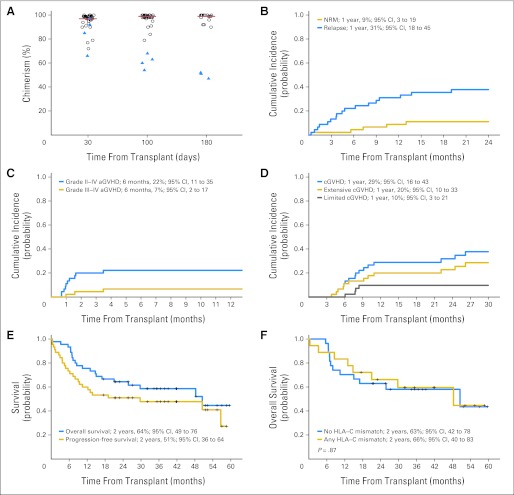
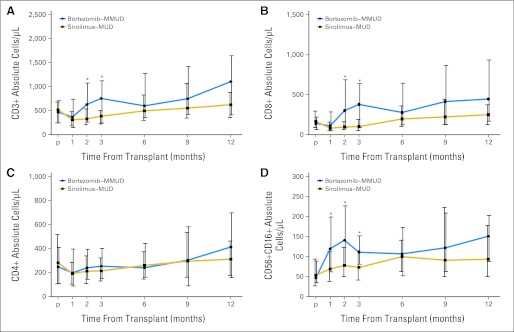
Results: The 180-day cumulative incidence of grade 2 to 4 acute GVHD was 22% (95% CI, 11% to 35%). One-year cumulative incidence of chronic GVHD was 29% (95% CI, 16% to 43%). Two-year cumulative incidences of nonrelapse mortality (NRM) and relapse were 11% (95% CI, 4% to 22%) and 38% (95% CI, 24% to 52%), respectively. Two-year progression-free survival and overall survival were 51% (95% CI, 36% to 64%) and 64% (95% CI, 49% to 76%), respectively. Bortezomib-treated HLA-mismatched patients experienced rates of NRM, acute and chronic GVHD, and survival similar to those of contemporaneous HLA-matched RIC HSCT at our institution. Immune recovery, including CD8(+) T-cell and natural killer cell reconstitution, was enhanced with bortezomib.
Conclusion: A novel short-course, bortezomib-based GVHD regimen can abrogate the survival impairment of MMUD RIC HSCT, can enhance early immune reconstitution, and appears to be suitable for prospective randomized evaluation.
Conflict of interest statement
Authors' disclosures of potential conflicts of interest and author contributions are found at the end of this article.
Figures
Comment in
-
Graft-versus-host disease: have we solved the problem?J Clin Oncol. 2012 Sep 10;30(26):3160-1. doi: 10.1200/JCO.2012.43.3201. Epub 2012 Aug 6. J Clin Oncol. 2012. PMID: 22869873 No abstract available.
References
-
- Lee SJ, Klein J, Haagenson M, et al. High-resolution donor-recipient HLA matching contributes to the success of unrelated donor marrow transplantation. Blood. 2007;110:4576–4583. - PubMed
-
- Petersdorf EW, Gooley T, Malkki M, et al. Clinical significance of donor-recipient HLA matching on survival after myeloablative hematopoietic cell transplantation from unrelated donors. Tissue Antigens. 2007;69(suppl 1):25–30. - PubMed
-
- Ho VT, Kim HT, Liney D, et al. HLA-C mismatch is associated with inferior survival after unrelated donor non-myeloablative hematopoietic stem cell transplantation. Bone Marrow Transplant. 2006;37:845–850. - PubMed
-
- Nakamae H, Storer BE, Storb R, et al. Low-dose total body irradiation and fludarabine conditioning for HLA class I-mismatched donor stem cell transplantation and immunologic recovery in patients with hematologic malignancies: A multicenter trial. Biol Blood Marrow Transplant. 2010;16:384–394. - PMC - PubMed
Publication types
MeSH terms
Substances
Grants and funding
LinkOut - more resources
Full Text Sources
Other Literature Sources
Medical
Research Materials