


Adaptive pacing, cognitive behaviour therapy, graded exercise, and specialist medical care for chronic fatigue syndrome: a cost-effectiveness analysis
- PMID: 22870204
- PMCID: PMC3411573
- DOI: 10.1371/journal.pone.0040808
Adaptive pacing, cognitive behaviour therapy, graded exercise, and specialist medical care for chronic fatigue syndrome: a cost-effectiveness analysis
Expression of concern in
-
Expression of Concern: Adaptive Pacing, Cognitive Behaviour Therapy, Graded Exercise, and Specialist Medical Care for Chronic Fatigue Syndrome: A Cost-Effectiveness Analysis.PLoS One. 2017 May 2;12(5):e0177037. doi: 10.1371/journal.pone.0177037. eCollection 2017. PLoS One. 2017. PMID: 28463341 Free PMC article. No abstract available.
Abstract
Background: The PACE trial compared the effectiveness of adding adaptive pacing therapy (APT), cognitive behaviour therapy (CBT), or graded exercise therapy (GET), to specialist medical care (SMC) for patients with chronic fatigue syndrome. This paper reports the relative cost-effectiveness of these treatments in terms of quality adjusted life years (QALYs) and improvements in fatigue and physical function.
Methods: Resource use was measured and costs calculated. Healthcare and societal costs (healthcare plus lost production and unpaid informal care) were combined with QALYs gained, and changes in fatigue and disability; incremental cost-effectiveness ratios (ICERs) were computed.
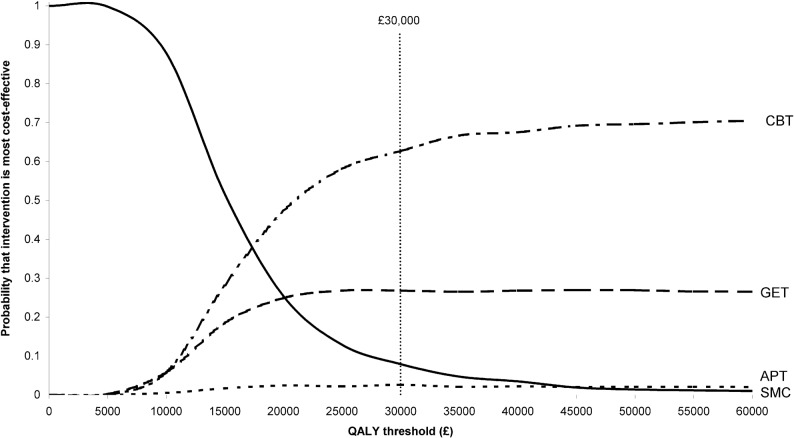
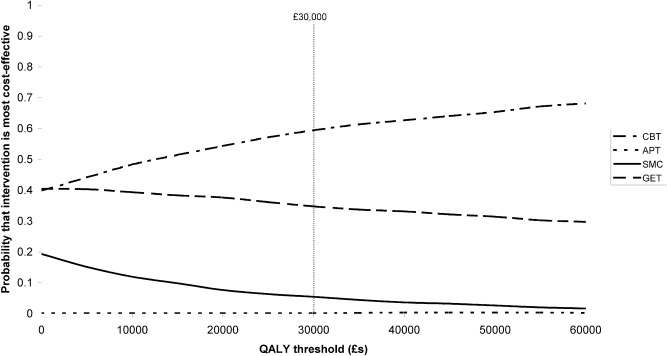
Results: SMC patients had significantly lower healthcare costs than those receiving APT, CBT and GET. If society is willing to value a QALY at £30,000 there is a 62.7% likelihood that CBT is the most cost-effective therapy, a 26.8% likelihood that GET is most cost effective, 2.6% that APT is most cost-effective and 7.9% that SMC alone is most cost-effective. Compared to SMC alone, the incremental healthcare cost per QALY was £18,374 for CBT, £23,615 for GET and £55,235 for APT. From a societal perspective CBT has a 59.5% likelihood of being the most cost-effective, GET 34.8%, APT 0.2% and SMC alone 5.5%. CBT and GET dominated SMC, while APT had a cost per QALY of £127,047. ICERs using reductions in fatigue and disability as outcomes largely mirrored these findings.
Conclusions: Comparing the four treatments using a health care perspective, CBT had the greatest probability of being the most cost-effective followed by GET. APT had a lower probability of being the most cost-effective option than SMC alone. The relative cost-effectiveness was even greater from a societal perspective as additional cost savings due to reduced need for informal care were likely.
Conflict of interest statement
Figures
References
-
- Prins JB, van der Meer JW, Bleijenberg G (2006) Chronic fatigue syndrome. Lancet 367: 346–355. - PubMed
-
- McCrone P, Darbishire D, Ridsdale L, Seed P (2003) The economic cost of chronic fatigue and chronic fatigue syndrome in UK primary care. Psychol Med 33: 253–261. - PubMed
-
- National Institute for Health and Clinical Excellence (2007) Clinical guideline CG53. Chronic fatigue syndrome/myalgic encephalomyelitis (or encephalopathy): diagnosis and management. Available: http://guidance.nice.org.uk/CG53. Accessed 2010 Nov 6.
Publication types
MeSH terms
Grants and funding
LinkOut - more resources
Full Text Sources
Medical
