. 2012 Jul;2(7):731-40.
doi: 10.1534/g3.112.002840. Epub 2012 Jul 1.

A genome-wide screen identifies genes that affect somatic homolog pairing in Drosophila

Affiliations

A genome-wide screen identifies genes that affect somatic homolog pairing in Drosophila

Jack R Bateman et al. G3 (Bethesda). 2012 Jul.

Abstract

In Drosophila and other Dipterans, homologous chromosomes are in close contact in virtually all nuclei, a phenomenon known as somatic homolog pairing. Although homolog pairing has been recognized for over a century, relatively little is known about its regulation. We performed a genome-wide RNAi-based screen that monitored the X-specific localization of the male-specific lethal (MSL) complex, and we identified 59 candidate genes whose knockdown via RNAi causes a change in the pattern of MSL staining that is consistent with a disruption of X-chromosomal homolog pairing. Using DNA fluorescent in situ hybridization (FISH), we confirmed that knockdown of 17 of these genes has a dramatic effect on pairing of the 359 bp repeat at the base of the X. Furthermore, dsRNAs targeting Pr-set7, which encodes an H4K20 methyltransferase, cause a modest disruption in somatic homolog pairing. Consistent with our results in cultured cells, a classical mutation in one of the strongest candidate genes, pebble (pbl), causes a decrease in somatic homolog pairing in developing embryos. Interestingly, many of the genes identified by our screen have known roles in diverse cell-cycle events, suggesting an important link between somatic homolog pairing and the choreography of chromosomes during the cell cycle.

Keywords: RNAi; cell cycle; homolog pairing; interchromosomal interaction; male-specific lethal.


Figures
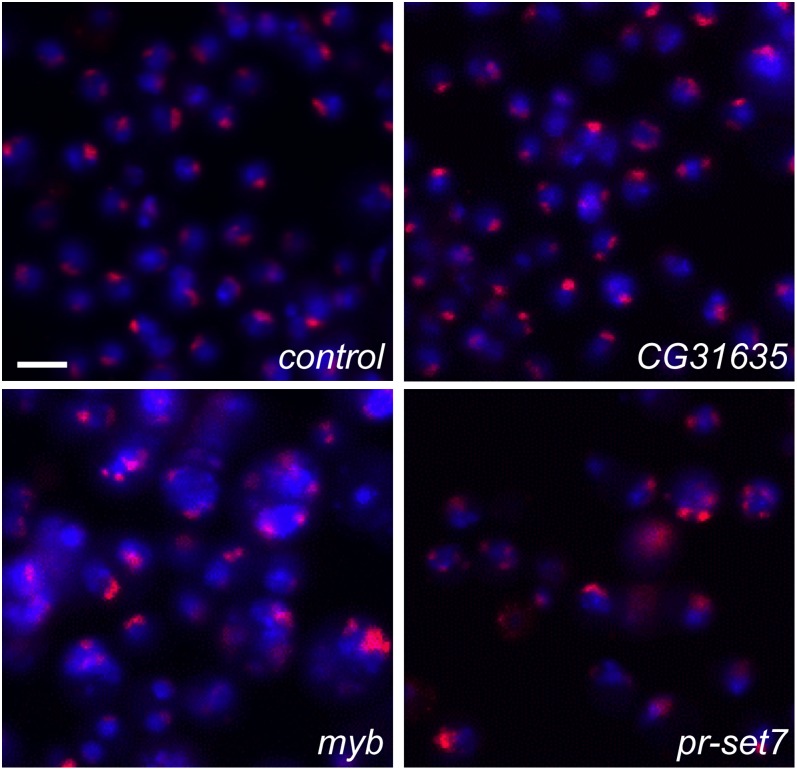
Figure 1
Figure 1
Genome-wide screening identifies dsRNAs that increase the number of MSL staining bodies per nucleus (“supernumerary” phenotype). Cropped example images from our screen show DNA (blue) and MSL1 (red) from cells treated with a control dsRNA targeting gfp or with dsRNAs targeting candidate CG31635, myb, or Pr-set7. Scale bar represents 10 µm for all panels.
Figure 2
Figure 2
DNA FISH shows loss of somatic homolog pairing in dsRNA-treated S2R+ cells. Each row shows staining of DNA by DAPI, DNA FISH targeting the 359 bp repeat, and a merged image. All images represent a z-series that has been compressed into a single plane. In water-treated cells (wt), 66.8% of nuclei have a single FISH signal. Shown are representative nuclei from cells treated with dsRNAs targeting FISH hits, including chromosome bows (chb), Separase (Sse), CG31635, pebble (pbl), and fascetto (feo). Scale bar represents 10 µm for all panels. Inset, bottom right, is an example of a large nucleus (at equivalent scale) treated with dsRNA targeting feo where more than four FISH signals are apparent; such nuclei are assumed to be polyploid/aneuploid.
Figure 3
Figure 3
RNAi knockdown of Pr-set7 causes a reduction in somatic homolog pairing in S2R+ cells. Each row shows staining of the nuclear envelope by fluorescently labeled wheat germ agglutinin (WGA), DNA FISH targeting the 359 bp repeat, and a merged image. All images represent a z-series that has been compressed into a single plane. Top row, nuclei from representative water-treated cells (wt); bottom, nuclei from cells treated with dsRNA corresponding to amplicon DRSC27118 targeting Pr-set7. Scale bar represents 5 µm for all panels.
Figure 4
Figure 4
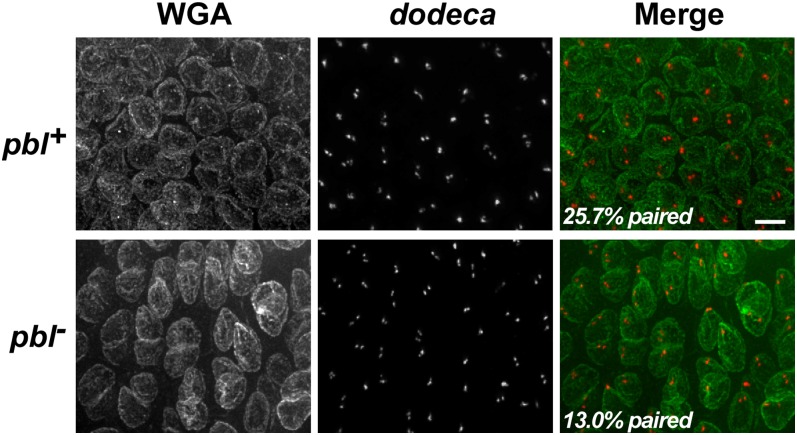
A classical allele of pbl causes disruption of somatic homolog pairing in vivo. Each row shows staining of the nuclear envelope by fluorescently labeled wheat germ agglutinin (WGA), DNA FISH targeting the dodeca repeat on chromosome III, and a merged image. All images represent a z-series that has been compressed into a single plane. Nuclei are derived from zone 1 of early stage 9 pbl2/pbl2 embryos (pbl; identified by their binucleate phenotype; 308 nuclei from 4 embryos) or their pbl2/pbl+ or pbl+/pbl+ siblings at the same stage of development (pbl+; 382 nuclei from 6 embryos). Scale bar represents 5 µm for all panels. Note that both pbl+ and pbl- embryos show several nuclei with three and four signals for the dodeca repeat, which are presumed to result from separation of sister chromatids (Bateman and Wu 2008).

References

    1. Alekseyenko A. A., Larschan E., Lai W. R., Park P. J., Kuroda M. I., 2006. High-resolution ChIP-chip analysis reveals that the Drosophila MSL complex selectively identifies active genes on the male X chromosome. Genes Dev. 20: 848–857 - PMC - PubMed
    1. Bacher C. P., Guggiari M., Brors B., Augui S., Clerc P., et al. , 2006. Transient colocalization of X-inactivation centres accompanies the initiation of X inactivation. Nat. Cell Biol. 8: 293–299 - PubMed
    1. Bantignies F., Cavalli G., 2011. Polycomb group proteins: repression in 3D. Trends in genetics. TIG 27: 454–464 - PubMed
    1. Bateman J. R., Wu C.-T., 2008. A genomewide survey argues that every zygotic gene product is dispensable for the initiation of somatic homolog pairing in Drosophila. Genetics 180: 1329–1342 - PMC - PubMed
    1. Belote J. M., Lucchesi J. C., 1980. Male-specific lethal mutations of Drosophila melanogaster. Genetics 96: 165–186 - PMC - PubMed

Publication types

MeSH terms

Substances

LinkOut - more resources