


L-citrulline supplementation reverses the impaired airway relaxation in neonatal rats exposed to hyperoxia
- PMID: 22870905
- PMCID: PMC3487946
- DOI: 10.1186/1465-9921-13-68
L-citrulline supplementation reverses the impaired airway relaxation in neonatal rats exposed to hyperoxia
Abstract
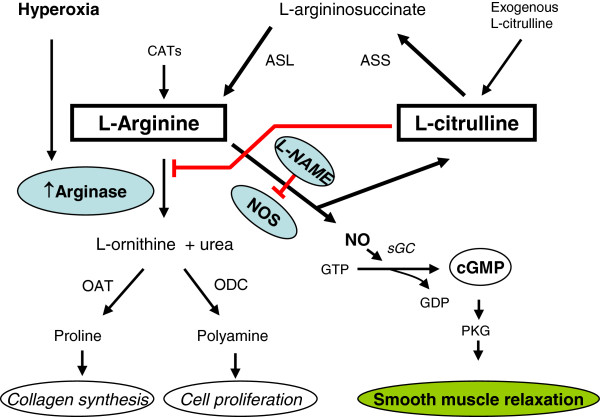
Background: Hyperoxia is shown to impair airway relaxation via limiting L-arginine bioavailability to nitric oxide synthase (NOS) and reducing NO production as a consequence. L-arginine can also be synthesized by L-citrulline recycling. The role of L-citrulline supplementation was investigated in the reversing of hyperoxia-induced impaired relaxation of rat tracheal smooth muscle (TSM).
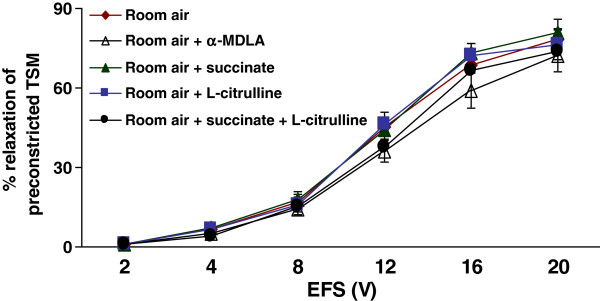
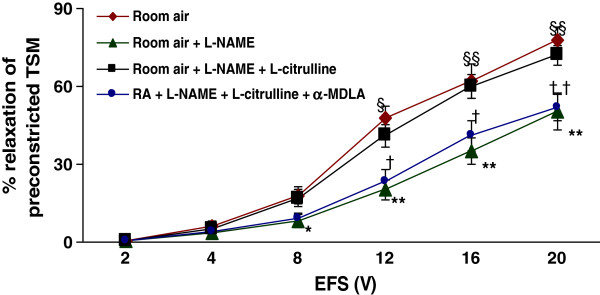
Methods: Electrical field stimulation (EFS, 2-20 V)-induced relaxation was measured under in vitro conditions in preconstricted tracheal preparations obtained from 12 day old rat pups exposed to room air or hyperoxia (>95% oxygen) for 7 days supplemented with L-citrulline or saline (in vitro or in vivo). The role of the L-citrulline/L-arginine cycle under basal conditions was studied by incubation of preparations in the presence of argininosuccinate synthase (ASS) inhibitor [α-methyl-D, L-aspartate, 1 mM] or argininosuccinate lyase inhibitor (ASL) succinate (1 mM) and/or NOS inhibitor [Nω-nitro-L-arginine methyl ester; 100 μM] with respect to the presence or absence of L-citrulline (2 mM).
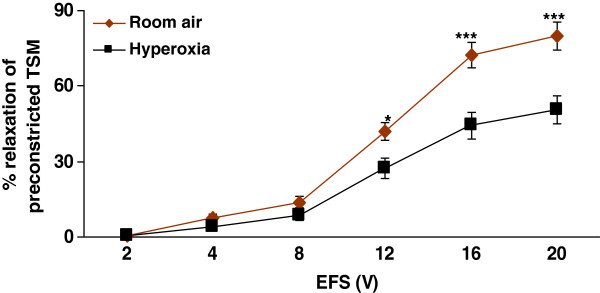
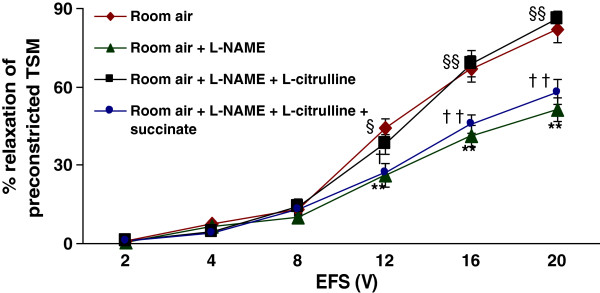
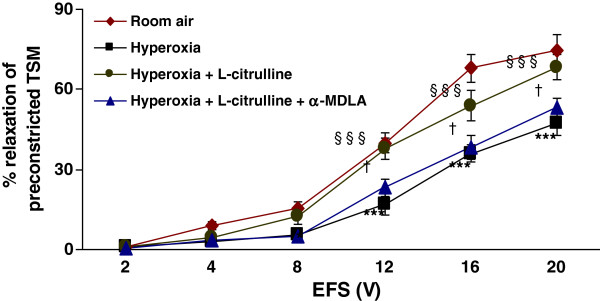
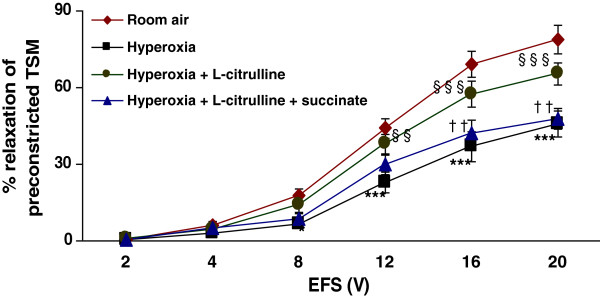
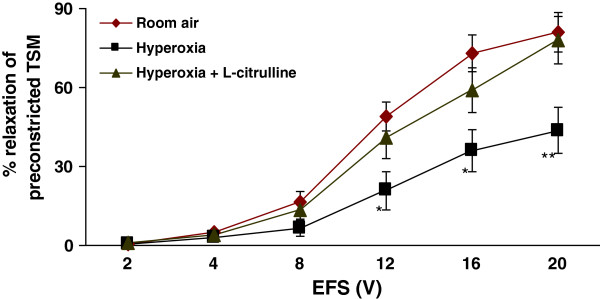
Results: Hyperoxia impaired the EFS-induced relaxation of TSM as compared to room air control (p < 0.001; 0.5 ± 0.1% at 2 V to 50.6 ± 5.7% at 20 V in hyperoxic group: 0.7 ± 0.2 at 2 V to 80.0 ± 5.6% at 20 V in room air group). Inhibition of ASS or ASL, and L-citrulline supplementation did not affect relaxation responses under basal conditions. However, inhibition of NOS significantly reduced relaxation responses (p < 0.001), which were restored to control level by L-citrulline. L-citrulline supplementation in vivo and in vitro also reversed the hyperoxia-impaired relaxation. The differences were significant (p <0.001; 0.8 ± 0.3% at 2 V to 47.1 ± 4.1% at 20 V without L-citrulline; 0.9 ± 0.3% at 2 V to 68.2 ± 4.8% at 20 V with L-citrulline). Inhibition of ASS or ASL prevented this effect of L-citrulline.
Conclusion: The results indicate the presence of an L-citrulline/L-arginine cycle in the airways of rat pups. L-citrulline recycling does not play a major role under basal conditions in airways, but it has an important role under conditions of substrate limitations to NOS as a source of L-arginine, and L-citrulline supplementation reverses the impaired relaxation of airways under hyperoxic conditions.
Figures
References
-
- Pelkonen AS, Hakulinen AL, Turpeinen M. Bronchial lability and responsiveness in school children born very preterm. Am J Respir Crit Care Med. 1997;156:1178–1184. - PubMed
-
- Hack M, Taylor HG, Drotar D, Schluchter M, Cartar L, Andreias L, Wilson-Costello D, Klein N. Chronic conditions, functional limitations and special health care needs of school-aged children born with extremely low-birth-weight in the 1990's. JAMA. 2005;294:318–325. doi: 10.1001/jama.294.3.318. - DOI - PubMed
-
- Sopi RB, Martin RJ, Haxhiu MA, Dreshaj IA, Yao Q, Jafri A, Zaidi SI. Role of brain-derived neurotrophic factor in hyperoxia-induced enhancement of contractility and impairment of relaxation in lung parenchyma. Am J Physiol Lung Cell Mol Physiol. 2008;295:L348–L355. doi: 10.1152/ajplung.00067.2008. - DOI - PMC - PubMed
Publication types
MeSH terms
Substances
LinkOut - more resources
Full Text Sources
Medical
Miscellaneous
