


Nomogram prediction for overall survival of patients diagnosed with cervical cancer
- PMID: 22871885
- PMCID: PMC3464766
- DOI: 10.1038/bjc.2012.340
Nomogram prediction for overall survival of patients diagnosed with cervical cancer
Abstract
Background: Nomograms are predictive tools that are widely used for estimating cancer prognosis. The aim of this study was to develop a nomogram for the prediction of overall survival (OS) in patients diagnosed with cervical cancer.
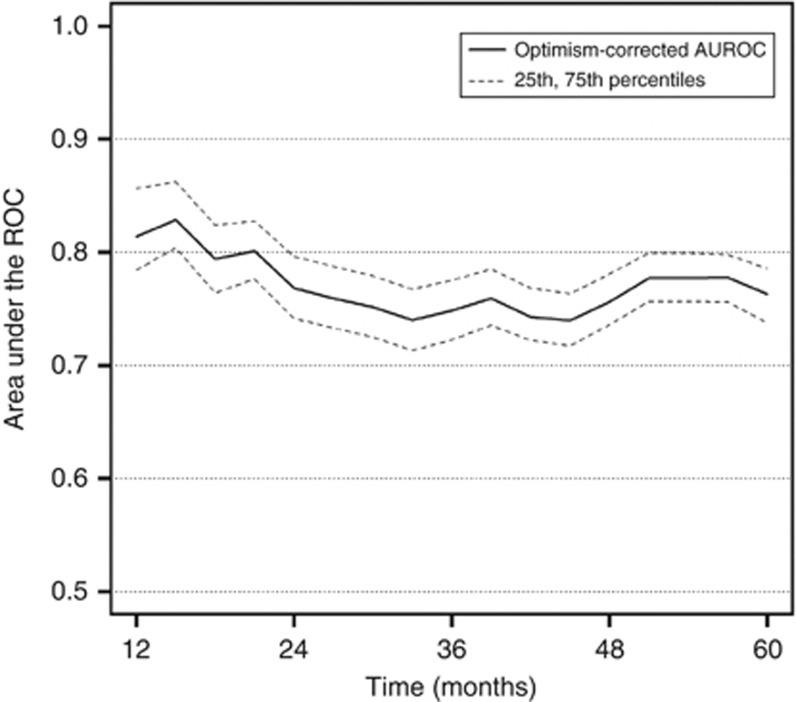
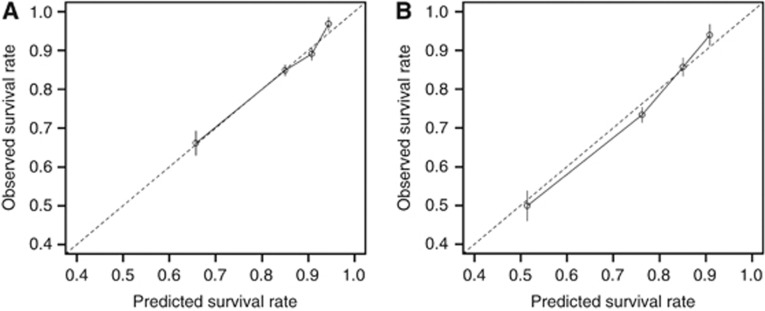
Methods: Cervical cancer databases of two large institutions were analysed. Overall survival was defined as the clinical endpoint and OS probabilities were estimated using the Kaplan-Meier method. Based on the results of survival analyses and previous studies, relevant covariates were identified, a nomogram was constructed and validated using bootstrap cross-validation. Discrimination of the nomogram was quantified with the concordance probability.
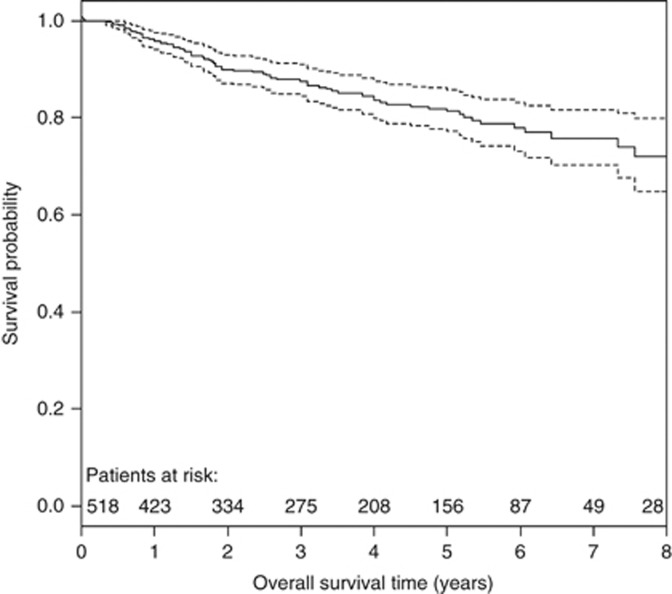
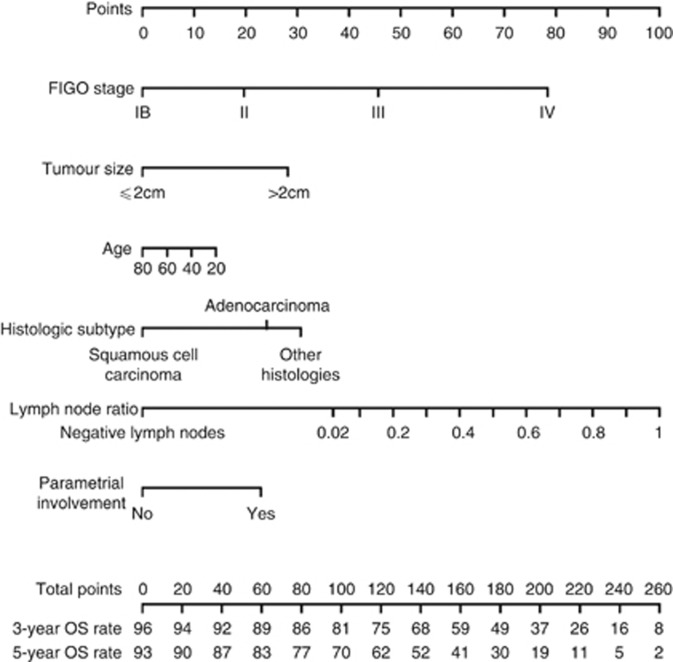
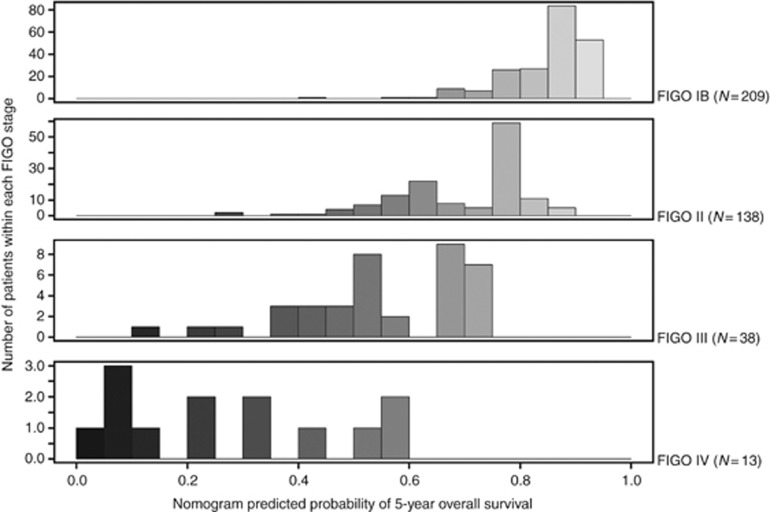
Results: In total, 528 consecutive patients with invasive cervical cancer, who had all nomogram variables available, were identified. Mean 5-year OS rates for patients with International Federation of Gynecologists and Obstetricians (FIGO) stage IA, IB, II, III, and IV were 99.0%, 88.6%, 65.8%, 58.7%, and 41.5%, respectively. Seventy-six cancer-related deaths were observed during the follow-up period. FIGO stage, tumour size, age, histologic subtype, lymph node ratio, and parametrial involvement were selected as nomogram covariates. The prognostic performance of the model exceeded that of FIGO stage alone and the model's estimated optimism-corrected concordance probability was 0.723, indicating accurate prediction of OS. We present the prediction model as nomogram and provide a web-based risk calculator (http://www.ccc.ac.at/gcu).
Conclusion: Based on six easily available parameters, a novel statistical model to predict OS of patients diagnosed with cervical cancer was constructed and validated. The model was implemented in a nomogram and provides accurate prediction of individual patients' prognosis useful for patient counselling and deciding on follow-up strategies.
© 2012 Cancer Research UK
Conflict of interest statement
The authors declare no conflict of interest.
Figures
References
-
- Abu-Rustum NR, Zhou Q, Gomez JD, Alektiar KM, Hensley ML, Soslow RA, Levine DA, Chi DS, Barakat RR, Iasonos A (2010) A nomogram for predicting overall survival of women with endometrial cancer following primary therapy: toward improving individualized cancer care. Gynecol Oncol 116: 399–403 - PMC - PubMed
-
- Ambler G, Seaman S, Omar R (2012) An evaluation of penalised survival methods for developing prognostic models with rare events. Stat Med 31: 1150–1161 - PubMed
-
- Benedet JL, Bender H, Jones H, Ngan HY, Pecorelli S (2000) FIGO staging classifications and clinical practice guidelines in the management of gynecologic cancers. FIGO Committee on Gynecologic Oncology. Int J Gynaecol Obstet 70: 209. - PubMed
-
- Chen RJ, Lin YH, Chen CA, Huang SC, Chow SN, Hsieh CY (1999) Influence of histologic type and age on survival rates for invasive cervical carcinoma in Taiwan. Gynecol Oncol 73: 184–190 - PubMed
