


Severity of aortic calcification is positively associated with vertebral fracture in older men--a densitometry study in the STRAMBO cohort
- PMID: 22872071
- PMCID: PMC3656471
- DOI: 10.1007/s00198-012-2101-z
Severity of aortic calcification is positively associated with vertebral fracture in older men--a densitometry study in the STRAMBO cohort
Abstract
In older men, severe abdominal aortic calcification and vertebral fracture (both assessed using dual-energy X-ray absorptiometry) were positively associated after adjustment for confounders including bone mineral density.
Introduction: Abdominal aortic calcification (AAC) is associated with higher fracture risk, independently of low bone mineral density (BMD). Dual-energy X-ray absorptiometry (DXA) can be used to assess both vertebral fracture and AAC and requires less time, cost, and radiation exposure.
Methods: We conducted a cross-sectional study of the association between AAC and prevalent vertebral fractures in 901 men≥50 years old. We used DXA (vertebral fracture assessment) to evaluate BMD, vertebral fracture, and AAC.
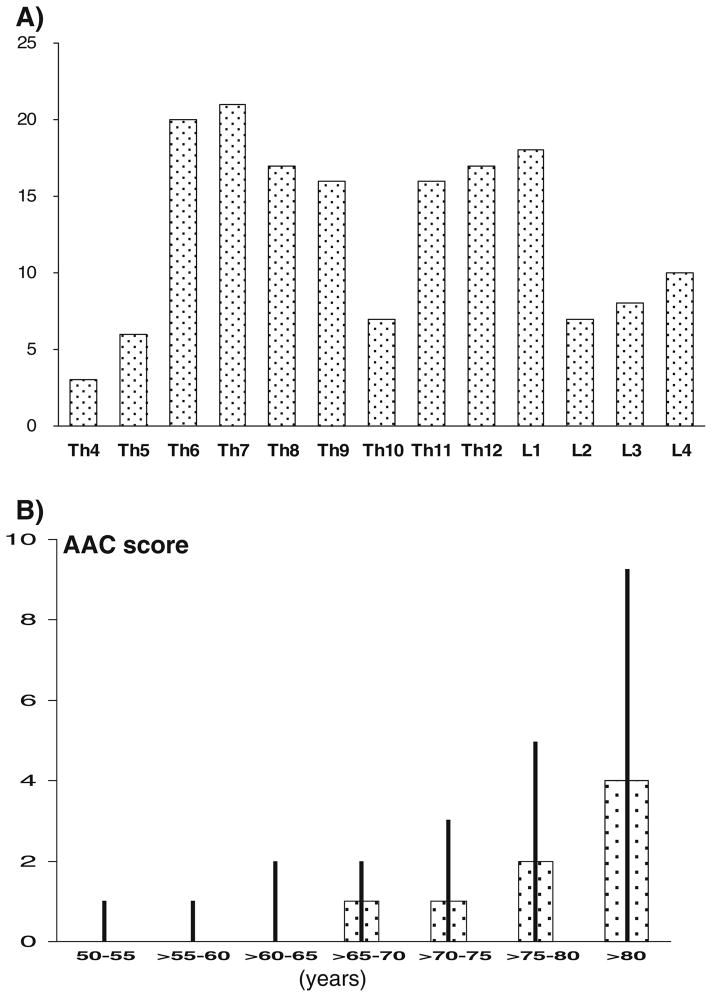
Results: Prevalence of vertebral fracture was 11%. Median AAC score was 1 and 12% of men had AAC score>6. After adjustment for age, weight, femoral neck BMD, smoking, ischemic heart disease, diabetes, and hypertension, AAC score>6 (vs ≤6) was associated with 2.5 (95% CI, 1.4-4.5) higher odds of vertebral fracture. Odds of vertebral fracture for AAC score>6 increased with vertebral fracture severity (grade 1, OR=1.8; grade 2, OR=2.4; grade 3, OR=4.4; trend p<0.01) and with the number of vertebral fractures (1 fracture, OR=2.0, >1 fracture, OR=3.5). Prevalence of vertebral fracture was twice as high in men having both a T-score<-2.0 and an AAC score>6 compared with men having only one of these characteristics.
Conclusions: Men with greater severity AAC had greater severity and greater number of vertebral fractures, independently of BMD and co-morbidities. DXA can be used to assess vertebral fracture and AAC. It can provide a rapid, safe, and less expensive alternative to radiography. DXA may be an important clinical tool to identify men at high risk of adverse outcomes from osteoporosis and cardiovascular disease.
Conflict of interest statement
Figures
References
-
- Bagger YZ, Tankó LB, Alexandersen P, Qin G, Christiansen C. Radiographic measure of aorta calcification is a site-specific predictor of bone loss and fracture risk at the hip. J Intern Med. 2006;259:598–605. - PubMed
-
- Wang TK, Bolland MJ, Pelt NC, Horne AM, Mason BH, Ames RW, Grey AB, Ruygrok PN, Gamble GD, Reid IR. Relationships between vascular calcification, calcium metabolism, bone density, and fractures. J Bone Miner Res. 2010;25:2501–2509. - PubMed
-
- Naves M, Rodríguez-García M, Díaz-López JB, Gómez-Alonso C, Cannata-Andía JB. Progression of vascular calcifications is associated with greater bone loss and increased bone fractures. Osteoporos Int. 2008;19:1161–1166. - PubMed
-
- Rajzbaum G, Roger VL, Bézie Y, Chauffert M, Bréville P, Roux F, Safar ME, Blacher J. French women, fractures and aortic calcifications. J Intern Med. 2005;257:117–119. - PubMed
-
- Szulc P, Kiel DP, Delmas PD. Calcifications in the abdominal aorta predict fractures in men: MINOS study. J Bone Miner Res. 2008;23:95–102. - PubMed
Publication types
MeSH terms
Grants and funding
LinkOut - more resources
Full Text Sources
Medical
Research Materials
